
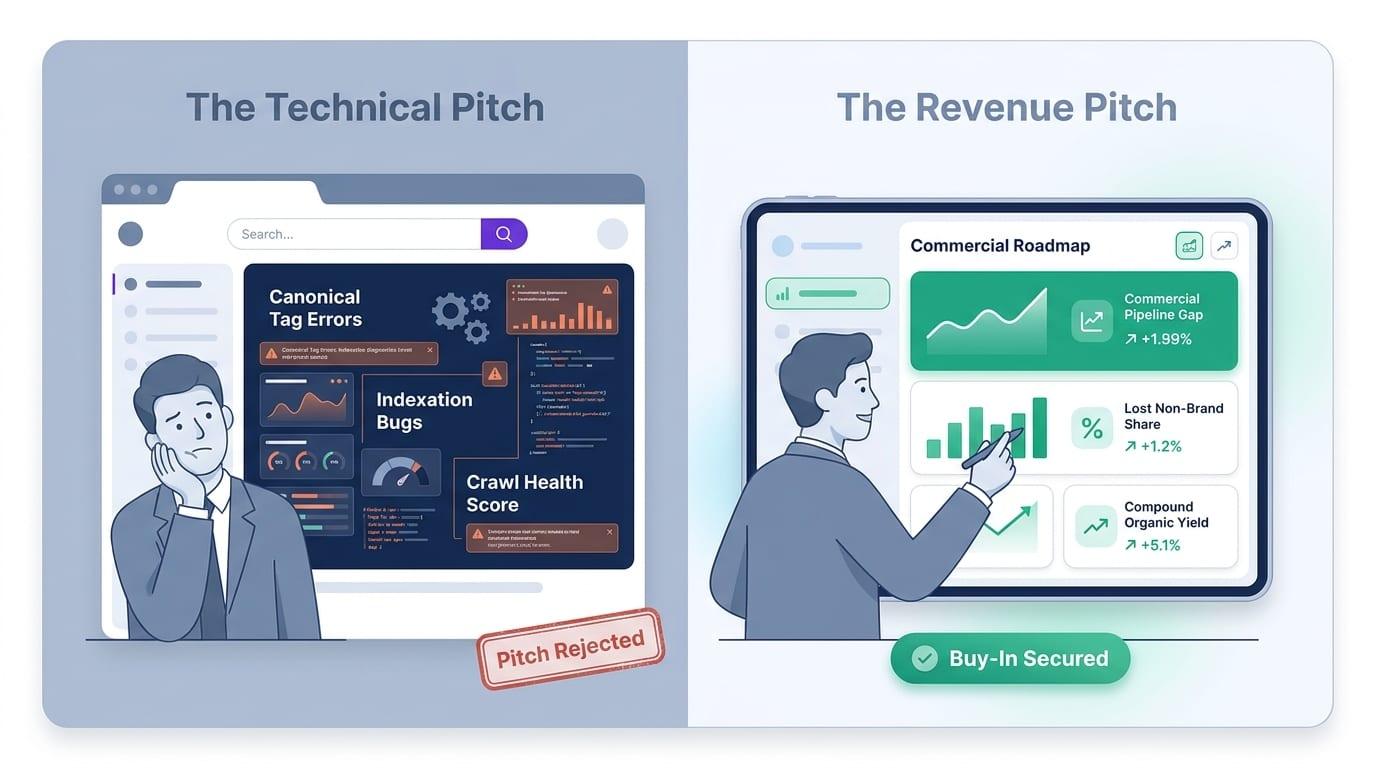
Building an effective seo strategy proposal requires connecting technical mechanics directly to commercial revenue. When pitching organic growth to enterprise leadership, I avoid technical audits in the opening pitch. Executives reject jargon dumps, preferring clear commercial roadmaps that solve pipeline deficits.
▶ Related Video
How to Write a Business Proposal Step-by-Step with FREE Template
This guide walks through the exact pitching framework I use to secure executive sign-off and multi-month retainers. You will learn how to audit competitive gaps, scope deliverables realistically, and present financial projections without making deceptive rank guarantees.
| Proposal Section | Core Objective | Primary Executive Question Answered |
|---|---|---|
| Executive Summary | Connect search visibility to commercial pipeline | Why should we allocate capital to organic search today? |
| Opportunity & Baseline | Quantify brand vs. non-brand search share against competitors | Where are our rivals out-positioning us in the funnel? |
| Strategic Pillars | Define tactical execution across code, content, and authority | What concrete work will your team actually perform? |
| Implementation Roadmap | Establish phased milestones and technical dependencies | When will we see operational deliverables completed? |
| Forecasting & KPIs | Model conversion value ranges using conversion baselines | What financial return can the business expect over 12 months? |
| Investment & Scope | Present tiered pricing, retainer models, and change orders | What internal and external resources are required? |
Key Takeaways
- Anchor on commercial impact. Leadership funds pipeline growth and customer acquisition rather than raw keyword rankings or arbitrary crawl health scores.
- Diagnose before prescribing. Highlighting the delta between branded and non-branded search reveals the immediate market share competitors currently capture.
- Separate work into clear pillars. Dividing execution across technical infrastructure, content velocity, on-page optimization, and authority clarifies operational dependencies.
- Forecast scenarios conservatively. Modeling conservative, moderate, and aggressive growth based on historical conversion rates protects your strategic credibility.
- Enforce strict scope governance. Clarifying developer resource requirements and revision boundaries upfront prevents the dreaded scope creep that kills agency margins.
Aligning the Executive Summary with Real Revenue Goals
Your executive summary must articulate the commercial cost of inaction before describing a single optimization tactic. When presenting to a chief financial officer or vice president, opening with indexation bugs instantly loses the room. Senior leaders allocate capital to address revenue vulnerabilities, not to fix canonical tags.
I structure this opening section by defining the client's current organic market capture alongside their core business goal alignment. If their quarterly mandate is pipeline acceleration, I frame organic search as an acquisition channel that reduces dependence on escalating paid media costs.
In my view, if a proposal's opening pages prioritize crawl errors over lost commercial pipeline, the pitch is dead on arrival. Executive sponsors want to see that you comprehend their operational model before you touch their website.
I frequently reference research on executive capital allocation from the Harvard Business Review to reinforce why organic discovery functions as long-term enterprise equity. Framing search as compound yield immediately changes how leadership evaluates the retainer. For a detailed breakdown of presentation decks, review our seo proposal plan.
- The Commercial Problem: Specify the current revenue ceiling caused by weak non-brand organic market visibility.
- The Market Window: Detail why competitor movements make immediate organic investment urgent over the next quarter.
- The Financial Upside: Project realistic pipeline expansion based on qualified organic intent capture.
- The Execution Path: Outline the operational commitments required from both consulting and internal engineering teams.
Diagnosing Organic Baselines and Sizing Competitor Gaps
Every winning proposal establishes credibility by splitting current organic visibility into brand vs. non-brand traffic. Most prospective clients believe their organic channel is healthy simply because branded navigation searches generate steady volume. Revealing that unbranded commercial search drives less than 15% of total sessions is a powerful wake-up call.
To diagnose performance accurately, pull raw query impressions from Google Search Console. Filter out brand variations and navigational intent to calculate true commercial baseline performance. This exposes whether their existing traffic reflects true market demand or simple brand recall.

My firm opinion is that blending branded navigation with non-brand demand in initial reporting borders on strategic dishonesty. It conceals structural weaknesses and sets unrealistic expectations for revenue attribution later in the engagement.
Next, run a rigorous competitor gap analysis against three direct rivals and two indirect category disruptors. Quantify the exact keyword themes where rivals capture bottom-of-the-funnel buyer interest. When executives see direct competitors owning terms with high commercial value, funding approval moves rapidly from theoretical debate to urgent priority.
- Isolate brand queries: Remove navigational keywords to calculate the real non-branded organic baseline.
- Benchmark market share: Map organic visibility against the top three market rivals across commercial search categories.
- Identify high-intent content deficits: Highlight missing comparison, alternative, and solution landing pages.
- Calculate lost acquisition value: Translate missing search traffic into equivalent paid search acquisition expense.
Structuring the Four Core Pillars of Tactical Scope
I organize client deliverables across four distinct operational pillars: technical architecture, content velocity, on-page relevance, and off-site authority. Grouping initiatives this way prevents clients from viewing SEO as an amorphous set of minor tweaks.
For technical infrastructure, I rely on detailed crawls to uncover indexing bottlenecks and routing flaws. Reviewing crawl architecture through Screaming Frog reveals whether search bots waste budget on faceted navigation or duplicate URL parameters.
I believe isolating technical infrastructure repairs into an upfront sprint is essential to avoid endless bug-hunting retainers. If engineering barriers linger indefinitely, downstream content production and digital authority campaigns will fail to achieve maximum indexation velocity.
Ensure technical specifications comply with structured data guidelines from Schema.org and modern browser rendering standards governed by the World Wide Web Consortium. Connecting structural markup to rich snippets boosts click-through performance across transactional search listings.
For authority generation, integrate editorial media outreach with your organic strategy. If you manage localized campaigns, apply the tactical principles in our local search marketing strategy. For broader earned media development, align editorial campaigns with our seo pr strategy.
- Technical Infrastructure: Crawl budget optimization, Core Web Vitals remediation, structured data deployment, and indexation hygiene.
- Content Velocity: Scaled landing page production, buyer-intent articles, programmatic catalog expansion, and keyword cannibalization cleanup.
- On-Page Relevance: Metadata rewriting, internal link topology restructuring, heading hierarchy alignment, and conversion rate alignment.
- Authority Development: High-tier digital PR placements, unlinked brand mention reclamation, and strategic partner ecosystem links.
Mapping Deliverables and Milestones Across 12 Months
A sequential deliverables roadmap establishes accountability by tying operational sprints to realistic ranking incubation periods. Search engines require time to discover, evaluate, and re-index updated page architectures. A twelve-month schedule keeps client stakeholders focused on long-term compound growth instead of weekly rank fluctuations.
My view is that promising top-tier ranking improvements within sixty days destroys consultant credibility when algorithmic realities take hold. Google's crawling cycles and index processing require structured phases to show compound momentum.
I structure the rollout into three distinct execution phases. The first quarter focuses on remediating severe technical debt and establishing foundational tracking. You cannot scale content effectively on a fundamentally broken website that violates guidelines outlined in Google Search Central documentation.
During the second half of the year, pivot attention toward conversion funnel velocity and user experience. Traffic without conversion creates zero balance sheet value. I consistently align late-stage roadmap initiatives with the methodologies outlined in our conversion optimisation strategy.
- Months 1 to 3 (Foundation): Resolve critical technical blockers, configure analytics governance, and deploy core transactional metadata updates.
- Months 4 to 6 (Expansion): Launch targeted commercial content clusters, expand internal link authority pathways, and resolve faceted index bloat.
- Months 7 to 9 (Acceleration): Execute digital PR link-earning campaigns, deploy structured schema templates, and scale long-tail programmatic coverage.
- Months 10 to 12 (Optimization): Refine user experience signals, execute page-level conversion testing, and recalibrate competitive keyword targets.
Forecasting Traffic and Revenue Without False Rank Guarantees
To forecast organic returns ethically, model traffic scenarios using conservative click-through rate distributions against qualified search volumes. Never promise a specific position on an organic results page. Algorithmic volatility, competitor investments, and shifting search page layouts make absolute ranking promises impossible.
Offering contractual guarantees for organic search positions is an amateur gimmick that compromises professional integrity. Legitimate organic forecasting uses statistical ranges, probability distributions, and verified conversion metrics.
I use CTR benchmark data from Advanced Web Ranking to model realistic traffic acquisition models. By evaluating organic position curves across desktop and mobile devices, you can demonstrate the mathematical probability of incremental visits.
Combine projected traffic with the client's verified e-commerce conversion rate or qualified lead capture rate. Multiply those acquisitions by their average order value or customer lifetime value. This grounds your strategy proposal in verifiable enterprise mathematics that finance leaders appreciate.
- Conservative Scenario: Assumes 10% category visibility growth, accounting for aggressive competitor resistance and indexing delays.
- Moderate Scenario: Models 25% non-brand traffic expansion based on timely content publication and technical issue resolution.
- Aggressive Scenario: Anticipates 45% traffic expansion driven by breakthrough digital PR pickups and rapid market share capture.
- Revenue Formula: Project Non-Brand Visits multiplied by Baseline Conversion Rate multiplied by Average Customer Value.
Structuring Pricing Tiers and Contractual Scope Boundaries
The most effective pricing presentation provides three structured investment tiers anchored to business velocity rather than arbitrary task counts. When buyers receive a single take-it-or-leave-it price, their decision becomes binary. Providing three options shifts their internal conversation from whether to work with you to how fast they wish to scale.
In my experience, quoting open-ended hourly rates rather than milestone deliverables invites endless micromanagement. Retainer tiers aligned with concrete deliverables give your team the operational autonomy needed to drive results. To review formal contract language, read our guide on the seo marketing proposal.
Two major mistakes routinely sink proposals during final legal reviews. The first is drowning executives in technical crawler logs rather than business outcomes during early presentations. The second mistake is omitting developer dependencies and scope boundaries in the final agreement.
If a client's internal engineering team takes eight weeks to approve a simple URL redirect, your roadmap stalls through no fault of your own. Your proposal's Scope of Work (SOW) must formally document internal turnaround service-level agreements (SLAs), client sign-off deadlines, and specific developer resource allocations.
- Tier 1 (Foundation): Focuses on technical stabilization, critical on-page fixes, and core quarterly content updates.
- Tier 2 (Growth Engine): Adds rapid programmatic page deployment, bi-weekly editorial publishing, and authority outreach sprints.
- Tier 3 (Market Dominance): Encompasses dedicated digital PR campaigns, advanced landing page testing, and continuous competitive response.
- Scope Boundaries: Clearly define revision maximums, engineering hand-off rules, and change-order trigger conditions.
When scaling programmatic landing pages and data-backed search architectures, ProgSEO automates high-volume page generation from structured business data. This platform simplifies technical catalog expansion so growth teams can execute broad organic strategies without overburdening internal engineering.
An effective proposal must contain an executive summary tied to revenue, baseline diagnostics separating brand from non-brand traffic, a four-pillar tactical scope, a phased implementation roadmap, conservative ROI projections, and transparent investment tiers.
Aim for a concise 12 to 18 slide presentation deck or an 8 to 12 page strategic document. Avoid bloated 60-page audit dumps; executives need actionable business clarity, not hundreds of pages of raw crawler output.
Forecast organic growth using scenario ranges (conservative, moderate, aggressive) based on realistic click-through rate distributions, category search volumes, and historical site conversion data rather than promising exact keyword positions.
Proposals fail primarily because they focus on technical vanity metrics rather than revenue outcomes, hide pricing structures, fail to establish clear scope boundaries, or require engineering resources the client cannot provide.
Sources & References
- Harvard Business Review — Authoritative corporate management research analyzing executive decision-making, strategic prioritization, and enterprise budget allocation.
- Google Search Console — Official Google webmaster portal used to analyze organic search impression queries, crawl health, and keyword click distribution.
- Ahrefs — Search engine intelligence platform utilized for competitive content gap evaluation, backlink profiling, and keyword volume benchmarking.
- Screaming Frog — Industry standard desktop website crawler for evaluating technical site architectures, URL routing, and indexation hygiene.
- Schema.org — Official collaborative community maintaining semantic structured data vocabularies for search engine rich snippets and entity comprehension.
- World Wide Web Consortium — International web standards organization developing protocols and architectural standards for modern digital accessibility and code quality.
- Google Search Central — Google's official developer documentation covering search guidelines, crawling mechanics, and ranking system documentation.
- Advanced Web Ranking — Ongoing search engine research analyzing organic click-through rate distribution across positions, device types, and search features.