
I have spent years refining my pitch workflow, and writing a winning seo marketing proposal takes about four hours of preparation once you master a structured framework. You need domain access, thirty minutes of direct discovery, and clear financial targets from your prospective buyer.
▶ Related Video
Exact Proposal I Use To Close 2K+ SEO Clients
Before drafting slides or contract terms, I map the prospective engagement across four standardized stages. This quick overview clarifies how the proposal process moves from initial technical auditing to commercial agreement.
| Proposal Stage | Core Objective | Primary Deliverables | Typical Turnaround |
|---|---|---|---|
| Pre-Proposal Discovery | Identify commercial pipeline bottlenecks | Traffic baseline, competitor gap notes, intake brief | 2–3 business days |
| Strategic Architecture | Map growth opportunities to business revenue | Executive summary, technical gap analysis, roadmap | 1–2 business days |
| Commercial Structuring | Frame investment packages and project scope | Three-tiered retainers, governance rules, SOW | 1 business day |
| Pitch Presentation | Align stakeholders and secure verbal commitment | Live deck walkthrough, objection resolution, contract | Same-day pitch call |
Key Takeaways
- Pre-pitch discovery is non-negotiable. Without knowing your prospect's pipeline conversion rates, organic projections fail to justify retainer investment.
- Executive summaries decide the sale. Decision-makers review the commercial summary first and often skip raw technical crawl logs entirely.
- Milestone phases prevent scope creep. Grouping deliverables into quarterly operational sprints establishes clear boundaries and mutual accountability.
- Value pricing outperforms hourly rates. Structuring tiered service packages around commercial growth outcomes closes larger retainers at higher profit margins.
- Never send cold proposal files. Presenting the strategic deck during a scheduled video conference doubles close rates compared to emailing standalone PDFs.
Discovery and Pre-Pitch Auditing: Finding Commercial Pain Points
I never write a single proposal slide until I understand the exact commercial arithmetic driving the client's business. In my opinion, dumping generic automated audit exports into an early pitch is an insult to the prospect's intelligence.
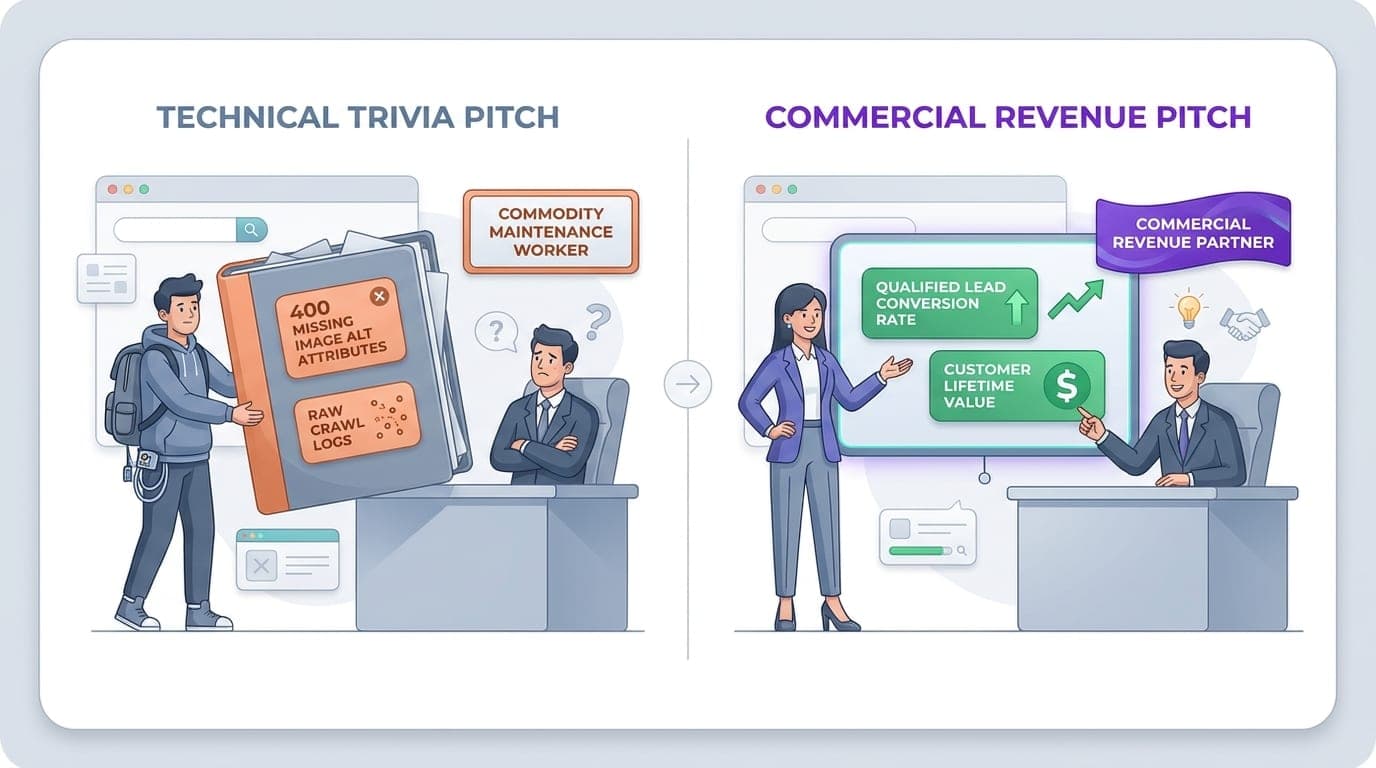
Most prospects do not care about four hundred missing image alt attributes. They care about customer acquisition costs, average contract value, and stagnant pipeline velocity. If you build your pitch around technical trivia, you position yourself as a commodity maintenance worker instead of a commercial revenue partner.
To build an accurate assessment, I request view-only access to their verified data inside Google Search Console. I combine that internal data with competitive gap intelligence from platforms evaluated in our guide on Moz vs Semrush vs Ahrefs.
- Qualified lead conversion rate: What percentage of organic landing page visitors actually convert into paying customers?
- Average customer lifetime value: How much revenue does a single closed account or retail buyer generate across twelve months?
- Current organic baseline: What is the actual monthly non-brand search traffic, excluding direct navigational searches?
- Internal technical bottlenecks: Does the engineering team ship codebase updates weekly, or do tickets sit in backlogs for quarters?
- Commercial priority lines: Which high-margin products or service categories have immediate excess capacity to sell?
If a stakeholder refuses to share baseline conversion figures, I use reasonable industry benchmarks to estimate pipeline yield. Grounding your pitch in revenue math guarantees your proposal reads like an investment memorandum rather than an operational expense.
The Core Proposal Architecture: What Every Pitch Document Requires
The structure of a winning proposal must follow a persuasive narrative arc rather than an encyclopedic index of technical checks. Slide decks and interactive web documents decisively beat static forty-page PDFs because busy executives scan for business clarity, not page weight.
When structuring a comprehensive SEO marketing strategy, I restrict my slide deck to eight core sections. This pacing guides the reader naturally from their current operational frustration to your planned commercial resolution.

- Executive Summary: A single slide stating the current challenge, the quantified growth opportunity, and the proposed investment range.
- Current Baseline Audit: A concise diagnosis of organic visibility bottlenecks based on Google Search Central documentation.
- Competitor Market Gap: An analysis showing exactly where industry rivals capture commercial search volume that your prospect misses.
- Strategic Pillars: A high-level overview detailing technical infrastructure, programmatic or editorial content, and external authority acquisition.
- Scope of Work (SOW): Specific deliverables, editorial quotas, technical tickets, and quarterly operational sprints.
- Timeline and Milestones: Clear 30-day, 60-day, 90-day, and 180-day progress markers.
- Investment Tiers: Three tiered pricing packages with clearly delineated deliverables and strategic advisory access.
- Governance and Terms: Approval turnaround expectations, payment schedules, and mutual cancellation parameters.
For presentation software, modern web platforms like PandaDoc allow you to track viewer engagement per slide and secure legally binding electronic signatures immediately after your pitch call.
“Executives skim proposals looking for risk and return. If your executive summary doesn't outline both in under sixty seconds, they will never read your crawl data.”
- Marcus Vance
Building the Scope of Work and a 6-Month Deliverables Roadmap
A sustainable scope of work (SOW) balances rapid technical remediation with consistent organic asset generation. In my experience, contracting arbitrary monthly link-building quotas is toxic to client relationships; real authority stems from publishing authoritative search assets and eliminating indexing barriers.
I organize every six-month retainer around three sequential two-month operational sprints. This keeps your delivery team focused on high-leverage bottlenecks and protects you against scope creep when spontaneous client requests arise.

- Phase 1 (Months 1–2): Infrastructure and Technical Stabilization: Deep crawl remediation, Core Web Vitals optimization adhering to W3C Web Standards, information architecture redesign, and initial keyword intent mapping.
- Phase 2 (Months 3–4): Content Velocity and On-Page Consolidation: Executing an authoritative content marketing strategy for SEO, deploying keyword clusters, pruning thin pages, and optimizing high-intent metadata.
- Phase 3 (Months 5–6): Authority Building and Conversion Rate Optimization: Targeted digital PR campaigns, internal link restructuring, and landing page UX tuning to maximize lead capture.
To prevent stalled campaigns, I always define client responsibilities inside the roadmap document. Your contract must stipulate that engineering approvals and content sign-offs must occur within five business days to maintain projected timeline milestones.
Framing Pricing Models and Business ROI Without Quoting Hourly Rates
I price SEO campaigns strictly against revenue upside rather than estimated billable hours. In my opinion, hourly billing penalizes operational efficiency, encourages administrative micromanagement, and traps you as a disposable vendor instead of an indispensable strategic advisor.
When presenting your commercial options, always present three tiered SEO digital marketing packages. This structure leverages the anchoring effect documented in pricing research from Harvard Business Review, leading prospects to choose the balanced middle option.
- Tier 1: Core Foundation: Technical governance, monthly health audits, and steady maintenance of existing organic rankings for low-growth organizations.
- Tier 2: Accelerated Market Capture: Comprehensive technical execution, continuous content asset generation, proactive link acquisition, and fortnightly consulting sprints.
- Tier 3: Aggressive Market Dominance: Complete organic ownership, multi-market expansion, dedicated technical implementation, and multi-channel synchronization matching our SEO and SEM marketing strategies.
To justify the monthly investment, demonstrate the financial return using conservative modeling. If an extra five thousand qualified monthly visitors convert at two percent into one hundred leads worth three hundred dollars each, a five-thousand-dollar monthly retainer delivers an immediate six-to-one gross revenue return.
Pitch Delivery, Closing Tactics, and Mistakes That Kill Deals
Deals are won or lost during the live presentation call, never inside an email inbox. Sending a finished proposal as a passive attachment without securing a walk-through appointment significantly reduces your closing rate.
I require all key stakeholders to attend a forty-five-minute video conference before I share the document. During the call, I allocate fifteen minutes to discovery recap, fifteen minutes to strategic execution, and fifteen minutes to pricing review and direct question handling.
- Review business objectives first: Open by reiterating their stated revenue goals to demonstrate thorough listening.
- Highlight high-impact opportunities: Show two or three critical keyword clusters currently dominated by weaker competitors.
- Present the milestone roadmap: Walk through quarterly operational deliverables so they visualize the implementation schedule.
- Unveil pricing packages: Explain the resource allocation behind each tier and pause immediately to let the prospect react first.
- Establish clear next steps: Confirm the formal contract decision date and schedule a short follow-up check-in before ending the call.
Over years of agency pitching, I have observed two recurring mistakes that reliably derail otherwise solid proposals. Avoiding these traps will safeguard your close rate when pitching demanding corporate executives.
- Blinding the buyer with algorithmic jargon: Reciting complex indexing trivia without connecting findings to customer pipeline metrics creates confusion, and confused buyers always decline to sign.
- Failing to define client approval dependencies: Omitting required stakeholder turnaround times invites scope creep and creates awkward disputes over billing when client delays stall campaign momentum.
Understanding complex buyer evaluation behavior outlined by Gartner research helps you recognize that multiple stakeholders need reassurance. Equipping your primary contact with a polished summary enables them to advocate internally on your behalf.
When your strategy calls for scaling large catalogs of programmatic content or continuous data-driven pages, deploying automated workflows through ProgSEO can help streamline operational delivery across complex customer websites.
A high-performing pitch deck should range between 10 and 15 focused slides. Long documents overwhelm executive decision-makers, while concise presentations that emphasize business ROI, milestones, and clear pricing tiers close contracts significantly faster.
Present conservative growth ranges based on historical market click-through data and existing conversion metrics. Frame projections as mathematical potential based on competitor share of voice rather than contractual guarantees.
A six-month initial commitment with thirty-day cancellation notices provides sufficient operational runway to show technical momentum and search traffic growth while keeping the barrier to entry comfortable for prospective buyers.
Never email the deck beforehand. When prospects read slides without strategic narration, they flip straight to the pricing page without appreciating the operational value or context, drastically reducing your closing leverage.
Sources & References
- Google Search Console — Official portal for monitoring site indexing status and verified organic search performance.
- Google Search Central Documentation — Authoritative technical guidelines on crawlability, indexing, and on-page search best practices.
- Ahrefs — Search intelligence platform providing backlink profiles, domain authority metrics, and organic keyword gap tracking.
- PandaDoc — Document automation and digital signing software designed for tracking proposal engagement metrics.
- W3C Web Standards — International web standards organization detailing modern accessibility and technical markup requirements.
- Harvard Business Review — Business management publication providing research-backed frameworks for pricing structures and commercial negotiations.
- Semrush — Comprehensive digital marketing tool suite used for search competitive intelligence and organic position monitoring.
- HubSpot — Inbound sales research and CRM benchmarks detailing proposal closing rates and pipeline follow-up strategies.
- Gartner — Global research and advisory company delivering insights into enterprise B2B buying behavior and consensus decision-making.