
When I pitch organic search campaigns to executives, I know technical jargon alone never closes a deal. Learning how to craft an authoritative seo proposal plan lets you translate crawling errors and architectural bottlenecks into commercial value that earns stakeholder buy-in within days. In this guide, I share the exact framework, milestones, and boundaries I rely on to turn initial discovery audits into signed agreements.
▶ Related Video
Build 6 Months of SEO Content in 60 Minutes (Complete Workflow)
| Project Phase | Primary Focus | Key Work Products | Expected Business Impact |
|---|---|---|---|
| Days 1–30 | Technical Foundation & Tracking | Indexation cleanup, canonical audits, conversion tracking validation | Stabilized crawl budget and accurate revenue attribution |
| Days 31–60 | On-Page Optimization & Architecture | Metadata overhaul, internal linking maps, URL structure realignment | Improved topical authority and higher secondary keyword rankings |
| Days 61–90+ | Content Velocity & External Authority | Net-new cluster publishing, digital PR, resource asset outreach | Primary keyword visibility expansion and qualified organic pipeline |
Key Takeaways
- Align metrics to commercial revenue. Executive sign-off hinges on pipeline value rather than raw crawl error counts.
- Phase your roadmap chronologically. Structure execution across clear 30-day technical, on-page, and authority development milestones.
- Demarcate out-of-scope tasks. Explicit boundaries prevent developer friction and protect agency margins from project creep.
- Offer three strategic investment tiers. Providing anchored pricing options shifts prospect evaluation from cost to scope alignment.
- Secure execution commitments upfront. Detailed turnaround windows for client technical approvals protect the project timeline from stagnation.
Translating Preliminary Audit Findings into Executive Business KPIs
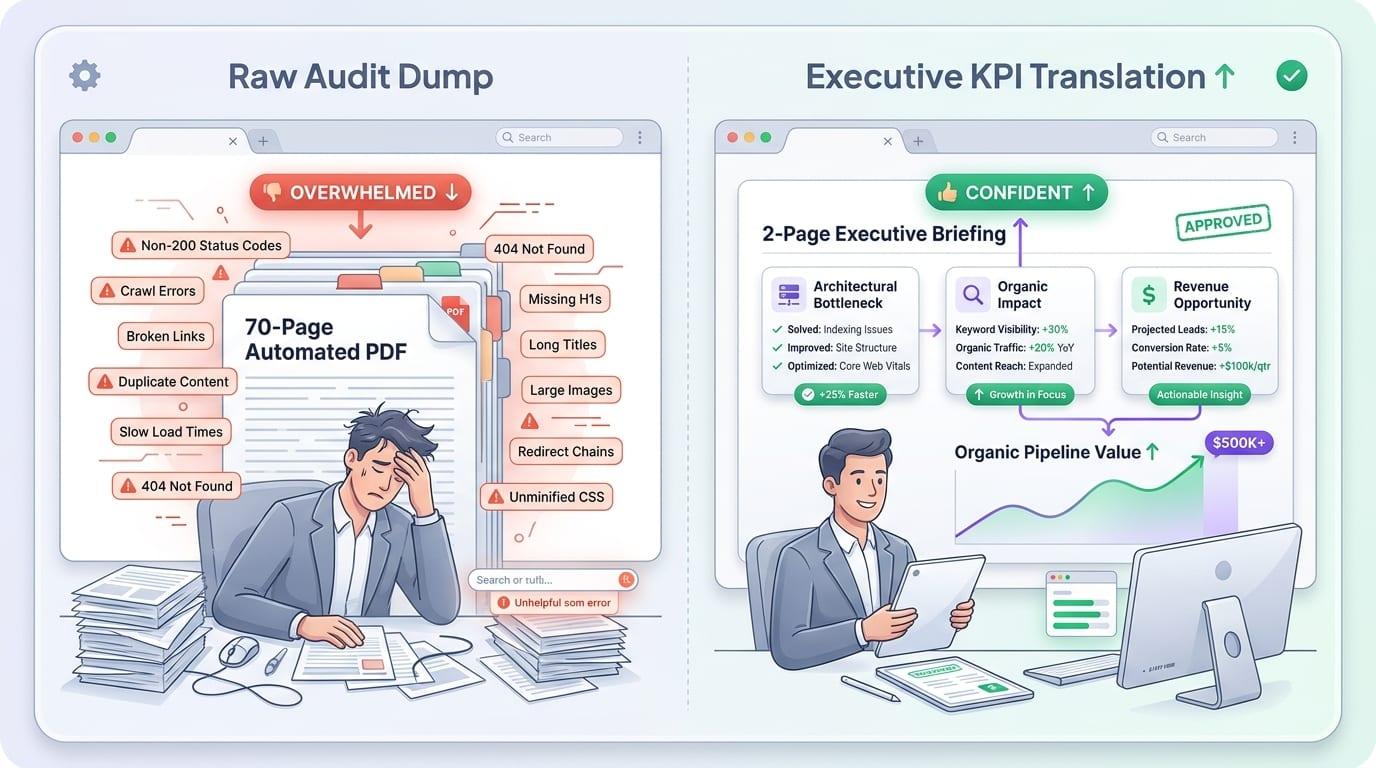
A technical audit without commercial context is simply noise. The first catastrophic mistake I often see consultants make is dumping a 70-page automated PDF filled with server codes directly into an executive's inbox. Decision-makers rarely care about non-200 status codes; they care about missed pipeline, customer acquisition costs, and competitive market share.
When I review initial technical discoveries, I filter observations through Google's Search Essentials documentation to isolate issues directly impeding indexation. From there, I convert raw technical problems into measurable commercial consequences that justify an engagement. You can explore our foundational framework in our seo plan for clients guide.
“Audits in proposals should never exceed two pages. Executives do not buy site crawlers; they invest in strategic roadmaps that unlock organic revenue bottlenecks.”
- Practitioner Rule
To bridge this technical-to-executive communication gap, I frame every diagnostic finding in the pitch document using three sequential metrics:
- The Architectural Bottleneck: The exact rendering, indexing, or structural flaw detected by your crawler.
- The Organic Impact: How that issue depresses organic impressions and topical authority across key product categories.
- The Revenue Opportunity: The projected traffic value and lead volume recovered once engineering resolves the blocker.
- The Primary KPI: A specific trailing metric, such as organic pipeline value or qualified demo bookings.
The Core Anatomy of a High-Converting SEO Proposal Plan
A winning proposal must balance concise strategic diagnosis with tactical execution clarity. If your document requires more than twenty minutes for a busy prospect to digest, you have compiled a bloated training manual rather than an actionable commercial proposal. I insist on keeping the core narrative structured across six distinct, high-impact sections.
When compiling your final pitch, you can use digital contracting tools like PandaDoc to monitor document interactions and capture digital signatures seamlessly. For solo operators looking to formalize their pitch collateral, our guide on writing an seo consultant business plan provides valuable operational structure.
- Executive Summary: A one-page synthesis highlighting current organic market share, core bottlenecks, and the financial opportunity of remediation.
- Strategic Diagnostics: A curated snapshot of architectural, on-page, and backlink barriers holding the domain back from target rankings.
- 30-60-90 Day Roadmap: A phased timeline detailing exact technical fixes, editorial additions, and optimization milestones.
- Scope of Work & Deliverables: An itemized breakdown separating committed monthly deliverables from out-of-scope requests.
- Investment & Engagement Terms: Three distinct engagement tiers alongside formal payment schedules and contract duration requirements.
Structuring a 30-60-90 Day Phased Execution Roadmap
Front-loading aggressive content production in month one is an amateur mistake that routinely burns client budgets. If a domain suffers from crawl loops, duplicate canonicals, or broken rendering pipelines, publishing net-new articles yields negligible ranking momentum. I establish realistic expectations by arranging work into three distinct operational cycles.
During the initial phase, I address core technical hygiene and measurement infrastructure verified through Ahrefs and search engine diagnostics. Once technical baselines are resolved, our team initiates architectural enhancements detailed in our on-page seo plan framework. Here is how I structure the sequential 90-day rollout:
- Month 1 (Days 1–30): Foundation & Diagnostics. Perform comprehensive log-file analysis, correct indexation anomalies, audit canonical hierarchy, and configure verified goal tracking in analytics.
- Month 2 (Days 31–60): Architectural & On-Page Alignment. Re-engineer internal linking pathways, optimize high-intent product metadata, and restructure content silos around primary commercial entities.
- Month 3 (Days 61–90): Scaled Publishing & Digital PR. Launch keyword cluster expansion, produce linkable assets, and initiate authoritative brand mention campaigns.
Defining Hard Deliverables and Enforcing Scope Boundaries
Ambiguous language in a proposal guarantees margin erosion. The second frequent mistake agencies make is promising vague 'ongoing search optimization' without specifying deliverable quantities, format constraints, or engineering boundaries. This lack of definition inevitably causes fatal scope creep within ninety days.
I manage client expectations by documenting deliverables as discrete artifacts tracked inside project software such as Asana. For off-site initiatives, we outline link acquisition rules detailed in our off-page seo plan documentation. Unlimited revision cycles destroy agency profitability; I cap content and strategic revisions strictly at two feedback rounds per deliverable.
- In-Scope Technical Artifacts: Comprehensive engineering tickets with code snippets, quarterly schema deployment sheets, and monthly core web vitals audits.
- In-Scope Editorial Deliverables: Four fully formatted, cluster-aligned editorial assets per month including custom metadata and visual briefs.
- Explicitly Out-of-Scope Items: Custom CMS backend development, manual web accessibility refactoring compliant with W3C accessibility standards, and paid advertising management.
- Change Order Protocols: Any technical implementation assistance exceeding five consulting hours per month requires a separate, billable scope of work (SOW).
Selecting Pricing Structures and Packaging Retainer Tiers
I avoid presenting prospects with a single take-it-or-leave-it figure. When you provide only one quote, the executive's mental calculation remains binary: 'Do we hire this team, or do we walk away?' Providing three structured tiers shifts their internal deliberation to: 'Which of these three strategic tiers best matches our growth goals?'
Whether you are pitching multi-location clients via our local seo business plan or enterprise brands, tiered packaging establishes clear governance. According to established industry frameworks from Moz's SEO resources, structuring scopes around velocity gives clients financial predictability. I anchor packages into three deliberate service levels:
- Tier 1: Foundational Maintenance. Focuses strictly on technical monitoring, bi-weekly health crawls, and core page optimization for low-volatility niches.
- Tier 2: Growth Accelerator (Recommended Anchor). Combines comprehensive technical remediation, monthly content cluster production, and internal link restructuring.
- Tier 3: Aggressive Market Capture. Includes multi-language expansion, weekly editorial assets, high-tier digital PR outreach, and dedicated developer implementation support.
Client Dependencies, Approval Protocols, and Live Presentation Strategy
An SEO campaign cannot succeed in isolation. If a client's engineering department delays staging deployments for six weeks, organic rankings will flatline regardless of how brilliant your technical recommendations are. I include mandatory client obligations directly within the proposal to preserve accountability on both sides.
As industry analyses on Search Engine Land frequently emphasize, operational velocity determines campaign success. I require clients to commit to concrete operational turnaround windows in writing:
- Technical Access: Unrestricted view access to search analytics, CMS administrative rights, and CDN headers granted within five business days of contract execution.
- Development Sprints: Staging deployment of approved engineering tickets within a rolling ten-day development cycle.
- Content Approvals: Written editorial sign-off or structural revisions returned within five business days of draft submission.
- Point of Contact: A designated in-house project manager empowered to greenlight architectural tickets without board review.
Never email an investment proposal as a detached PDF attachment. Sending a document blind invites prospects to flip directly to the pricing page without digesting the underlying value framework. I insist on walking stakeholders through the proposal during a 30-minute live video session, addressing objections in real time before formal delivery.
To streamline execution after winning client approval, ProgSEO provides programmatic infrastructure that transforms your approved topical clusters into high-performing organic landing pages. This automated approach allows agencies to accelerate technical deployments while maintaining strict content quality across extensive enterprise domains.
A high-converting proposal includes an executive summary tied to business KPIs, diagnostic audit findings, a 30-60-90 day execution roadmap, an itemized scope of work with strict out-of-scope boundaries, tiered investment pricing, and formal client dependency agreements.
Specify exact deliverables with quantitative limits, such as four 1,500-word articles per month, two rounds of editorial revisions, and monthly developer tickets capped at five consulting hours. Explicitly list out-of-scope items like custom CMS coding or accessibility redesigns.
Presenting three tiered retainer options (Foundational, Growth, and Aggressive Capture) is most effective. It anchors your value, accommodates budget variations, and transitions the client conversation from deciding whether to hire you to selecting which scope level fits best.
Always walk stakeholders through the proposal during a live presentation. Pitching live lets you guide them through the commercial logic of your audit, handle pricing hesitations immediately, and establish mutual accountability before sending the agreement for signature.
Sources & References
- Google Search Central — Official search essentials, indexing prerequisites, and technical crawling guidelines.
- Google Search Console — Webmaster tools documentation for tracking organic indexation, search performance, and technical errors.
- PandaDoc — Digital proposal creation, document analytics, and automated contract execution platform.
- Ahrefs — SEO industry data platform for competitor backlink research, keyword gap analysis, and rank tracking.
- Asana — Collaborative project management suite for organizing client deliverables and tracking sprint workflows.
- W3C Web Accessibility Initiative — International technical standards and guidelines for website accessibility compliance.
- Moz SEO Learning Center — Comprehensive educational resources covering foundational organic search optimization and agency retainers.
- Search Engine Land — Industry news publication covering organic algorithm updates, search marketing strategies, and client campaign management.