I execute an seo pr strategy whenever our organic search rankings stall and manual email outreach hits a ceiling. Building this PR infrastructure takes four to six weeks of pipeline development, access to proprietary data, and focused media research. In this guide, I share my framework for earning editorial backlinks that move competitive search positions.
▶ Related Video
How To Build High Authority PR Backlinks For FREE (Full Guide)
| Strategy Type | Primary Link Value | Target Publications | Average Turnaround |
|---|---|---|---|
| Digital SEO PR | Dofollow editorial backlinks | Tier-1 national & trade news | 3 to 6 weeks |
| Traditional PR | Brand visibility & awareness | Print, broadcast, & online media | Ongoing / quarterly |
| Wire Distribution | Nofollow syndicated links | Automated news aggregators | Immediate (<24 hours) |
| Manual Outreach | Mid-tier contextual links | Niche blogs & resource pages | 2 to 4 weeks |
Key Takeaways
- Editorial links drive real authority. Top-tier press placements provide genuine PageRank equity that syndication wires and guest posts cannot match.
- Original data wins coverage. Journalists prioritize proprietary surveys, market benchmarks, and data analyses over corporate product announcements.
- Pitch length dictates response rates. Keeping your initial media outreach pitch under 150 words dramatically increases journalist response and pickup rates.
- Reclamation captures missed equity. Recovering unlinked brand mentions turns passive digital PR coverage into active search ranking power.
Understanding Digital PR: How Editorial Coverage Drives Search Rankings
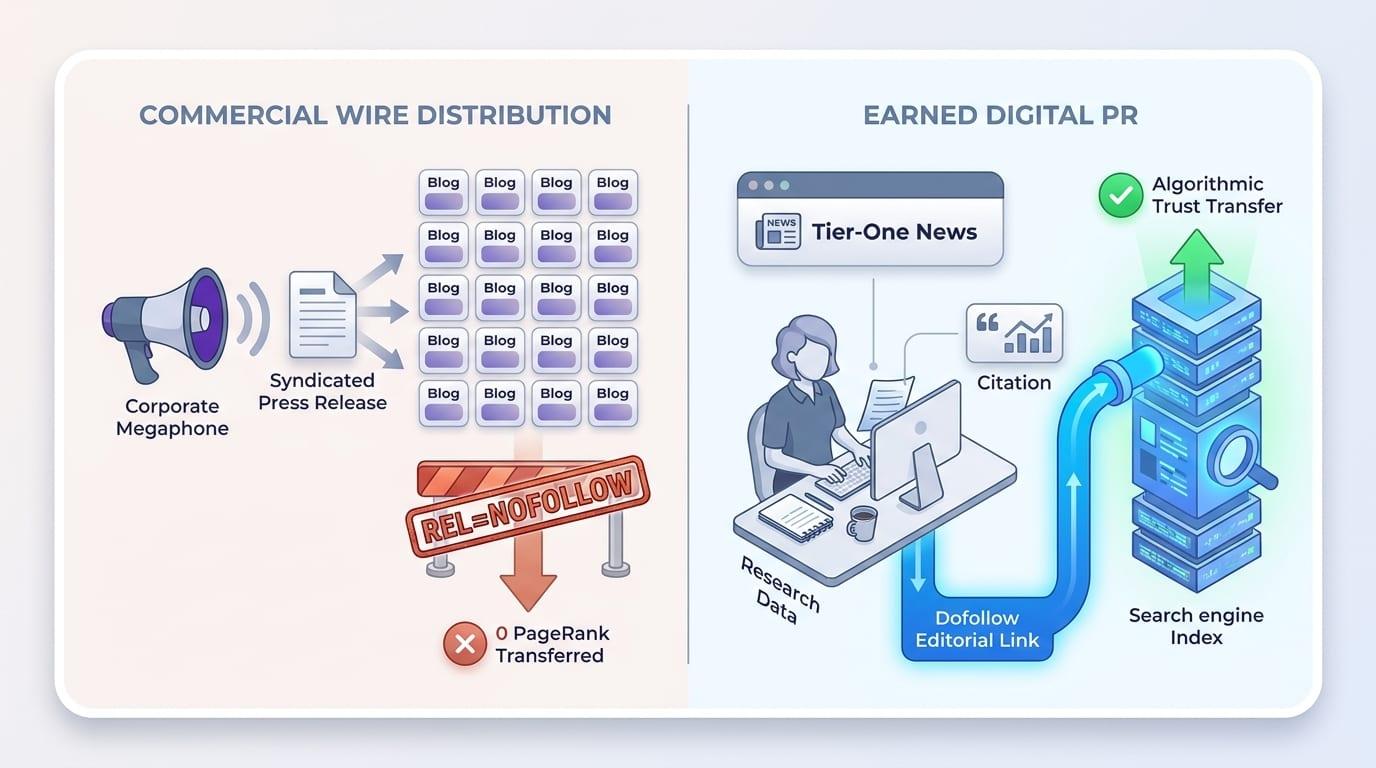
Digital PR exists to secure editorial backlinks from high-trust news publications rather than vanity placements. In my experience, a single followed link from a major newsroom outperforms fifty paid guest posts on secondary blogs. It signals direct algorithmic trust to search engines.
Traditional public relations measures column inches, television airtime, and estimated reader impressions. An SEO-driven approach focuses on referring domains, anchor placement context, and domain authority transfer. When an editor links to your research, search algorithms treat that citation as an authoritative endorsement.
Many teams make the mistake of relying on commercial press wire distribution for SEO. These wire services distribute syndicated releases that search engines discount. In fact, Google Search Central guidelines mandate rel='nofollow' or rel='sponsored' attributes on paid syndicated content, meaning zero PageRank flows to your domain.
To elevate your organic visibility, integrating PR into your broader seo strategy plan pdf creates durable competitive separation. Traditional manual link building tactics are facing diminishing returns. Earned editorial links from established news brands remain the strongest remaining trust signal in organic search.

Developing High-Yield Campaign Formats That Earn Editorial Links
Reporters do not link to homepages or product feature announcements; they link to proprietary data, authoritative benchmarks, and resources that validate their reporting. My rule is simple: if your asset does not answer a burning industry question, journalists will ignore it.
I find that teams waste months designing elaborate interactive graphics that reporters never embed. Simple data tables, concise statistical anomalies, and clean methodology notes win editorial citations far more reliably. Editors want verifiable figures they can quote on deadline.
- Proprietary Data Studies: Mine internal user telemetry or transactional databases to reveal macroeconomic trends and shifts.
- Public Index Rankings: Analyze public government records or census datasets to rank cities, states, or industry sectors.
- Original Consumer Surveys: Poll verified respondents using platforms like Pew Research Center benchmarks to reveal counter-intuitive consumer sentiment.
- Reactive Newsjacking: Provide expert commentary, technical explanations, or immediate data analysis within four hours of a major breaking news story.
When designing linkable assets, prioritize topics with persistent search interest. Creating evergreen research studies ensures your asset continues attracting passive editorial links years after the initial PR push. You can inspect your target link profile using our documentation on backlinks to calibrate your acquisition goals.
For enterprise brands, executing this research model powers an enterprise seo strategy by earning references across national business publications. The goal is positioning your domain as the primary source of truth for industry metrics.

Executing an End-to-End Campaign Workflow from Ideation to Pitch
A successful digital PR campaign succeeds during media list curation, not in the email drafting tool. If you blast hundreds of untargeted editors, your domain ends up on spam blacklists. I prefer building focused lists of thirty to fifty relevant journalists.
A critical mistake marketers make is pitching reporters who have not covered that specific beat in months. I spend hours reading recent articles to confirm each journalist actively covers the exact topic before drafting an outreach sequence.
- Identify the Hook: Match your dataset to an upcoming seasonal event, regulatory change, or viral media discussion.
- Build the Asset Page: Host the full study, methodology, and downloadable visual charts on a dedicated canonical URL.
- Curate the Media List: Identify specific beat journalists using discovery tools like BuzzSumo and Muck Rack.
- Draft the Short Pitch: Write a 100-to-150-word email summarizing the three most surprising data points.
- Send and Follow Up Once: Pitch individually Tuesday morning; send one courteous follow-up 72 hours later, then stop.

When planning localized campaigns, pairing digital PR with your local search marketing strategy yields rapid regional press pickups. Local news editors are notoriously hungry for regional data studies highlighting their specific municipal areas.
Here is the email pitch structure that consistently produces response rates above 15% across my client campaigns:
- Subject Line: [Data] 64% of engineers report AI tool fatigue in 2026
- Hook: Hi [Name], saw your recent piece on technical staffing shortages.
- Key Finding: Our latest study of 1,200 firms revealed developer churn jumped 28% this quarter.
- Data Highlights: Bulleted list of three concise, verified statistics.
- Call to Action: Let me know if you would like the full raw dataset and high-res charts.
“Journalists do not want marketing hype. Give them three verifiable statistics, a link to your methodology, and an offer to interview your technical lead. That is all it takes.”
- Digital PR Campaign Lead
Reclaiming Unlinked Brand Mentions and Turning Coverage into Links
Between 35% and 50% of earned media stories mention your brand or study findings without including a clickable hyperlink. Unlinked brand mention reclamation is the highest-ROI activity in digital PR because the reporter has already vetted your credibility.
In my opinion, demanding a backlink as if an editorial team owes you one is a surefire way to get ignored. Instead, frame your request around user experience and factual verification for their readers.
I monitor new press mentions daily using tools like Semrush and Google Alerts. When an article publishes without a link, I reach out within 24 hours while the piece is fresh in the journalist's mind.
- Step 1: Discover Mentions: Configure automated brand alerts for your company name, executive names, and proprietary study titles.
- Step 2: Check Link Presence: Inspect the article source code to confirm your brand is named without an active anchor tag.
- Step 3: Evaluate Editorial Policy: Check if the publication allows outbound links; some corporate parents enforce strict no-link rules.
- Step 4: Send Value-Added Outreach: Thank the journalist for the coverage, provide a direct URL to the primary source data, and politely suggest it as a reference for their readership.

Measuring Organic Impact, Authority Growth, and Campaign ROI
Measuring digital PR requires looking past surface-level vanity metrics like social shares or theoretical reach. I evaluate SEO PR campaigns by measuring referring domain velocity, non-branded keyword movement, and downstream search visibility.
According to industry benchmarks from Cision, corporate visibility initiatives often struggle when disconnected from search goals. Tracking your link portfolio in search consoles confirms whether incoming editorial links are indexing and transferring PageRank.
- Domain Rating Growth: Monitor cumulative increases in domain-level link equity across third-party tools.
- Target URL Ranking Shifts: Track whether topically related commercial landing pages experience upward position movement within 4 to 8 weeks.
- Branded Search Volume: Observe whether PR coverage generates measurable lift in direct search queries for your company name.
- Referral Traffic Conversion: Audit incoming traffic quality and assisted conversions by linking your PR assets to your conversion optimisation strategy.
Direct search attribution is inherently messy, but isolating ranking shifts across your core keyword clusters provides clear proof of value. When an authoritative news brand links to your research, target commercial pages typically see organic traffic acceleration within two algorithm refresh cycles.
To scale your organic footprint alongside editorial PR wins, ProgSEO turns your structured proprietary data into thousands of optimized, programmatic search pages automatically. This compound approach bridges top-of-funnel brand equity with broad non-branded organic capture.
Traditional PR focuses on brand awareness, press coverage impressions, and message control. Digital PR for SEO focuses on earning authoritative, dofollow editorial backlinks that improve search rankings and organic visibility.
Proprietary research, original survey benchmarks, and data-driven index rankings earn the highest volume of editorial links because journalists need primary source statistics to support their stories.
Keep your pitch under 150 words, personalize it to the reporter's recent beat coverage, highlight two or three surprising statistics, and link directly to your source methodology.
Send a polite email within 24 to 48 hours thanking the journalist for the coverage, and suggest adding a link to the primary data study so their readers can review the full methodology.
Sources & References
- Google Search Central — Official documentation on outbound link attributes and qualification standards.
- Ahrefs — Search engine optimization software and backlink profile intelligence.
- Pew Research Center — Benchmark methodologies for public polling and statistical demographic research.
- BuzzSumo — Content discovery, journalist database, and social amplification platform.
- Muck Rack — Public relations software and media contact database.
- Semrush — Digital marketing toolset for organic search tracking and brand monitoring.
- Cision — Media communication technology and annual State of the Media industry research.