Writing a winning search engine marketing proposal requires treating the pitch as an operational blueprint rather than a generic sales deck. In my agency pitches, closing high-value accounts takes roughly four days of diagnostic research, access to benchmark data, and strict alignment on business revenue goals.
▶ Related Video
The Only Marketing Strategy That Is Working In 2026
Most agencies lose pitches because they pitch generic deliverables before auditing real account performance. Prospective clients want predictable customer acquisition channels, not vanity impressions. According to Statcounter's search engine market share data, search platforms remain the dominant driver of intent-driven consumer traffic.
| Proposal Section | Primary Objective | Core Deliverable | Common Failure Point |
|---|---|---|---|
| Executive Summary | Align with client commercial targets | Defined revenue and CAC benchmarks | Highlighting agency awards instead of client business outcomes |
| Search Diagnostic Audit | Identify performance baselines | Wasted ad spend and indexing barriers | Overwhelming prospects with raw 80-page automated tool exports |
| Integrated SEM Strategy | Unify paid and organic initiatives | Keyword intent mapping across SERP channels | Treating paid ads and organic rankings as opposing tactics |
| Scope of Work (SOW) | Establish operational boundaries | Itemized monthly sprints and technical fixes | Vague promises of 'routine account maintenance' |
| Commercial Model | Clarify financial commitments | Separated direct ad spend and agency retainer | Hiding agency markups within blended ad spend packages |
Key Takeaways
- Diagnose before prescribing. A pre-proposal audit reveals whether a prospect needs immediate PPC lead velocity, foundational SEO architecture, or an integrated model.
- Isolate ad spend from retainer fees. Mixing media budgets with agency management fees creates billing confusion and misaligns campaign optimization incentives.
- Scope deliverables over arbitrary tasks. Replace vague promises of ongoing management with defined monthly cadence items for ad copy, landing pages, and technical fixes.
- Forecast pipeline without guaranteeing rankings. Model conservative revenue scenarios based on conversion rates and historical cost-per-click averages instead of rank positions.
- Walk through the pitch interactively. Presenting the strategic proposal live closes significantly more retainers than emailing a silent static document.
Conduct Pre-Proposal Discovery to Pinpoint Commercial Search Goals
Before I write a single word of a pitch, I conduct a structured discovery session to diagnose where the prospective client loses revenue. A proposal drafted in a vacuum produces generic scopes that fail to solve the prospect's real conversion bottlenecks.
Request read-only access to their existing ad accounts, analytics properties, and search tools. Reviewing historical data in Google Analytics 4 documentation shows conversion paths, while examining query baselines in our Moz, Semrush, and Ahrefs comparison reveals organic authority gaps.

In my experience, pitching an SEM engagement without read-only access to their existing ad accounts is pure gambling. When a client refuses analytics access, I rely on historical industry CPCs from the Google Ads Keyword Planner to build conservative diagnostic projections.
- Target Customer Acquisition Cost (CAC): Establish their allowable customer acquisition cost and lifetime customer value upfront.
- Historical Lead Quality: Uncover whether their current search traffic delivers qualified sales conversations or unqualified form fills.
- Commercial Search Priorities: Determine which product lines carry the highest gross profit margins before allocating media budgets.
- Internal Marketing Capacity: Audit whether their internal team handles design assets and developer implementation or requires end-to-end execution.
- Past Agency Friction: Ask why previous agency relationships dissolved to avoid repeating identical operational and communication mistakes.
Structure the Core Components of a Search Engine Marketing Proposal
Every high-converting pitch document follows a six-part narrative that guides decision-makers from their current pain points directly to your execution plan. When clients evaluate proposals, they look for clarity, operational realism, and risk mitigation.
If you are pitching an organic-only project, you can use a focused standalone SEO marketing proposal. However, an integrated search pitch requires demonstrating how organic authority and paid intent work in concert to capture maximum SERP real estate.
I believe an executive summary must never exceed a single page. If you cannot outline the client's commercial problem and your search engine marketing solution in three hundred words, you do not understand their account.
- Executive Summary: A concise synthesis of the client's current baseline, their growth objectives, and the primary search strategy.
- Diagnostic Audit & Market Findings: A sharp teardown highlighting wasted ad spend, negative keyword omissions, and organic crawl errors.
- Strategic Search Roadmap: The operational phases showing how paid campaigns generate quick revenue while organic search compounds.
- Scope of Work (SOW): An itemized schedule of monthly campaign management, technical fixes, content expansion, and landing page builds.
- Measurement & KPIs: Defined reporting metrics linking organic impressions, clicks, conversion rates, and closed pipeline.
- Investment & Terms: Transparent pricing separating the monthly agency management fee from direct platform media spend.
Balance Scope Between Paid Search (PPC) and Organic Search (SEO)
Balancing paid search and organic search within a single scope requires positioning Google Ads as your rapid testing ground while organic search builds cumulative enterprise value. Pitching them against each other confuses prospective buyers and splinters their marketing budget.
I explain to clients that paid search buys immediate market feedback, validating conversion rates on commercial queries. As detailed in our guide to integrated SEO and SEM marketing strategies, insights gathered from Google Ads inform long-term organic content architectures.
For large-scale websites, incorporate an enterprise search engine optimization framework to tackle complex technical crawling, indexing, and internal link equity alongside paid initiatives. According to Think with Google's search research, unified search marketing campaigns maximize total brand visibility across high-intent shopping queries.
In my view, agencies that divide paid search and organic search into disconnected silos produce poor campaign outcomes. When bidding on high-CPC terms, supporting those queries with organic rankings lowers your blended customer acquisition cost over six to twelve months.
To build transparency in your scope, split tactical deliverables into distinct operational categories. Pair technical site architecture with high-converting search advertising sprints so clients see immediate and long-term milestones.
- Paid Search Deliverables: Account restructuring, negative keyword scrubbing, ad copy variant testing, responsive search ad deployment, and bid strategy optimization.
- Organic Technical Deliverables: Schema markup validation according to Schema.org standards, Core Web Vitals remediation, crawl budget optimization, and site hierarchy adjustments.
- Content Expansion Deliverables: Deploying high-intent landing pages based on a targeted content marketing strategy for search visibility.
- Conversion & Tracking Deliverables: Server-side tracking setup, Google Tag Manager event debugging, and CRM pipeline attribution integration.
Separate Ad Spend Budgets, Agency Fees, and Performance Forecasts
You must separate third-party media ad spend from your agency management retainer to establish total financial trust. Blending ad spend and agency fees creates an immediate conflict of interest where clients wonder whether increased budget benefits their business or your margin.
Clients must pay platforms like Google Ads and Microsoft Advertising directly through their own corporate credit cards. As explored in HubSpot's analysis of agency pricing models, direct billing prevents cash-flow liability and keeps agency compensation tied strictly to strategic execution.
I adamantly refuse to run client media spend through agency bank accounts. Direct billing reinforces your role as an objective strategic partner evaluating performance rather than a media reseller marking up click prices.
- Flat Monthly Retainer: Ideal for consistent workloads across SEO and PPC management. It provides predictable agency revenue but caps upside during rapid spend scaling.
- Tiered Spend-Plus-Retainer: A base monthly retainer covering routine management, paired with a small percentage fee (typically 10-15%) once monthly ad spend exceeds agreed thresholds.
- Performance Hybrid: A reduced baseline fee paired with pre-negotiated milestone bonuses tied to validated qualified leads or confirmed sales revenue.
When modeling return on investment, present three clear scenarios: conservative, expected, and aggressive. Base these models on historical conversion rates and auction dynamics outlined in Google Ads auction and Quality Score documentation.
Deliver the Pitch and Overcome Common Proposal Killers
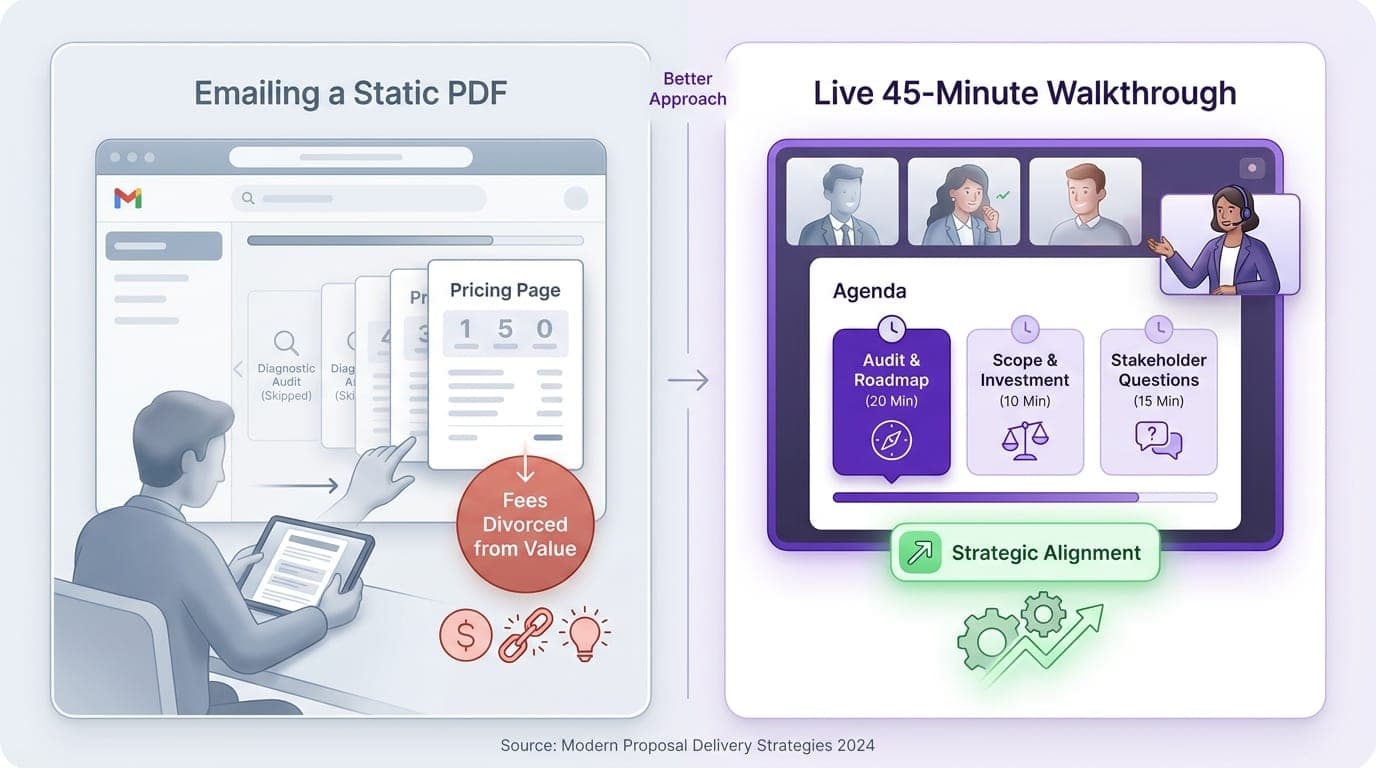
Delivering your proposal via a live video walkthrough dramatically increases your win rate compared to emailing a static document. When you email a PDF, decision-makers inevitably skip straight to the pricing page, divorcing your fees from the strategic value you provide.
Schedule a 45-minute interactive review meeting. Spend the first twenty minutes discussing the audit findings and strategic roadmap, spend ten minutes outlining the scope and investment, and reserve fifteen minutes for addressing stakeholder questions.
In my experience, prospects who refuse a live 30-minute proposal walkthrough consistently become difficult, uncooperative operational partners. A live walkthrough tests client communication styles and ensures mutual alignment before contracts are signed.
Watch out for two common mistakes that routinely kill promising deals during the proposal phase:
- Mistake 1: Guaranteeing specific search rankings. Search engines update ranking systems constantly. Promising a number-one rank on Google signals naivety. Instead, benchmark performance against qualified organic traffic and conversion rates.
- Mistake 2: Drowning executive buyers in technical jargon. C-suite stakeholders care about customer acquisition costs and payback periods. Confining your pitch to Quality Scores, bounce rates, and schema tags alienates decision-makers.
- Address Budget Hesitations Directly: If a prospect pushes back on pricing, adjust the operational scope rather than discounting your fee. Remove deliverables to preserve agency profit margins.
- Define Rigid Implementation Guardrails: Clarify developer responsibilities in writing to ensure technical fixes are deployed promptly without draining agency resources.
For agencies managing large content footprints across client domains, scaling programmatic landing pages efficiently can accelerate both organic indexing and paid ad relevance. Implementing an automated workflow with ProgSEO helps teams generate structured, data-driven landing pages that support integrated search marketing campaigns without manual authoring bottlenecks.
A high-performing SEM proposal should be between 8 and 15 pages (or slides). Keep the executive summary to one page, spend four to five pages diagnosing audit findings and outlining strategy, and allocate the remainder to scope, timelines, and commercial terms.
Yes, if the client has commercial goals that require both immediate pipeline generation and compounding organic authority. Present paid search as your immediate testing engine and organic search as the long-term asset that reduces blended acquisition costs.
Build a tiered financial model displaying conservative, expected, and aggressive scenarios. Calculate projected returns using their historical conversion rates, average order value or client lifetime value, and published platform CPC benchmarks.
The client should always pay Google Ads and other ad platforms directly using their own corporate credit card or billing profile. This guarantees transparency, protects agency cash flow, and ensures the client retains complete account ownership.
Sources & References
- Statcounter Global Stats — Comprehensive search engine market share data across desktop and mobile devices.
- Google Analytics 4 Documentation — Official setup and attribution measurement guidelines for tracking online conversions.
- Google Ads Keyword Planner — Search volume benchmarks, cost-per-click forecasts, and competitive bid estimates.
- Google Search Central — Technical SEO starter documentation, indexing standards, and search engine best practices.
- Think with Google Search Strategies — Research studies on consumer search intent and integrated cross-channel campaigns.
- Schema.org — Structured data vocabulary standards for search engine indexing and rich snippets.
- HubSpot Agency Pricing Models — Strategic analysis of digital agency retainer structures, billing models, and margins.
- Google Ads Support — Explanation of the Google Ads ad auction system, ad rank calculations, and Quality Score factors.