
Building an effective seo content plan requires moving beyond isolated keyword lists to build a predictable organic traffic engine. In this guide, I share my framework for auditing competitor gaps, designing topic clusters, and prioritizing content that converts.
▶ Related Video
SEO in 2025: How I'd Learn it if I Were Starting Over
With basic spreadsheet software and standard research tools, you can build an actionable six-month roadmap in roughly two working days. Here is the operational workflow I rely on across competitive B2B and consumer software verticals.
Key Takeaways
- Search intent dictates layout. Matching query intent determines whether a URL ranks faster than raw backlink volume or word count.
- Topic clusters build topical authority. Organizing content around dedicated pillar pages and bidirectional internal links protects your domain against core algorithm volatility.
- Prioritize by business impact first. High-intent, mid-volume terms consistently yield faster pipeline conversions than competitive top-of-funnel informational queries.
- Briefs prevent editorial drift. Giving writers entity requirements and heading outlines cuts revision rounds by more than half.
- Audit performance quarterly. Pruning decaying content and updating stale statistics keeps historical rankings stable.
Essential Components of a Working SEO Content Roadmap
A successful strategy document serves as a shared single source of truth for SEOs, writers, and business leaders. Without explicit metadata for every target page, editorial teams default to publishing disjointed posts that fail to generate pipeline.
In my experience, starting an editorial schedule without a centralized architectural sheet is why most organic campaigns stall after three months. Teams produce dozens of disconnected blog posts that fail to pass PageRank or establish domain depth.
When structuring your roadmap, whether using a spreadsheet or an automated database, you should document specific operational fields for every asset before drafting begins. You can reference our foundational breakdown of a basic SEO plan to establish these core parameters.
- Primary target keyword: The single head query with verified search volume and addressable commercial value.
- Search intent classification: Explicit categorization across informational, commercial, transactional, or navigational stages.
- Topic cluster assignment: Designation as either a core pillar page or a supporting cluster article.
- Proposed URL slug: The standardized permalink adhering strictly to site taxonomy guidelines.
- Assigned writer and target publish date: Clear operational ownership preventing workflow bottlenecks across your editorial cycle.
Google's helpful content guidelines within Google Search Central documentation emphasize creating purpose-driven material tailored to real human queries rather than search engine algorithms. Establishing these fields ensures your team builds pages that fulfill distinct search tasks.
| Roadmap Stage | Key Deliverables | Primary Tools | Review Cadence |
|---|---|---|---|
| 1. Topic Discovery | Keyword lists, intent tags, competitor gap matrix | Semrush, Ahrefs, Ubersuggest | Quarterly |
| 2. Cluster Architecture | Pillar-to-cluster site map, internal link wireframe | Spreadsheets, Miro, Notion | Semi-annually |
| 3. Prioritization Scoring | Scored roadmap based on business value and difficulty | Custom scoring spreadsheets | Monthly |
| 4. Production & QA | Structured content briefs, entity checklists, drafts | Google Docs, Content Harmony, Clearscope | Weekly |
| 5. Performance Auditing | Rank tracking, decay analysis, refresh backlog | Google Search Console, GA4 | Bi-weekly |
Conducting Search Intent Mapping and Competitor Gap Audits
Search intent mapping must dictate your page layout and angle before a writer creates an outline. If a user seeks a downloadable template and you deliver an essay, your page will not rank.
I routinely review SERPs manually in an incognito window to classify the dominant format. If the top five results are interactive tools, creating a 3,000-word guide is a waste of your editorial budget.
Mistake #1 I see teams make constantly is relying solely on monthly search volume while ignoring search intent. They target 10,000-volume keywords with blog posts when Google only ranks landing pages or calculators.
To surface immediate keyword opportunities, run a competitive gap audit against three direct search competitors. Using features documented in the Semrush Keyword Gap tool, you can isolate search queries where competitors rank on page one but your site holds no visibility.
If you are working with leaner tool stacks, platforms like the Semrush free plan or the Ubersuggest free plan still provide daily queries to run gap queries and collect initial competitor ranking lists.
- Export competitor keyword rankings: Pull ranking exports for your top three organic rivals using competitive analysis platforms.
- Filter for shared rankings: Identify intersection queries where at least two competitors rank within the top 20 positions.
- Exclude your existing URLs: Cross-reference the list against your current sitemap to isolate true missing assets.
- Tag by intent bucket: Categorize findings into informational questions, product comparisons, or bottom-funnel solution searches.
As outlined in Neil Patel's competitive analysis framework, studying rival content structures uncovers untapped angles that search algorithms already reward. Focus your efforts on missing queries with clear commercial intent rather than chasing vanity informational volume.
Structuring Topic Clusters and Internal Link Architectures
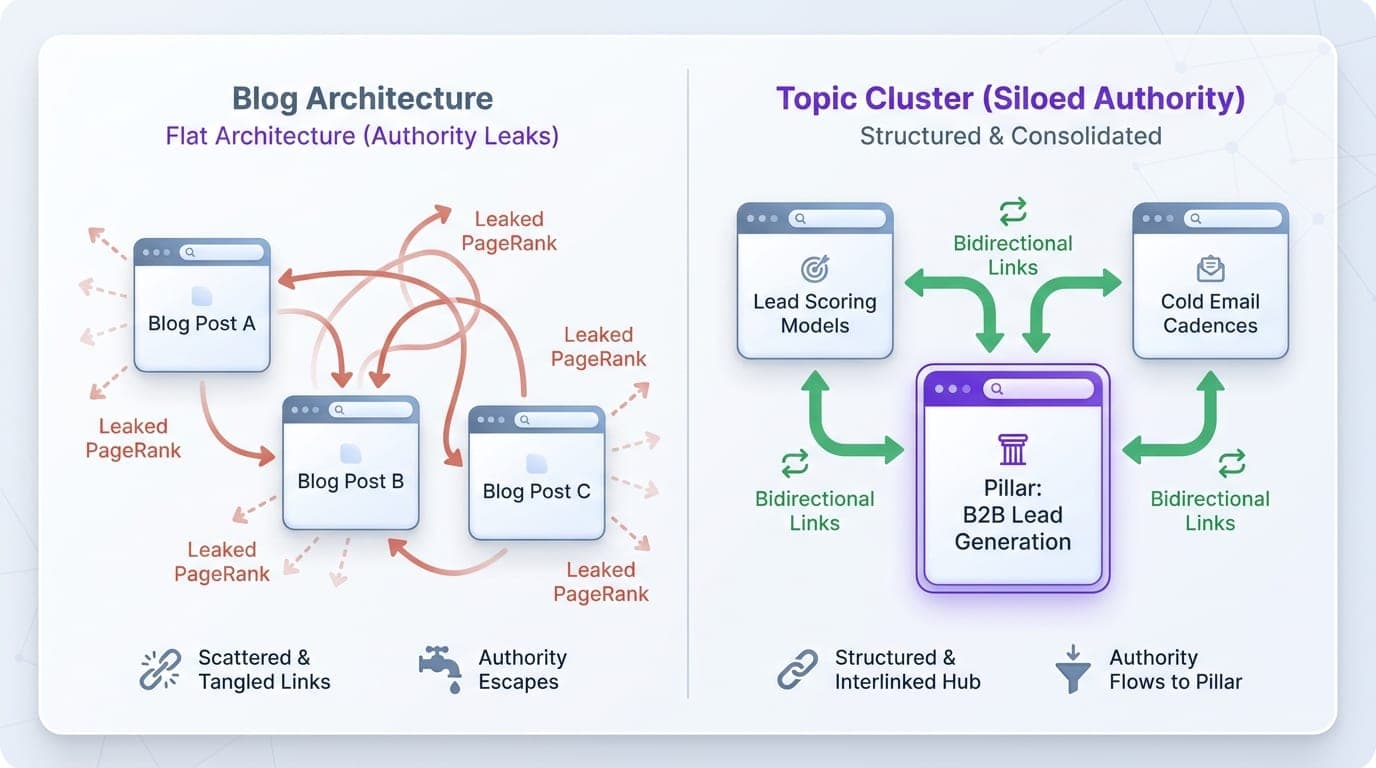
A topic cluster groups a comprehensive pillar page with tightly focused subtopic cluster pages using bidirectional internal links. This architecture signals topical authority to search engines far more effectively than isolated blog posts.

In my view, flat site architectures with random cross-links leak PageRank and confuse search engines about your site's core specialism. Organizing pages into strict thematic silos keeps crawler equity focused on your most profitable landing pages.
When evaluating your link equity, research tools can help trace internal equity distribution. If you manage legacy accounts, our review of the Ahrefs legacy plan details how older tier limits affect extensive internal link auditing workflows.
According to research from Ahrefs' topic clusters analysis, publishing comprehensive thematic content clusters correlates directly with higher organic ranking velocity across competitive verticals.
- Identify the broad core entity: Establish a high-level pillar topic covering a broad subject area (e.g., 'B2B Lead Generation').
- Map 5 to 15 subtopic queries: Develop discrete articles answering specific long-tail questions (e.g., 'Lead Scoring Models', 'Cold Email Cadences').
- Implement bidirectional linking: Ensure every cluster article links up to the pillar page using descriptive anchor text, and the pillar references every cluster page.
- Avoid inter-cluster dilution: Do not cross-link between unrelated clusters unless there is genuine contextual relevance for the reader.
The structural rules explained in Ahrefs' internal linking guide emphasize using exact or partial-match descriptive anchors. Vague anchors like 'click here' fail to transfer semantic context to search engine crawlers.
Prioritizing Target Topics by Commercial Value and Effort
An objective scoring formula separates high-revenue search opportunities from vanity traffic traps. Scoring keywords mathematically removes internal bias and prevents stakeholders from prioritizing low-value pet topics.
I consider monthly search volume the most deceptive vanity metric in search marketing. A bottom-of-funnel query with 40 monthly searches that generates three enterprise sales calls beats a 5,000-search informational guide that only attracts students.
Mistake #2 is tackling maximum-difficulty informational keywords before establishing topical depth on high-converting bottom-of-funnel queries. Build your conversion baseline first before expanding into broad awareness terms.
- Business Value (Score 1-3): Assign a 3 to topics directly showcasing your product, a 2 to topics where your product solves a sub-problem, and a 1 to purely educational queries.
- Keyword Difficulty (Score 1-3): Score a 1 for high keyword difficulty (>60), a 2 for moderate difficulty (30-60), and a 3 for accessible targets (<30).
- Search Volume Weight (Score 1-2): Assign a 1 for low volume (<100 searches) and a 2 for steady search demand (>100 searches).
- Calculate Priority Score: Use the formula: `(Business Value * 2) + Keyword Difficulty Score + Search Volume Weight` to establish production ranking.
Standard competitive benchmarking, such as Moz's keyword difficulty documentation, highlights why assessing domain authority and SERP page strength is vital. Never schedule competitive queries without realistic backlink acquisition resources.
Standardizing Content Briefs and Production Scheduling
Production schedules succeed or fail based on the clarity of content briefs given to writers. An ambiguous brief yields unfocused writing, bloated word counts, and endless revision cycles.
My stance is that paying writers by the word incentivizes bloat, whereas defining specific entities and questions guarantees depth. When writers have structured parameters, production velocity accelerates while maintaining high editorial standards.
Publishing schedules must also account for Content Management System capabilities and hosting setup costs. Understanding operational investments, like the analysis in our guide to Wix SEO plan costs, helps teams budget realistically for site infrastructure.
- Semantic entities and secondary keywords: List the technical terms, entities, and secondary queries that must appear naturally in the body text.
- Defined heading structure: Outline mandatory H2 and H3 subheadings matching user intent patterns.
- Competitor URLs to outperform: Provide two top-ranking URLs so writers analyze existing SERP benchmarks.
- Internal link targets: Specify at least three existing pages on your site that the writer must link to within the draft.
- Information gain requirement: Mandate one proprietary data point, original graphic, or unique practitioner insight.
Ensuring technical schema requirements are met early helps search crawlers parse page context. Review the Google Developers structured data guide to plan schema implementation alongside your editorial calendar.
Tracking Organic Performance and Quarterly Roadmap Updates
Evaluating an SEO plan requires tracking leading indicators like impression growth and ranking velocity well before evaluating revenue attribution. Waiting six months to check traffic is a recipe for wasted marketing spend.
I believe quarterly roadmap adjustments are non-negotiable because search landscapes shift faster than annual enterprise budgeting cycles allow. Sticking rigidly to an unvalidated twelve-month plan burns resources on declining topics.
Use first-party measurement tools to monitor page progress. The official documentation in Google Search Console Help explains how analyzing impressions and average position changes surfaces early ranking signals within 30 days of indexation.
- Days 1 to 30: Verify indexation in Google Search Console and confirm schema validation.
- Days 31 to 60: Monitor query impression velocity and identify secondary queries gaining unexpected traction.
- Days 61 to 90: Track top-20 position movements and update internal links from newer relevant articles.
- Days 91+: Measure organic conversion rates and schedule content refreshes for URLs stagnating between positions 4 and 10.
Conduct a formal content audit every quarter to maintain catalog health. As recommended in Search Engine Journal's content audit framework, prune decaying pages, consolidate cannibalizing assets, and redirect dead URLs to preserve site authority.
For teams managing extensive topic architectures, ProgSEO automates data-driven page creation to scale your organic coverage efficiently. It streamlines topic execution while preserving editorial control over your search strategy.
Plan detailed briefs three months in advance, while keeping a high-level roadmap mapped for six months. Search algorithms, competitors, and business priorities shift too quickly to commit to rigid twelve-month production schedules.
Each piece should focus on one primary keyword representing the core user intent, supported by three to eight closely related secondary keywords and semantic entities that naturally fit the heading structure.
New articles on established websites typically begin showing impression velocity within 30 to 60 days, reaching peak ranking stability between 90 and 180 days. Newer domains often experience longer evaluation cycles.
An editorial calendar is a project management tool tracking draft deadlines, writers, and publication dates. An SEO content plan includes the foundational keyword research, search intent mapping, topic cluster models, and internal link architecture driving those deadlines.
Sources & References
- Google Search Central — Official guidelines on creating helpful, reliable, people-first content.
- Semrush Knowledge Base — Documentation covering competitive gap audits and missing query identification.
- Neil Patel Blog — Strategic workflows for running competitor SEO audits and content analysis.
- Ahrefs Topic Clusters Guide — Practical methodology on pillar pages and topic cluster architectures.
- Ahrefs Internal Linking Guide — Strategic implementation rules for PageRank distribution and contextual anchor text.
- Moz SEO Learning Center — Technical explanations of keyword difficulty metrics and SERP competition analysis.
- Google Developers — Technical reference for schema markup and structured data implementation.
- Google Search Console Help — Official guidance on performance reports, impressions, and ranking data.
- Search Engine Journal — Complete framework for conducting organic content audits and performance maintenance.