
Executing a successful content marketing strategy for seo requires moving past random blog posts to build methodical topical dominance. In this guide, I will show you how to build an organic engine from keyword architecture to link acquisition over a 90-day execution window using tools like Google Search Console and professional search intelligence platforms.
▶ Related Video
Content Marketing For Beginners: Complete Guide
Key Takeaways
- Intent beats search volume. Ranking for a 200-search commercial query generates more revenue than chasing 10,000-search informational fluff.
- Topic clusters establish authority. Search engines prioritize sites that thoroughly cover a subject over websites that publish isolated articles.
- Original data attracts backlinks. You do not need aggressive outreach when you publish proprietary benchmark data that journalists naturally reference.
- Bidirectional internal linking transfers equity. Linking pillar pages to cluster pieces signals contextual hierarchy and page importance directly to crawlers.
- Content pruning defends rankings. Regularly updating declining pages or removing decaying dead weight protects your domain from site-wide quality downgrades.
Principles of an Organic-First Content Framework
An SEO-driven content strategy prioritizes verified search demand and crawlable information architecture over subjective editorial whims. Traditional brand storytelling aims for immediate emotional resonance or social virality. In contrast, an organic-first strategy satisfies search algorithms by solving specific user problems.
In my opinion, brand storytelling without search demand is pure vanity for any business allocating capital toward scalable customer acquisition. If nobody searches for your topic, your article disappears into an archive after forty-eight hours.
Before drafting a single paragraph, you need a structured operational roadmap like a dedicated SEO strategy plan document. This keeps production aligned directly with indexation goals and search demand benchmarks.
- Search demand validation: Target keywords that reflect measurable organic search volume rather than internal company jargon.
- Algorithmic alignment: Satisfy the quality criteria outlined in Google's helpful content guidelines.
- Topical depth: Cover every facet of a core theme to demonstrate comprehensive domain expertise.
- Compounding value: Build evergreen assets that continue accumulating qualified organic traffic for years without recurring ad spend.
Mistake 1: Publishing disconnected articles based purely on high search volume without establishing a cohesive topical foundation. A high monthly search volume means nothing if your domain lacks the contextual relevance required to rank against established competitors.
Mapping Search Intent Across the Acquisition Funnel
Search intent dictates the exact format, depth, and tone your content must take to satisfy search engine algorithms. Ranking algorithms analyze how searchers interact with results to determine whether a page fulfills the searcher's core query.
When evaluating keywords, I look past raw search volume and examine the live search engine results page (SERP). If the top three results are step-by-step guides, writing an opinion essay guarantees failure.
Selecting the right toolset is essential for dissecting SERPs. I evaluate platforms through a detailed comparison of Moz, Semrush, and Ahrefs to audit keyword difficulty and SERP features effectively.
| Funnel Stage | Search Intent | Example Query | Optimal Format | Primary Goal |
|---|---|---|---|---|
| Top of Funnel (TOFU) | Informational | what is programmatic seo | Comprehensive guide or glossary | Build awareness and establish authority |
| Middle of Funnel (MOFU) | Commercial Investigation | best seo audit tools | Comparison guide or product teardown | Evaluate options and build trust |
| Bottom of Funnel (BOFU) | Transactional | enterprise seo platform pricing | Landing page or pricing calculator | Direct lead capture or sale |
| Retention / Support | Navigational | google search console api docs | Technical documentation or portal | User retention and task completion |
My take is that commercial investigation queries yield the highest ROI in organic search, yet most marketing teams waste 80% of their budget writing superficial top-of-funnel glossaries. You should always build your conversion assets first.
- Deconstruct top results: Open the top five ranking pages to identify the dominant content type, formatting, and word count.
- Match user expectations: Provide the core answer immediately rather than hiding critical details beneath filler paragraphs.
- Target specific pain points: Answer the implicit questions searchers hold based on industry studies like Ahrefs' research on search intent.
- Deploy relevant CTAs: Connect top-of-funnel informational readers to logical next-step commercial guides.
Structuring Topic Clusters to Build Topical Authority
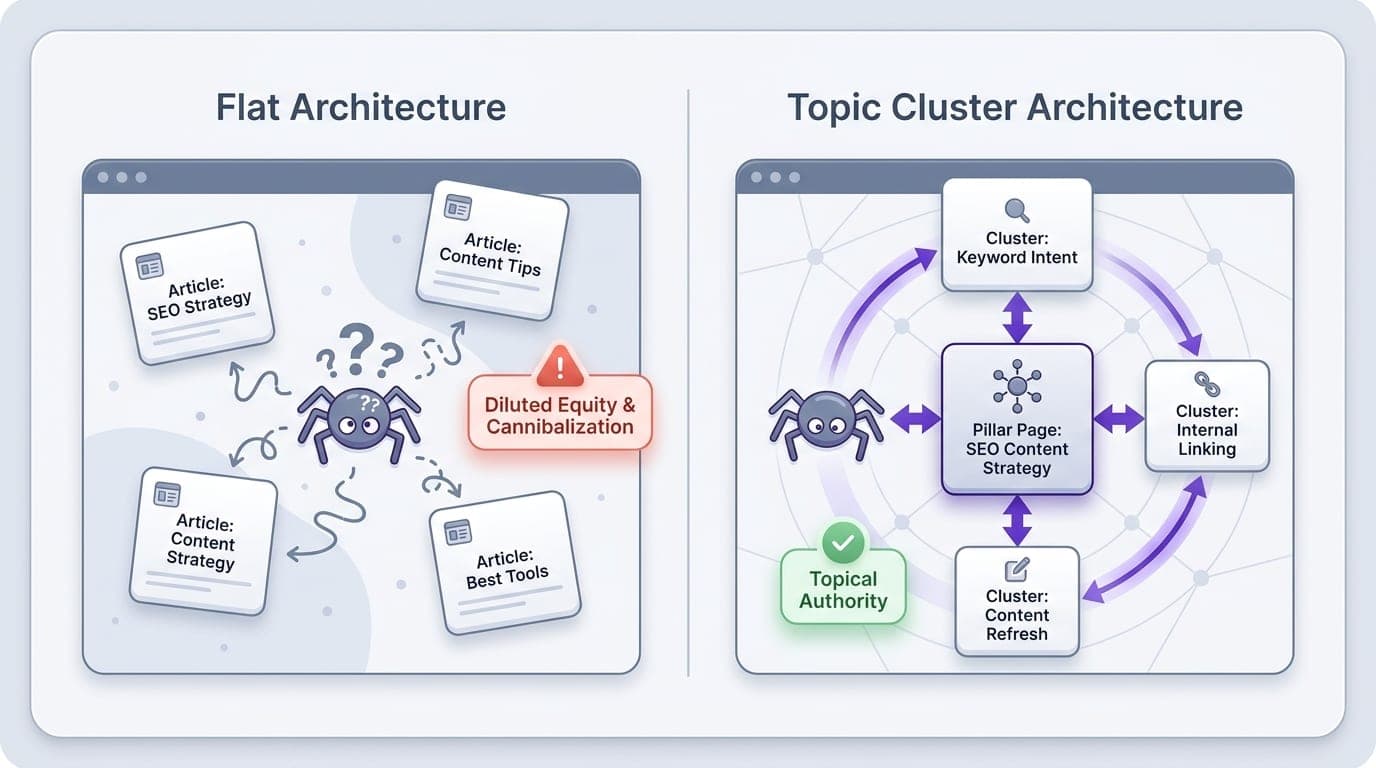
Topical authority is established when your site thoroughly answers every relevant question surrounding a parent topic through a deliberate pillar-cluster structure. Modern search algorithms evaluate a domain's overall depth of knowledge across a subject, not just individual keywords.
A topic cluster consists of a comprehensive pillar page that covers a broad topic broadly and multiple supporting cluster pages that address specific subtopics in detail. This organization mirrors how search engines understand semantic relationships.
I firmly believe flat site architectures without rigid cluster hierarchies confuse search crawlers and dilute link equity across unrelated pages. You must enforce strict bidirectional linking across every cluster you launch.
Connecting these pages requires a deliberate internal linking strategy. Every cluster article must link back to its parent pillar page using exact or partial-match descriptive anchor text.
- Define the pillar topic: Select a high-value core topic with broad informational and commercial search interest.
- Uncover long-tail subtopics: Extract secondary questions, procedural steps, and specific comparisons using search analytics.
- Establish bidirectional links: Link every cluster asset directly to the pillar, and link the pillar out to every cluster piece.
- Cross-link related clusters: Connect adjacent topics horizontally only when there is genuine contextual relevance for the reader.
Mistake 2: Targeting nearly identical search queries across multiple articles, which triggers keyword cannibalization and confuses search engines. If you write two articles targeting "content marketing strategy for seo" and "seo content strategy", both pages will struggle to achieve top rankings.
To prevent keyword overlap across large organizations, teams often adopt a structured enterprise SEO strategy framework to coordinate publishing schedules and establish clear page ownership.
Execution Standards: Creating and Optimizing Rank-Ready Content
High-ranking content requires demonstrative first-hand experience, precise heading taxonomy, and comprehensive resolution of secondary search queries. Thin content generated solely by summarizing the existing top results no longer secures lasting search rankings.
Search engines prioritize information gain—content that provides novel data, original viewpoints, or unique practical frameworks that do not exist elsewhere on the web. Search algorithms actively reward unique contributions.
“Creating helpful, reliable, people-first content means providing original information, reporting, research, or analysis rather than rewriting existing web pages.”
- Google Search Central Documentation
In my experience, standardizing your production quality protects against volatile core algorithm updates. Adhering to the principles in Google's ranking systems guide ensures your library withstands shifting search criteria.
- Clear heading taxonomy: Use descriptive H2 and H3 tags that outline the article's structure logically for both readers and web crawlers.
- Demonstrable E-E-A-T signals: Include clear author bios, transparent sourcing, hands-on testing notes, and direct industry experience.
- Structural readability: Keep paragraphs under 60 words, utilize scannable bullet lists, and incorporate practical tables.
- Information gain additions: Include proprietary survey data, teardowns, or custom workflows that competitors lack.
When evaluating production capacity, many growing organizations turn to specialized SEO digital marketing packages to scale their content creation without sacrificing technical rigor.
Earning Backlinks Passively with Data-Led Content Assets
Passive link acquisition relies on publishing reference assets that content creators and journalists cite as primary sources. Manual outreach often produces diminishing returns, but authoritative reference content earns organic citations continuously.
Cold outreach emails asking for links are largely dead; in my experience, spending that outreach budget on original surveys generates ten times more natural backlinks. Writers search Google for stats, locate your resource, and cite it directly.
Industry analyses from publishers like Search Engine Land show that editorial backlinks remain one of the strongest foundational pillars for competitive domain visibility.
- Proprietary industry surveys: Poll professionals in your niche and release an annual state-of-the-industry benchmark report.
- Data-driven studies: Analyze anonymized customer usage data or large public datasets to reveal unique behavioral trends.
- Original definitions and frameworks: Coin specific terminology for emerging industry concepts to capture attribution queries.
- Free calculators and templates: Build lightweight, embeddable tools that solve recurring mathematical or workflow calculations.
According to extensive research by Backlinko on ranking factors, pages with a higher volume of quality referring domains consistently outrank competitors with superior keyword optimization alone.
Measurement, Refresh Cadence, and Pruning Tactics
Tracking organic content performance requires measuring keyword trajectory, indexed impressions, and assisted conversions rather than vanity pageviews. High traffic volume is useless if it fails to generate commercial value for your organization.
I prioritize Search Console impressions as my primary leading indicator during the first sixty days after publishing. An exponential increase in impressions reveals that crawlers are indexing your semantic terms before traffic flows.
- Rank trajectory: Monitor keyword movements from positions 50–100 into the top 20, then into positions 1–3.
- Search Console click yield: Track non-branded click growth across specific cluster URLs rather than domain-wide totals.
- Assisted conversions: Measure which informational cluster pages appear along the conversion path in your analytics platform.
- Organic bounce rate and satisfaction: Ensure searchers do not immediately return to the SERP to select an alternative result.
Every piece of published content eventually faces decay. Industry resources like the Moz Learning Center emphasize that search intent shifts as markets evolve, requiring regular content maintenance.
- Quarterly content audits: Flag articles experiencing a 20% or greater decline in organic clicks over a ninety-day window.
- Content refreshes: Update obsolete statistics, replace outdated screenshots, expand thin sections, and re-index the page.
- Strategic pruning: Consolidate duplicate articles via 301 redirects, or delete zero-traffic zombie pages to preserve crawl equity.
In my experience, deleting low-quality pages that generate zero impressions often lifts organic traffic across the rest of the site within eight weeks. Pruning poor content signals quality to search engine algorithms.
When managing programmatic content libraries at scale, automated systems prevent performance decay across thousands of dynamic URLs. You can use ProgSEO to turn structured data into search-optimized pages that stay updated automatically as your business evolves.
A disciplined strategy typically demonstrates leading indicators like impression growth within 60 to 90 days. Significant organic traffic and revenue gains generally require 6 to 12 months of consistent cluster publishing and internal link building.
A balanced portfolio typically dedicates 60% of content to informational topics that build topical authority and earn backlinks, and 40% to commercial investigation and transactional assets that convert searchers into customers.
Update an existing article when its primary target keywords begin losing positions or when the page experiences traffic decay. Create a new article only when you identify a distinct secondary keyword cluster with different search intent.
Yes, if you target low-competition long-tail keywords and publish comprehensive topic clusters. However, highly competitive commercial queries will eventually require linkable assets to build domain authority.
Sources & References
- Google Search Console — Official webmaster platform for monitoring crawl performance and organic query impressions.
- Google Search Central — Developer guidelines defining quality standards for helpful, people-first content.
- Google Search Documentation — Comprehensive overview of algorithmic ranking systems and automated quality signals.
- Ahrefs — Empirical industry research explaining search intent categorization and SERP satisfaction metrics.
- Search Engine Land — Practitioner guides detailing modern search engine optimization fundamentals and link equity.
- Backlinko — Extensive correlation study analyzing domain authority, backlink metrics, and top Google rankings.
- Moz — Foundational search educational resources covering organic metrics, search intent, and indexation.