If you operate as a solo consultant or run an agency doing high-volume keyword scraping, keep your ahrefs legacy plan. Retaining your grandfathered subscription protects you from per-click credit consumption. However, if your team requires multi-year historical SERP trends, Looker Studio integrations, or extra active seats, migrating to modern tiers makes financial sense. I evaluate these tradeoffs constantly when auditing agency software stacks against Search Engine Journal's analysis of SEO tool costs.
▶ Related Video
The Agency Workshop, LAB 02: Build Your Citation & Authority Checklist
Key Takeaways
- Legacy tiers bypass per-click meters. Older accounts run daily report allowances without burning individual usage credits on every filter change.
- Modern features remain strictly gated. Grandfathered accounts cannot access expanded historical index data, portfolio overviews, or modern API integrations.
- Payment lapses permanently revoke grandfathering. A single expired credit card or failed billing attempt can instantly force your account onto modern pricing.
- High-frequency research saves thousands yearly. Solo practitioners who check hundreds of SERP views daily will exhaust modern credit allowances within days.
- Multi-seat collaboration requires tier upgrades. Expanding your marketing team past legacy seat limits triggers mandatory migration to contemporary workspace billing.
What Defines an Ahrefs Legacy Plan in 2026?
An Ahrefs legacy plan refers to any subscription activated before March 2022 that maintains original flat-rate pricing. Under these legacy terms, your account operates on fixed daily or monthly report quotas rather than the modern credit consumption model.
When I first managed multi-client SEO portfolios under these older plans, cost forecasting was simple. You paid a predictable monthly or annual invoice, and your team conducted research without tracking individual user actions. You can read my complete breakdown of standard ahrefs plans to see how structures have evolved.
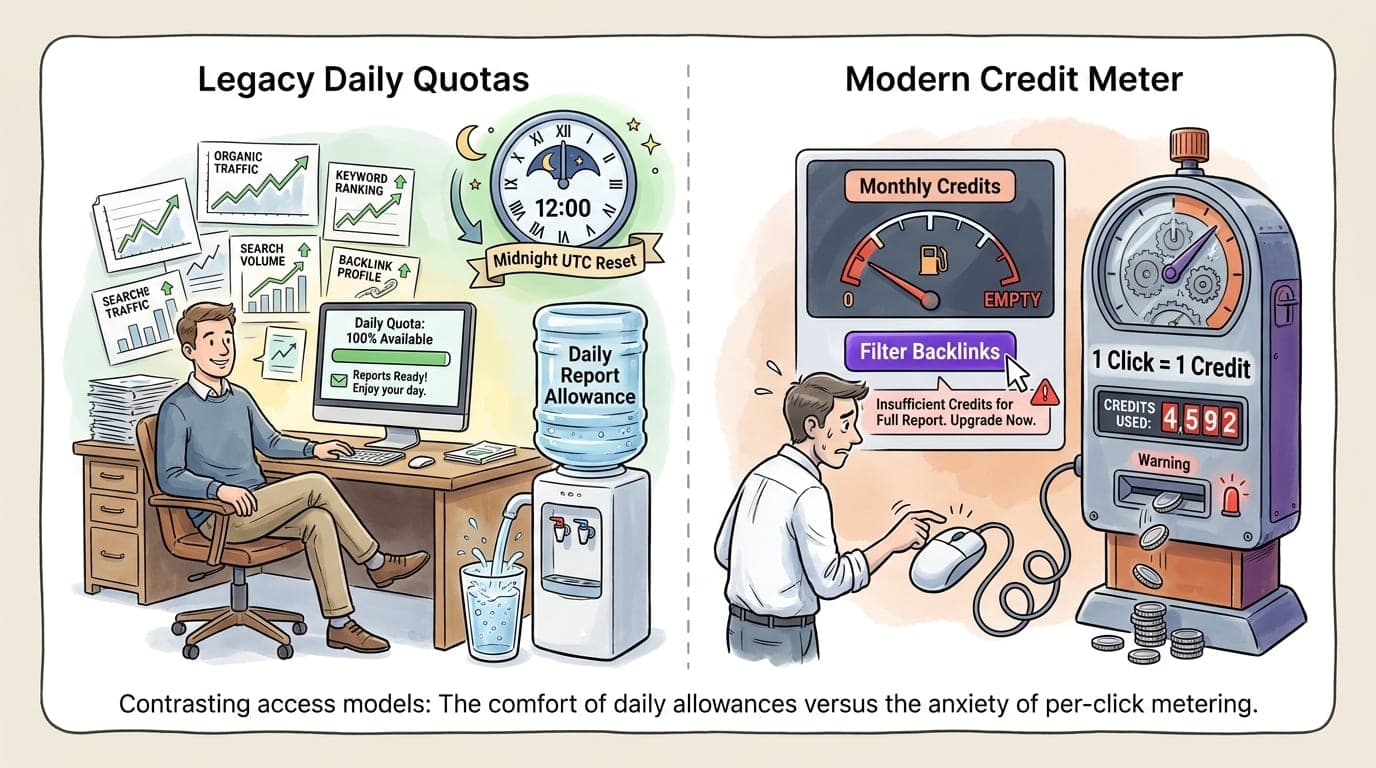
- Fixed daily report limits that reset every night at midnight UTC rather than pooling across a monthly billing cycle.
- Unlimited basic click browsing inside verified project dashboards without deducting from an account-wide allowance.
- Flat seat access without incremental fees for inactive or view-only project contributors.
- Exemption from consumption charges when applying granular secondary filters inside Site Explorer.
The fundamental mechanics behind these grandfathered tiers shield heavy researchers from micro-billing. In my opinion, grandfathered legacy plans remain the ultimate defense against micro-transaction fatigue in day-to-day SEO work. When you slice data all morning, you should not have to calculate the dollar cost of every click, a tension highlighted in Search Engine Land's coverage of SEO pricing changes.
Usage Credits vs. Daily Quotas: The Real Operational Difference
The operational divide between legacy plans and current accounts comes down to how usage credits deplete. In modern subscriptions, opening a report, filtering a backlink list, or opening Keywords Explorer consumes at least one credit per request.
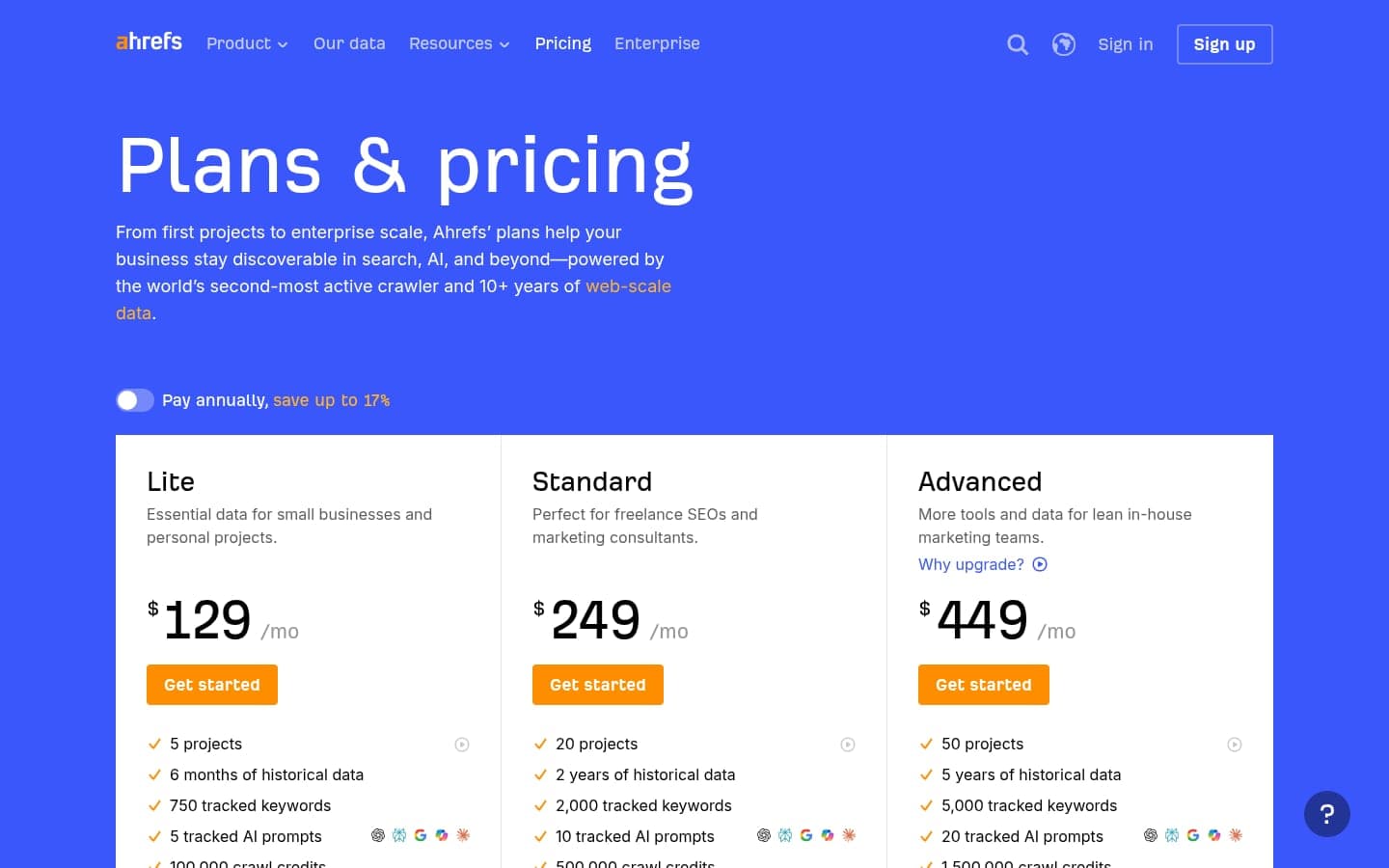
On modern tiers, limits are tightly budgeted. As of October 2026, the Ahrefs pricing page lists the Lite plan at $129 /mo (per month) with 5 projects, 750 tracked keywords, 100,000 crawl credits, and 500 credits per user. The Standard plan costs $249 /mo (per month) with 20 projects and 500,000 crawl credits.
Higher tiers expand capacity further. As of October 2026, the Advanced plan runs $449 /mo (per month) with 50 projects and 1,500,000 crawl credits, while the Enterprise plan begins at $1,499 /mo (per month) on Ahrefs pricing.
| Metric / Feature | Grandfathered Legacy Plan | Modern Current Plans |
|---|---|---|
| Billing Mechanic | Flat rate with daily resetting quotas | Usage credits deducted per user interaction |
| Filter Adjustments | Free within opened report views | Consumes 1 credit per modified request |
| Base Monthly Entry | Pre-March 2022 locked rates | $129 /mo (per month) on Lite tier |
| User Seat Pricing | Legacy shared seat allowances | Per-user monthly fees plus consumption add-ons |
| Export Row Limits | Generous daily export ceilings | Tiered monthly export caps tied to credit pools |
Under legacy terms, you could run 500 reports in a single afternoon, hit your ceiling, and resume work tomorrow without spending another cent. On modern plans, burning through your allocated credits per user halts work immediately unless you purchase expensive credit add-on packs. The Internet Archive's record of historic SEO SaaS limits clearly documents how dramatic this structural shift was.
1,000
Monthly credits per user on modern Lite
500+
Daily reports available on legacy Standard
50
Projects included on current Advanced
My view is that per-click consumption penalizes exploratory curiosity, turning routine data checks into anxiety-inducing budget decisions. Junior analysts often hesitate to drill into long-tail link profiles because every modified view chips away at the monthly credit pool,
Feature Gating: What Legacy Accounts Cannot Access
Holding onto an older plan is not without painful tradeoffs. Ahrefs does not give grandfathered users access to modern platform capabilities, locking advanced analytical tools behind current credit-based subscriptions.
If you run programmatic content operations or deep competitor forensics, these restrictions hurt. I often compare these data pipeline bottlenecks when reviewing ProgSEO vs Ahrefs for SaaS content generation alongside modern search tracking benchmarks.
- Multi-year historical index access: Legacy tiers often limit historical SERP and backlink analysis to six months or one year.
- Portfolio reporting: You cannot group multiple subdomains, root domains, and URLs into unified performance dashboards.
- Site Explorer nested filters: Modern compound logic operators for identifying specific SERP features remain unavailable.
- Looker Studio integration: Direct connector synchronization for executive reporting requires modern subscription tiers.
When auditing organic growth strategies, losing access to historical SERP snapshots prevents you from diagnosing algorithmic penalties from previous core updates. The documentation at Google Search Central stresses comparing multi-year indexation shifts to distinguish site-level technical regressions from industry-wide volatility.
I believe Ahrefs deliberately turned historical SERP data into a premium barrier to encourage legacy accounts to migrate. If your business depends on proving long-term traffic recovery to enterprise stakeholders, a legacy tier will eventually blindside your reporting team.
How You Lose Grandfathered Status and Common Traps
Losing your grandfathered status happens instantly and is completely irreversible. Once an account leaves its legacy contract, support will not restore your original terms under any circumstances.
I have seen two common mistakes cost agency founders their grandfathered plans over the years. The first mistake is letting an automated payment card expire without configuring secondary billing backups before the renewal invoice triggers.
The second mistake occurs when an account administrator attempts to add additional user seats or reassign workspace roles. Under contemporary platform rules, modifying your user roster frequently forces your entire workspace onto current credit contracts.
- Maintain active backup payment cards inside your billing settings to prevent involuntary dunning cancellations.
- Set calendar reminders 60 days before card expiration to update payment details well before your renewal date.
- Never adjust your subscription frequency between monthly and annual cycles without written confirmation from billing.
- Do not invite extra team members directly from the admin dashboard without verifying whether the invite prompts tier migration.
Involuntary churn caused by banking security protocols or replaced corporate cards accounts for a massive share of canceled legacy SaaS contracts. You can study these payment lapse mechanics in Stripe documentation on payment churn prevention to see why automated dunning cycles fail so abruptly.
I consider relying on a single automated payment card without active calendar reminders the single biggest mistake an SEO can make. Review your billing profile every quarter, and verify your account status against the binding Ahrefs terms of service.
Retain or Upgrade: My Framework for Making the Call
Deciding whether to retain your grandfathered subscription comes down to your daily data volume versus your team's collaboration requirements. There is no middle ground: you either benefit hugely from daily quotas or suffer from missing modern features.
If you are balancing this decision against other enterprise tools, read our comprehensive Moz vs Semrush vs Ahrefs marketing comparison. It highlights how different software architectures manage daily query allowances.
- Keep your legacy plan if you are an independent affiliate publisher or solo consultant doing aggressive manual link prospecting.
- Keep your legacy plan if your daily workflow involves filtering thousands of keywords across dozens of competing websites.
- Keep your legacy plan if you have established fixed operational overhead that cannot absorb variable credit overage invoices.
- Keep your legacy plan if you do not need native Looker Studio connectors or multi-user enterprise permissions.
Conversely, organizations scaling past three concurrent analysts will find grandfathered constraints suffocating. Upgrading becomes mandatory when workflow friction outpaces the financial savings of locked-in subscription pricing.
- Upgrade to modern tiers if you manage a team of five or more analysts who need individual workspace logins.
- Upgrade to modern tiers if your client retainers require five-year historical SERP trend benchmarking and index forensics.
- Upgrade to modern tiers if you rely on Portfolio views to monitor consolidated parent-child domain architectures.
- Upgrade to modern tiers if you need higher crawl allocations, such as the 1,500,000 crawl credits on the Advanced plan.
When evaluating your long-term roadmap, pair your tool investment with a sustainable basic SEO plan that aligns software budgets with revenue goals. Industry analysts at Moz blog research consistently emphasize that data volume alone never replaces execution strategy.
My rule of thumb is straightforward: run a monthly credit simulation first, because abandoning a legacy seat is permanent. If your team builds large organic footprints, ProgSEO helps programmatic sites publish search-aligned landing pages automatically from structured data.
An Ahrefs legacy plan is an account created prior to March 2022 that retains flat-rate pricing and daily usage limits. Instead of spending consumption credits on every search, filter change, or report view, users receive fixed daily report allocations that reset every night.
Modern plans give users a monthly allowance of usage credits, such as 1,000 credits per user on the $129 /mo Lite plan checked in October 2026. Every filter adjustment or report click consumes a credit. In contrast, legacy plans allow unlimited filtering inside active sessions and rely on daily report quotas.
Legacy accounts are blocked from accessing new platform updates, including extended historical SERP archives, consolidated Portfolio analysis, advanced compound filtering logic in Site Explorer, and official Looker Studio connector integrations.
No. Ahrefs enforces strict grandfathering rules. If a subscription cancels due to an expired credit card, failed billing attempt, or plan change, the account forfeits its legacy status permanently and must subscribe under current credit-based pricing.
Sources & References
- Search Engine Journal — Industry data and cost calculation guidelines for enterprise SEO tools.
- Search Engine Land — Reporting on SaaS pricing model transitions across search analytics platforms.
- Ahrefs Pricing — Official plan parameters, crawl allowances, and user credit allotments verified in October 2026.
- Internet Archive — Historical web archives documenting legacy SEO software quotas and feature structures.
- W3C — Standards and technical documentation on digital resource metering and consumption.
- Google Search Central — Official search documentation covering historical performance monitoring and index health.
- Stripe Resources — Technical overview of billing dunning cycles and involuntary customer churn prevention.
- Ahrefs Terms — Master subscription agreement detailing grandfathering termination conditions and account terms.
- Moz Blog — Strategic research on software tooling economics and search marketing budget allocation.