
Professional local seo plans vary in cost in 2026, driven directly by your geographic market, competitor saturation, and physical footprint. A single storefront in a quiet suburban town typically requires a smaller monthly investment, whereas multi-location dental practices or high-stakes metro legal firms routinely invest substantially more monthly for qualified visibility remove or replace with a reference to an industry pricing survey (the linked Search Engine Land URL covers local ranking factors, not pricing studies).
▶ Related Video
Local SEO Pricing for Contractors: What to Expect
If you manage citations and review workflows internally, dedicated software automation costs significantly less, starting at $30 to $60 monthly per location. Navigating these options requires knowing what tasks deliver actual foot traffic versus vanity metrics.
Key Takeaways
- Standard retainers scale by competition. Single-location businesses in low-density areas invest lower amounts monthly, while competitive metro areas run significantly higher.
- Deliverables must target the local 3-pack. Legitimate packages prioritize Google Business Profile optimization, localized landing pages, review systems, and citation cleanliness.
- One-time setup fees are customary. Expect an onboarding fee depending on scope, covering deep citation cleanups, historical audit work, and tracking setup.
- Automation software is not a full-service plan. Platforms handle data synchronization, but agencies provide tactical localization, custom content, and localized link acquisition.
- Cheap packages carry algorithmic risks. Low-cost retainers frequently rely on automated spam networks that trigger Google profile suspensions.
Monthly Pricing Tiers for Local SEO Retainers
In my experience auditing local campaigns, pricing predictably sorts into four standard agency tiers. Pricing reflects the manual hours required to outrank established local incumbents in the Google Local Pack.
| Plan Tier | Monthly Retainer | Best Suited For | Typical Onboarding Fee |
|---|---|---|---|
| Starter Local | See pricing page | Single-location shops in low-competition suburbs | See pricing page |
| Growth Local | See pricing page | Regional service businesses or moderate city competition | See pricing page |
| Competitive Metro | See pricing page | High-value verticals (legal, roofing, cosmetic surgery) | See pricing page |
| Multi-Location / Enterprise | See pricing page | Franchises and regional brands with 5+ branches | Custom quote |
Most established agencies also assess a one-time setup fee depending on the scope of work. This upfront capital funds initial technical audits, citation deduplication, and Google Business Profile verification.
My firm opinion is that any agency proposing zero onboarding fee simply amortizes their initial research deficit across your contract, leading to sluggish execution during your first 90 days. If your budget is lean, comparing a structured basic SEO plan helps establish baseline organic expectations before committing to localized retainers.

Standard Deliverables You Should Expect in Every Plan
A qualified local SEO package does not hide behind vague promises of 'optimization.' You should expect specific, observable work streams directed at Google's search algorithms and customer conversion points.
- Google Business Profile (GBP) management: Weekly geo-tagged media updates, prompt Q&A monitoring, attribute management, and continuous category alignment per Google's GBP guidelines.
- Core citation building and cleanup: Manual submission and continuous maintenance across the primary aggregator ecosystem to secure rigorous NAP consistency (Name, Address, Phone).
- Localized landing pages: Creation of dedicated city or neighborhood service pages marked up with Schema.org LocalBusiness structured data.
- Review generation frameworks: Deployment of SMS or email automation workflows designed to collect authentic customer feedback without violating FTC endorsement rules.
- Local link acquisition: Securing contextual backlinks through regional sponsorships, local business chambers, community partnerships, and industry associations.
- Proximity rank tracking: Monthly reporting measuring geo-grid visibility at varying radii from your physical location.
I consider weekly GBP photo updates and localized landing page content non-negotiable. If a plan omits geo-targeted page development, you will struggle to rank outside your immediate postal code.
Managed Agency Retainers vs. Software Subscription Plans
You must decide whether to outsource execution to a full-service team or run local marketing software internally. Tool platforms solve data syndication, but they do not write localized landing copy or negotiate local sponsorships.
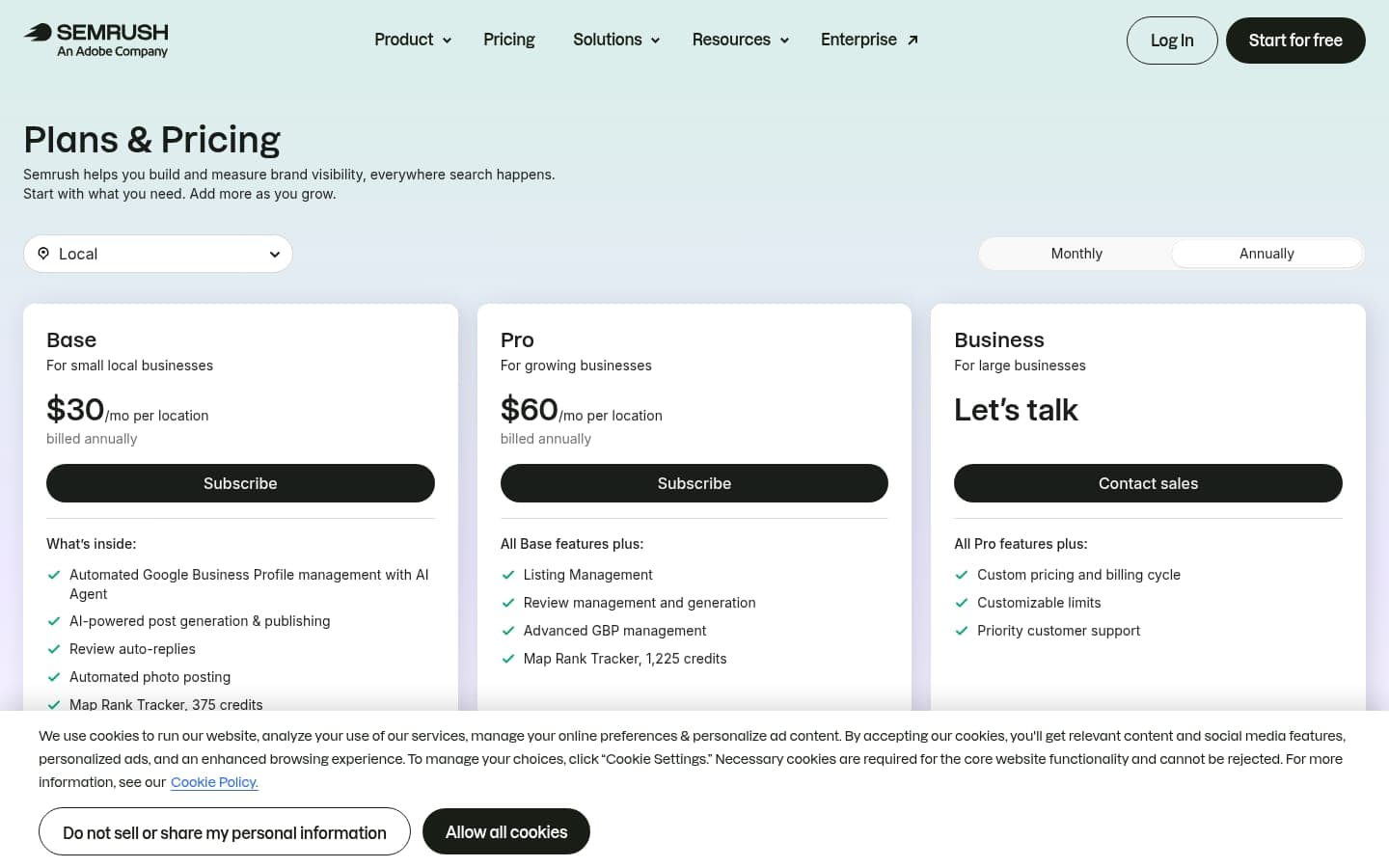
For automated listing distribution and rank checks, standalone software subscriptions offer an affordable operational layer. According to official documentation checked in October 2026 on the Semrush Local pricing page, their software tiers feature transparent per-location rates.
- Semrush Local Base plan: Costs $30/mo per location (billed annually or monthly) and includes 375 credits for the Map Rank Tracker as outlined in the Semrush Local Knowledge Base.
- Semrush Local Pro plan: Costs $60/mo per location (billed annually or monthly), distributing data to 70+ directories. It expands tracking to 1,225 credits and provides review analytics for up to 10 competitors with a limit of up to 10 reports per month.
- Available platform add-ons: Teams can add Additional Users for $20/mo, Lead Generation widgets for $90/mo, Base Reports for $10/mo, or Pro Reports for $20/mo.
- Managed agency execution: Retainers depending on campaign scope incorporate manual link outreach, technical code fixes, and ongoing customer review mitigation.
If you already evaluate tool costs via guides like the Semrush free plan or Ubersuggest free plan, remember that software merely surfaces diagnostic items. An agency fee covers the specialist labor needed to resolve those items.
In my view, buying a software subscription without assigning an internal staffer 10 hours a month to manage it is simply throwing money away.
Crucial Variables That Shift Package Costs
No two local businesses require identical intervention. When evaluating quotes, I look at three primary technical variables that dictate how much an agency bills per month.
📍
Physical Location Count
Each distinct brick-and-mortar storefront demands independent GBP management, localized review triage, and distinct landing page hierarchies.
🥊
Local Market Competition
Ranking an HVAC company in Chicago requires extensive link acquisition compared to ranking a boutique bakery in rural Ohio.
🛠️
Domain Baseline Health
Websites plagued by legacy duplicate listings, incorrect address migrations, or toxic penalties require extensive cleanup labor.
🌐
Target Radius & Footprint
Optimizing visibility across multiple contiguous municipalities demands dedicated landing pages for each surrounding community.
Website architecture also influences your agency's hourly burn. Businesses wrestling with platform-specific limitations—such as calculating a Wix SEO plan cost—frequently incur higher initial technical labor than those running cleanly configured WordPress setups.
My opinion is that market density outweighs every other cost factor. If you compete against five multi-location franchises in your zip code, a bargain starter plan will never gain sufficient link equity to compete.
Decision Matrix: Selecting the Right Tier for Your Footprint
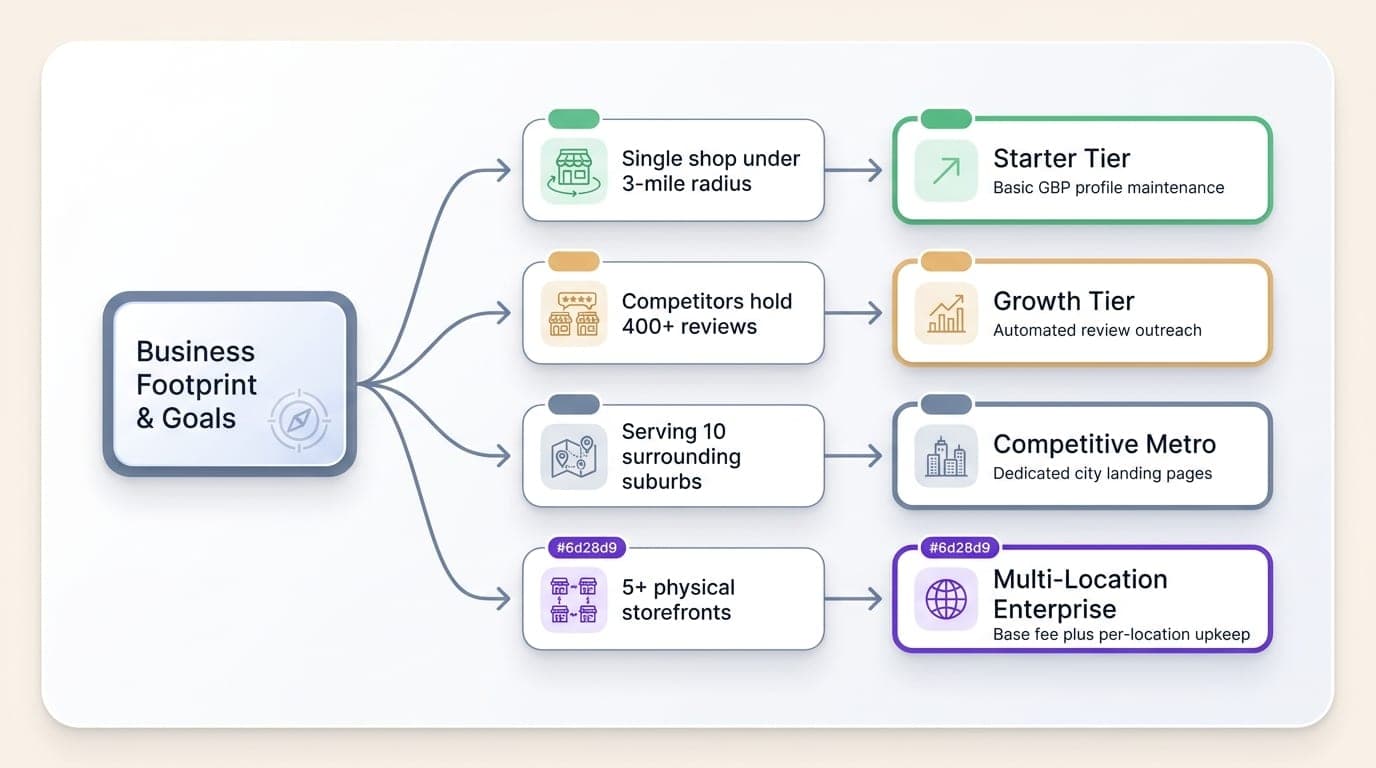
Choosing the wrong service package wastes budget or leaves ranking potential on the table. Use these decision rules to pinpoint the tier matching your operating model.
- Assess your geographic radius: If customers visit your physical shop from within a 3-mile perimeter, a Starter Tier provides sufficient profile maintenance.
- Evaluate competitor review volume: Run a quick local query. If top rivals possess 400+ reviews while you hold 20, choose a Growth Tier that features automated customer outreach per BrightLocal consumer data.
- Audit landing page needs: If you serve 10 surrounding suburbs, you need a plan allocating developer hours to build dedicated city pages using Google's LocalBusiness guidelines.
- Count physical storefronts: Multi-location enterprises should budget base agency fees plus additional monthly fees per location for localized asset upkeep.
- Check internal capabilities: If you employ an in-house webmaster, strip content writing out of the contract and purchase a specialized consulting retainer instead.

I always advise prospective buyers to check the provider's backlink monitoring approach. Legacy plans that ignore localized entity association fall flat, much like outdated search software frameworks discussed in guides to the Ahrefs legacy plan.
My recommendation: if an agency refuses to explain exactly how many hours go toward content creation versus outreach, do not sign their agreement.
Cheap Local SEO Red Flags and Common Traps
Budget packages priced at extremely low rates are almost universally predatory. Quality local marketing requires manual labor, and dirt-cheap providers rely on automated tactics that can trigger permanent suspension of your Google Business Profile.
Over years of reviewing troubled accounts, I consistently spot two mistakes people usually make when contracting local assistance: paying monthly recurring fees for static citation updates, and buying generic national SEO packages that ignore map pack proximity signals.
- Automated directory blast promises: Submitting your site to 500 low-quality directories creates harmful link noise without improving map rankings.
- Guaranteed #1 rankings: Google explicitly warns against providers promising guaranteed placement in the 3-Pack, as local algorithms adjust based on user distance and mobile location.
- Locking your Google Business Profile: Unscrupulous agencies occasionally establish ownership of your profile and refuse to surrender administrative access when you terminate the contract.
- Lack of transparent NAP audit logs: Providers who fail to deliver proof of resolved name, address, and phone inconsistencies often do no manual verification at all.
- Incentivized or fake reviews: Purchasing fraudulent 5-star ratings violates platform terms and risks heavy regulatory fines.
I believe hiring a cut-rate provider is significantly more dangerous than doing nothing at all. Untangling a suspended profile or fixing hundreds of mangled directory records often costs thousands in developer rescue fees.
When scaling local coverage across dozens of distinct neighborhoods, managing localized pages manually quickly becomes unsustainable. Using ProgSEO helps businesses programmatically generate and maintain structured, geo-targeted landing pages based directly on business data.
Most businesses observe initial movement in local map rankings within 60 to 90 days. Highly competitive urban markets or domains undergoing heavy citation cleanup generally require 6 to 9 months of sustained optimization to secure steady top 3-pack positions.
No. Core citation building is primarily a front-loaded baseline task. Once your key listings across primary aggregators and regional directories are clean and synchronized, monthly retainers should shift resources toward review generation, localized content, and local PR.
Yes, if you operate a single storefront in a low-competition area. You can claim your Google Business Profile for free, gather customer reviews manually, and use listing platforms like Semrush Local Base for $30 monthly per location to sync basic directory data.
Onboarding covers exhaustive technical audits, historical duplicate citation removal, tracking pixel installation, and structured data implementation. These manual tasks require 15 to 30 hours of labor before standard monthly maintenance routines begin.
Sources & References
- Search Engine Land — Analysis of local search ranking factors and industry marketing spend benchmarks.
- Wikipedia — Historical background on localized search algorithms and map pack display mechanics.
- Google Business Profile Help — Official guidelines on representing your business accurately on Google properties.
- Schema.org — Structured data markup standards for local business entities and geographical coordinates.
- Semrush Knowledge Base — Documentation detailing Semrush Local Base and Pro plan limits and tracking credits.
- Semrush Pricing — Official pricing page for Semrush Local tools and available workflow add-ons.
- Federal Trade Commission — Legal compliance guides governing commercial endorsements and customer reviews.
- Google Search Central — Technical documentation on implementing local business structured data.
- BrightLocal Research — Consumer survey data detailing customer behavior around local business ratings.