
Professional google seo plans typically range between $1,500 to $15,000+ per month, centering around an industry median monthly retainer of $3,500 according to recent industry pricing benchmarks. The final cost depends directly on existing domain health, market competitiveness, and content volume requirements. Google does not sell organic ranking services directly; agencies and independent consultants deliver these programs to optimize client sites against search algorithms.
▶ Related Video
How Much Do Google Ads Cost? 2026 Price Guide (New Info)
Key Takeaways
- Google never sells rankings. Third-party agencies build campaigns around Google Search Essentials rather than proprietary platform access.
- Retainers dominate agency billing. Approximately 61% of engagements operate on recurring monthly retainers, compared to 22% using project-based contracts.
- Median costs sit at $3,500. Monthly retainers range from $1,500 for small local footprints to more than $15,000 for aggressive national enterprise campaigns.
- Guarantees signal black-hat tactics. Any provider offering guaranteed rankings violates search engine guidelines and risks algorithmic devaluation.
- Timelines require patience. Measurable organic search traction typically demands four to six months of technical fixes and content deployment.
Does Google Sell SEO Plans Directly?
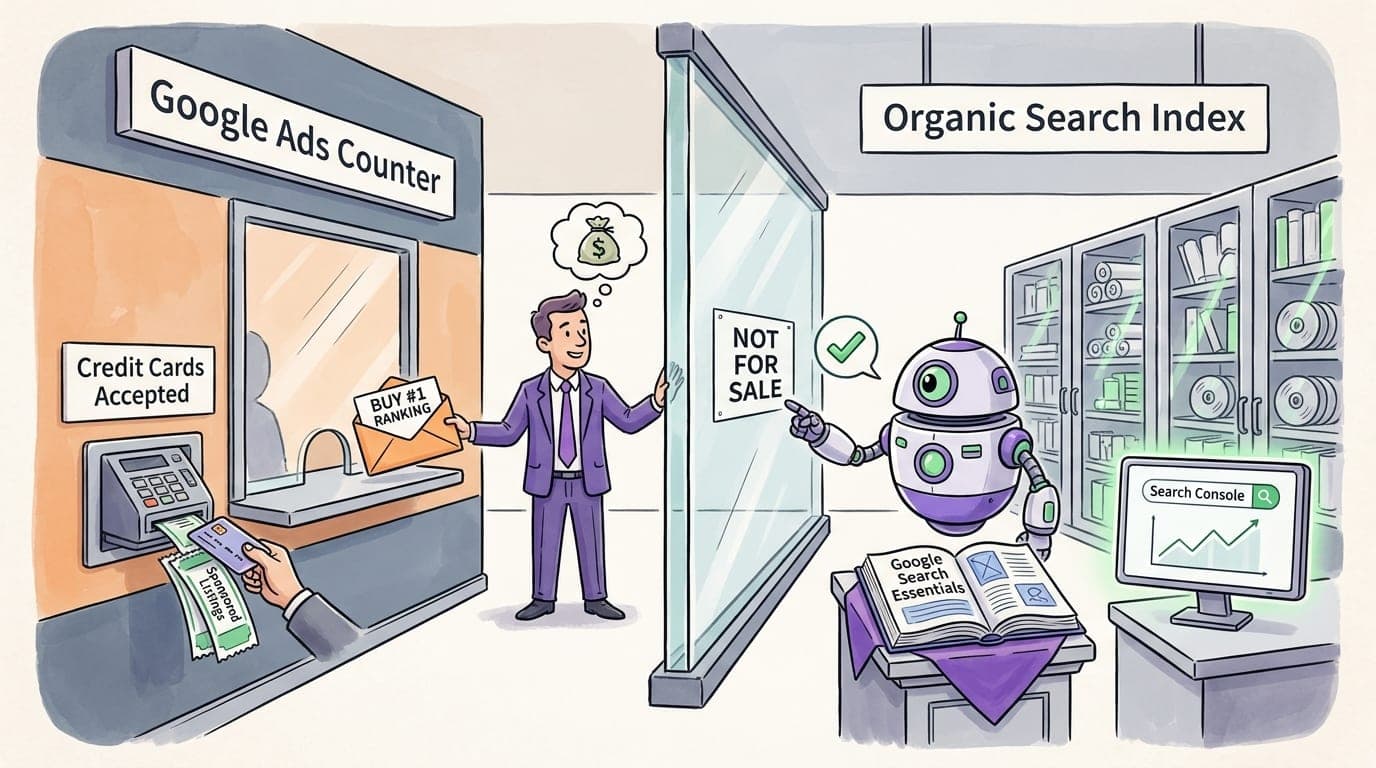
Google does not sell recurring optimization plans, paid search consulting retainers, or managed ranking packages. The search engine generates revenue by serving paid advertisements, keeping its organic index mathematically separate from commercial transactions. When a vendor advertises an official package endorsed by search engine executives, they are misrepresenting their relationship with the platform.
Instead, the company publishes public documentation to govern how crawlers index web pages. In my audits, I guide clients through the Google Search Essentials guidelines, which outline indexation rules, spam prevention measures, and Core Web Vitals standards. Any credible external service builds its tactical playbook on these public parameters rather than private arrangements.
One common mistake business owners make is assuming Google Ads account managers can intervene in organic search results. They cannot. Free diagnostic tools like Google Search Console surface indexing errors, but your team or agency must implement the necessary fixes.
- Google Search Console: Provides direct data on index coverage, search queries, and click-through rates.
- Google SEO Starter Guide: Outlines baseline technical structures and metadata standards through the Google SEO Starter Guide.
- PageSpeed Insights: Measures real-world user performance based on Core Web Vitals metrics.
- Rich Results Test: Validates structured data markup against standard Schema specifications.
If you operate a smaller DIY website, you might compare standard hosting add-ons like a GoDaddy SEO plan or a built-in Wix SEO plan before turning to custom retainers. In my view, Google's complete refusal to sell organic placement packages is the single best protection against pay-to-play monopolization of search results.
Typical Pricing Tiers for Monthly Retainers in 2026
Monthly retainer agreements define most professional optimization partnerships.
Their research shows that 61% of engagements use the monthly retainer model, while 22% use project-based pricing, 11% use performance-based or hybrid pricing, and only 6% rely on hourly-only billing. Furthermore, 42% of agencies offer multiple pricing models per client to accommodate different technical requirements.
$3,500
Median Monthly Retainer
$150/hr
Average Specialist Rate
61%
Use Monthly Retainers
$82B
2026 US Market Value
Broader industry survey data confirms this structure. They report an average US monthly SEO retainer of $2,917, while 68.8% of providers charge $2,000 per month or less. Among dedicated agencies, they found an average agency monthly retainer of 3,209 dollars, with 78.2 percent using monthly retainers as their primary model and an average agency hourly rate of 99 dollars.
| Plan Tier | Monthly Cost Range | Median Pricing | Target Website Profile |
|---|---|---|---|
| Local Business Tier | $1,500 – $2,500 / month | $2,000 / month | Single-location service companies, regional brick-and-mortar storefronts |
| Mid-Market Tier | See pricing page | $3,500 / month | B2B lead generation, growing regional brands, boutique e-commerce |
| Enterprise Tier | $7,500 – $15,000+ / month | See pricing page | Complex SaaS platforms, national e-commerce catalogs, media publishers |
| One-Time Technical Audit | See pricing page | $7,500 one-time | Domains undergoing migrations, CMS shifts, or deep architectural rebuilds |
Market rates shifted over recent seasons. Mid-market packages saw an average monthly retainer decrease from 2024 at mid-market tier of -8%, while high-end accounts experienced an enterprise tier price increase from 2024 of +12%. In my opinion, this divergence occurred because workflow automation lowered costs for routine deliverables, while complex enterprise codebases require far more senior engineering hours.
Standard Plan Deliverables and Service Inclusions
A credible optimization campaign balances code cleanliness, content production, and authority development. When reviewing scopes of work, I check whether the agency clearly delineates who writes code and who writes copy. Without clear execution ownership, deliverable roadmaps stall within weeks.

Modern workflows heavily integrate programmatic tools and editorial models. Industry data indicates that 73% of agencies include AI-assisted deliverables in standard packages, especially for content briefs and metadata drafts. If you monitor local citations, teams often deploy platforms like BrightLocal plans alongside manual citation audits.
- Technical health audits: Resolving crawl traps, internal redirect chains, canonicalization errors, and XML sitemap bugs.
- On-page optimization: Refining header hierarchy, internal link structures, and target term placement across priority landing pages.
- Content strategy and production: Publishing authoritative guides that solve specific informational intent without bloat.
- Digital PR and outreach: Securing earned references on relevant trade websites rather than purchasing automated directory links.
- Local profile management: Optimizing Google Business Profile data, category tags, and geo-targeted service pages.
Standalone fixed-fee projects address isolated challenges outside recurring agreements. According to October 2026 benchmarks from Digital Applied, agencies charge a median technical audit cost of $7,500, an average site migration cost of $15,000, and an average content strategy project cost of $8,000.
- Pre-migration site mapping: Ensuring historical URLs maintain 301 redirects to new destinations to preserve accumulated equity.
- Algorithmic recovery plans: Pruning thin, unhelpful pages after manual or algorithmic visibility drops.
- Content gap analyses: Evaluating competitor topical authority using tools like Surfer SEO plans to outline editorial pipelines.
E-commerce stores selling across third-party marketplaces often review alternative plans like the eRank free plan for tag optimization. I strongly believe that any agency dedicating less than 30% of its initial retainer hours to technical infrastructure is setting up its content marketing to underperform.
Primary Drivers Behind Service Costs and Scope
Pricing variance between different service providers stems from target query competition, existing technical debt, and geographic footprint. A local veterinary clinic competing in a suburban zip code requires far fewer structural changes than an enterprise fintech company fighting for global software queries.

A second major mistake businesses make is selecting an agency purely on the lowest hourly rate. An offshore contractor who takes thirty hours to diagnose a JavaScript crawling error costs more than an experienced specialist charging the average specialist hourly rate of $150/hr who fixes it in two hours.
- Website architecture scale: A site with 100,000 indexed URLs requires automated log analysis and custom crawl scripting.
- Legacy technical debt: Fixing multiple CMS migrations, nested redirects, and broken database endpoints inflates initial audit costs.
- Vertical competitive density: Highly lucrative sectors like insurance or personal injury demand aggressive digital PR to compete.
- In-house resource access: Agencies charge higher fees when they must write custom frontend code rather than supplying Jira tickets.
Site architecture complexity multiplies execution timelines. Implementing valid structured data following Schema.org vocabularies requires precise engineering across varied CMS templates. In my experience, investing upfront in clean code infrastructure yields far cheaper long-term organic growth than continuously paying for remedial page rewrites.
Red Flags and Low-Quality Plan Warning Signs
Low-cost optimization packages frequently employ automated, dangerous shortcuts. When an agency sells cheap link packages or guarantees immediate placement, they put your primary business asset at risk of severe algorithmic or manual penalties.
The search ecosystem penalizes manipulative tactics. Reviewing Google's published Spam Policies shows that link networks, doorway pages, and scraped content generate swift domain demotions. Once a domain receives an algorithmic demotion, recovery often takes several core update cycles.
- Guaranteed rankings: Nobody controls Google's algorithmic ranking systems or can promise a #1 search spot.
- Private blog networks (PBNs): Low-grade blog networks built for outbound links inevitably trigger spam flags.
- Withholding account access: Trustworthy agencies work inside your existing Google Search Console and Google Analytics accounts.
- Undisclosed link building: Refusal to disclose where your domain references and backlinks are being placed.
- Rigid 12-month lock-ins: Contracts with zero performance milestones or opt-out provisions suggest low deliverable accountability.
In my opinion, if an agency sales representative claims their team possesses special inside connections at Google, terminate the conversation immediately. Independent industry reporting from publications like Search Engine Land consistently proves that genuine search success comes from methodical technical hygiene and useful information architecture.
How to Evaluate Providers and Project Timelines
Meaningful organic growth requires sustained implementation over several quarters. In most competitive niches, search algorithms require four to six months to re-crawl, index, and recalculate quality signals across updated domain architectures.

When interviewing prospective providers, ask targeted questions about execution rather than theoretical concepts. A strong team explains how they measure Core Web Vitals alongside accessibility standards set by the World Wide Web Consortium.
- What does the initial 90-day roadmap include? Expect deep technical auditing and index pruning before content publishing.
- How do you document changes? Teams should log all URL modifications, redirects, and meta updates in a shared repository.
- What KPIs define monthly reporting? High-performing partners track organic impressions, qualified pipeline leads, and non-brand clicks.
- Who performs hands-on technical work? Confirm whether senior strategists or junior outsourced contractors execute the deliverables.
I consider a six-month initial commitment reasonable for mid-market campaigns. However, an agency that refuses to provide unvarnished Search Console access or skips scheduled sprint reviews during that window should be dismissed without hesitation.
When evaluating long-term execution, scalable page generation helps bridge the gap between technical strategy and content velocity. Platforms like ProgSEO allow teams to programmatically build search-optimized pages from structured data without bloated agency management overhead.
No. Google does not sell organic search packages, optimization consulting retainers, or keyword ranking services. All commercial plans are offered by third-party digital agencies, software providers, or independent consultants.
Monthly retainers typically range from $1,500 to $15,000+ per month, with an industry median of $3,500 per month according to benchmarks checked in October 2026. Local plans average $1,500 to $2,500, while enterprise retainers frequently exceed $7,500 per month.
A standard plan includes technical site audits, Core Web Vitals remediation, on-page optimization, content creation, digital PR or link building, and monthly Search Console reporting.
Most websites see initial ranking movement within three to four months, with compounding organic traffic growth typically materializing between six and twelve months of consistent implementation.
Sources & References
- Digital Applied — US SEO services market pricing benchmarks and project costs as of October 2026.
- Digital Success — Agency hourly rates and monthly retainer distributions checked in October 2026.
- Google Search Essentials — Official search engine guidelines for crawling, indexation, and ranking requirements.
- Google SEO Starter Guide — Foundational documentation on URL architecture and meta data best practices.
- Google Search Console — Native diagnostics for index coverage, click data, and organic search impressions.
- Google Spam Policies — Official search standards prohibiting link schemes, doorway pages, and scraped content.
- Search Engine Land — Industry analysis covering core algorithm updates and organic marketing practices.
- Schema.org — Structural vocabulary standards for entity recognition and rich search results.
- World Wide Web Consortium — Global standards for web accessibility, markup validation, and technical architecture.