You've just spent hours crafting the perfect blog post, but when you search for it on Google, your link is buried on page five with a messy, cut-off title. Think of your website like a physical store on a busy street. The text people see in search results — known as your Title Tag — is the sign above your shop door, which is often completely different from the main Headline sitting at the top of your actual webpage. If that digital sign is boring or confusing, potential customers will simply walk right past your business to visit the competitor next door.
Getting people to stop and click comes down to a crucial metric called Click-Through Rate (CTR), which represents the percentage of searchers who actually choose your link. According to widespread search industry data, moving up just one spot in Google search results can boost your traffic by over 30%, but only if your title is both highly searchable and instantly clickable.
That is exactly where a smart digital tool steps in to act as your professional shortcut. Using an SEO title generator is like having predictive text for your marketing — you provide the topic, and it instantly suggests the best ways to phrase it for both human readers and search algorithms. Increasing organic click-through rate with headlines doesn't require a marketing degree, but rather the right strategy to make your first impression count.
The 60-Character 'Sweet Spot' for Search Visibility
You finally wrote the perfect headline for your new website, but when you search for it, the text trails off into an awkward '...' instead of finishing your thought. This happens on the Search Engine Results Page (SERP) — the actual page of blue links Google shows after a search. When your title is too long, search engines chop off the end, a problem known as truncation. It looks unprofessional and often makes people scroll right past your site.
The reason behind this cut-off comes down to pixel-width — the physical space each letter takes up on a screen. Still, if you are wondering how many characters an SEO title should be, sticking to a proven formula is your best defense against missing words. Here is your quick-reference checklist:
- Google desktop limits: About 600 pixels wide (roughly 60 characters).
- Mobile limits: Often slightly longer, but screen sizes vary wildly.
- The 'safe zone': Keep it between 50 and 60 characters for maximum visibility.
Guessing if your text will fit can be frustrating, especially since fixing truncated title tags in search results means waiting days for Google to update your link. Instead of crossing your fingers, running your text through a SERP preview tool for mobile devices lets you preview exactly how your link will look on a smartphone before you hit publish.

How SEO Title Generators Turn Keywords into Click-Magnets
Staring at a blinking cursor while trying to condense an entire article into 60 characters is a frustrating way to end your writing process. Instead of wasting hours trying to brainstorm the perfect hook, successful content creators use a shortcut: an SEO optimized title generator. Think of this tool as an expert marketing assistant that uses pattern matching. It doesn't just guess what sounds good; it analyzes millions of successful search results to find the exact phrasing frameworks that already make people click.
To get the most out of a blog title maker, you need to match the tool's output to User Intent — which is simply a fancy way of describing what the person searching actually wants to achieve. Generating titles that answer that specific searcher need takes just three simple steps:
- Input your core topic: Give the generator a clear, basic keyword phrase (like 'easy vegan recipes' or 'winter car maintenance').
- Select your tone: Tell the tool if you want a result that sounds educational, exciting, or professional to match your brand.
- Refine the output: Review the generated options, pick the one that best matches your content, and tweak any awkward phrasing so it sounds entirely human. You can also run it through a text case converter to ensure your capitalization is consistent and looks professional in search results.
Once you adopt this streamlined workflow, an SEO title generator transforms a tedious chore into a creative advantage. You instantly gain dozens of clickable, professional options that capture attention without exceeding strict character limits.
Why 'Left-Loading' Your Keywords Boosts Your Rank
Imagine a librarian skimming thousands of book spines in seconds to find a specific category. Search engines work similarly when scanning your website. They assign the most importance to the very first words they read, moving from left to right. This strategy, known as 'left-loading,' ensures Google's crawlers immediately grasp your topic. Instead of hiding your main idea at the end of a sentence, proper semantic keyword placement in title tags puts those critical terms front and center.
“Instead of 'Five Simple Tips for Better Dog Training,' a left-loaded version becomes 'Dog Training: Five Simple Tips for Better Results.'”
Real people behave remarkably like these search algorithms when browsing online. When looking at a page of search results, our eyes naturally scan down the left side of the screen, hunting for the exact phrase we just typed. If your primary term is buried late in the headline, a hurried reader will likely scroll right past your link. An SEO title tag generator handles this eye-tracking behavior automatically.
Cramming every related search term into the front of your headline might seem tempting, but this common SEO title mistake actually hurts your visibility. Effective title optimization requires a careful balance between search engine rules and human appeal. You must position your core topic early to prove relevance to the bots, while using the remaining characters to persuade the actual person to click.
Using Power Words to Trigger Emotional Marketing Value
Getting a search engine to display your link is only half the battle; now you need actual humans to choose your page over the competitors. This is where the Emotional Marketing Value (EMV) of headlines comes into play. Think of it like a storefront window display. Even if your shop is on the busiest street (page one of Google), a boring window will not bring customers inside. EMV measures how strongly your words connect with a reader's feelings, turning a casual glance into an eager click.
Creating that connection relies heavily on the 'Curiosity Gap' — the sweet spot between what your audience currently knows and what they desperately want to learn. To bridge this gap without resorting to spammy clickbait, writers use specific vocabulary triggers. If you struggle to brainstorm these naturally, a modern catchy title generator can instantly weave these compelling words alongside your left-loaded keywords.
Try keeping this categorized power-word cheat sheet handy for your next post:
⚡
Urgency — Drives Immediate Action
Now, Today, Instant, Quick, Fast, Limited, Don't Miss
🏆
Authority — Builds Instant Trust
Proven, Expert, Complete, Ultimate, Guaranteed, Definitive
🎯
Curiosity — Opens the Loop
Secret, Hidden, Surprising, Little-Known, Revealed, Inside
💡
Value — Promises a Payoff
Free, Effortless, Simple, Easy, Step-by-Step, Beginner-Friendly
Aligning Your H1 Tags with Meta Titles for SEO Harmony
Imagine walking into a bakery whose sign promises 'Fresh Sourdough,' only to find a menu offering generic white bread. This frustration happens online when you confuse your Meta Title with your H1 Tag (the main headline inside your page). The Meta Title appears as the clickable link in search results, representing your off-page SEO efforts to attract clicks from the outside world. Conversely, the H1 tag is an on-page SEO element — the actual text visitors see once they arrive.
Bridging the gap between that outside sign and the inside menu creates a seamless experience for your readers. When a visitor clicks your link, they need instant reassurance they landed in the right spot. You want these two elements to be close cousins, not identical twins. If your Meta Title is '10 Easy Gardening Tips,' your H1 might say 'Simple Hacks for Your First Garden,' ensuring the bold promise perfectly matches the actual delivery.
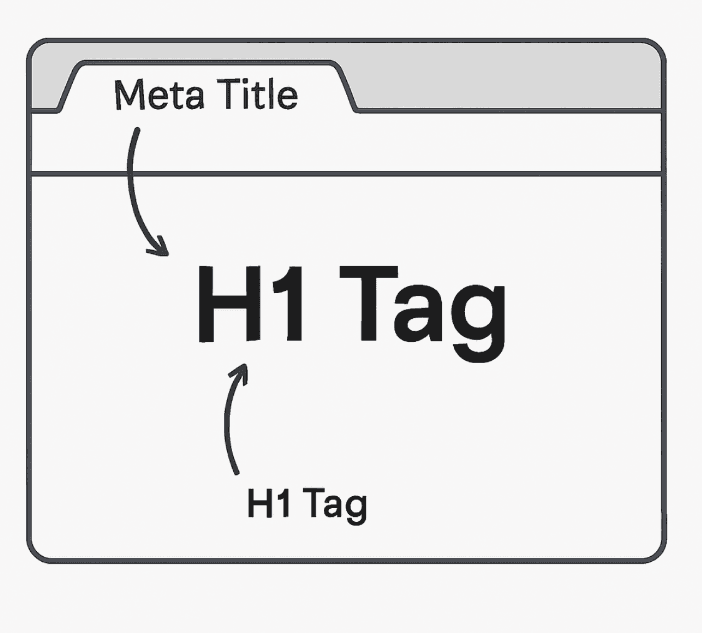
Search engines appreciate this natural variation because it provides deeper context about your specific topic. Slightly altering these phrases also assists in avoiding duplicate title tag penalties, which sometimes occur when website builders force identically copied titles across your code. Mastering this harmonious balance builds instant trust with algorithms and humans alike.
Your Success Roadmap: A Step-by-Step Headline Crafting Checklist
You used to wonder why your brilliant content stayed hidden on page five of search results. Now, creating compelling meta titles for blog posts isn't a guessing game. You hold the blueprint to write digital storefront signs that actively invite searchers inside.
Putting this into practice is simple. Pick a topic, let the generator spark ideas, and refine the suggestions. Before hitting publish on your next post, run your title through this final checklist:
- Keyword presence: Is your main topic near the front?
- Character count check: Is it within the 50–60 character sweet spot?
- Power word inclusion: Did you add a relatable emotional trigger?
- Mobile preview: Will it look readable on a smartphone screen?
- Intent match: Does the title accurately promise what your content delivers?
Try running an older, low-traffic page through this checklist today to begin improving its search visibility. Each time you optimize a title, you build confidence and take control of your website's performance. Your hard work deserves to be seen — go turn those passing scrollers into eager readers.
Generate Perfect SEO Titles in Seconds
Stop guessing and start ranking. Our SEO Title Generator instantly creates click-worthy, keyword-optimized titles tailored to your topic — no copywriting degree required.
- Left-loaded keywords for maximum search visibility
- Power words baked in for higher click-through rates
- Character count validation so you never get truncated
Frequently Asked Questions
An SEO title generator is a tool that takes your core topic or keyword as input and automatically suggests multiple title options optimized for both search engines and human readers. It applies proven frameworks — like left-loading keywords, power words, and character limits — to produce click-worthy headlines instantly.
The ideal SEO title length is between 50 and 60 characters. Google truncates titles that exceed approximately 600 pixels in width (roughly 60 characters). Staying within this range ensures your full title appears in search results without an awkward '...' cut-off.
The Meta Title is the clickable link text displayed in Google's search results — it's what attracts clicks from the outside. The H1 tag is the main headline visible on your actual webpage once a visitor arrives. They should be related but not identical; slight variation gives search engines more context.
Yes. Search engines give more weight to words that appear earlier in a title. 'Left-loading' your primary keyword — placing it near the beginning — signals to Google exactly what your page is about. This increases relevance for that query and can improve your ranking position.
Power words are emotionally charged terms (like 'proven,' 'ultimate,' 'instant,' or 'secret') that trigger psychological responses in readers. Adding one well-placed power word to your title can significantly boost your click-through rate by making your link feel more compelling than competing results.
No — using identical title tags across multiple pages creates duplicate content signals that can hurt your rankings. Each page should have a unique Meta Title that accurately describes its specific content, and a slightly varied H1 that reinforces the topic for on-page visitors.