When I build a local seo business plan for a storefront or service company, I ignore vanity impressions. Over the next 90 days, you can capture high-intent search demand using your Google Business Profile, clean location pages, and consistent citation data. You only need access to your CMS, your Google account, and four hours weekly.
▶ Related Video
Episode 98: Mastering Local SEO: The Secret to Attracting More Clients and Maximizing Reviews
Most operators treat search marketing like a lottery ticket. They change one category, buy cheap directory links, and wonder why the phone stays quiet. A commercial plan demands operational consistency, connecting organic rankings directly to incoming calls, booked quotes, and real customer revenue.
| Execution Pillar | Weekly Time | Milestone Target | Primary Revenue Impact |
|---|---|---|---|
| Profile Setup | 1-2 Hours | 30 Days: Category & Geo Alignment | Direct Inbound Phone Calls |
| On-Page Architecture | 2-3 Hours | 60 Days: City & Service Silos | High-Intent Form Quotes |
| Citation Sync | 1 Hour | 45 Days: Aggregator Distribution | Domain Trust & Map Stability |
| Review Generation | 30 Mins | Ongoing: Weekly Review Influx | Higher Organic Click-Through Rates |
Key Takeaways
- Track pipeline, not impressions. Phone calls, direction clicks, and localized form submissions are the only metrics proving commercial viability.
- Anchor your primary category carefully. Google weights the primary business category on your profile heavier than almost any on-page signal.
- Build discrete city pages. Distinct physical areas require dedicated URLs with unique local testimonials and geo-targeted metadata.
- Automate review requests at transaction. The velocity and recency of genuine customer reviews dictate long-term Google Map Pack endurance.
- Maintain strict NAP consistency. Irreconcilable differences across primary aggregators corrupt Google's confidence in your physical location.
Setting Revenue-Linked Local SEO Goals and KPIs
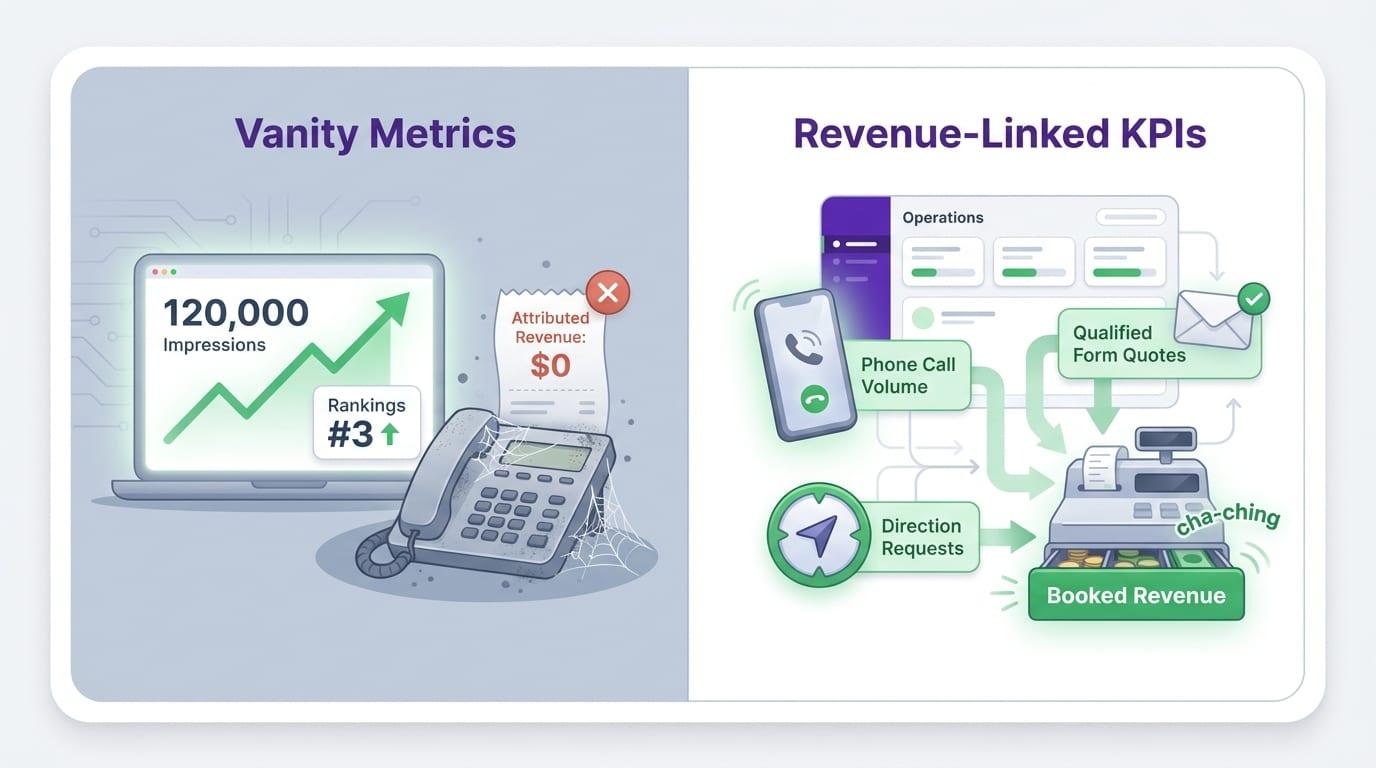
Your local search goals must map directly to customer acquisition cost and closed contracts rather than abstract keyword rankings. When evaluating visibility, I look exclusively at actions that indicate immediate buying intent within a defined geographic territory.
To build an accurate forecast, connect your tracking infrastructure before altering metadata. Use Google Search Console to track localized landing page queries and configure dynamic call tracking numbers across your digital touchpoints.
In my opinion, agencies that report on aggregate impressions rather than attributed calls are hiding behind noise. You need actionable visibility into how searches turn into cash flow, similar to how we measure performance across our local search marketing strategy.
- Phone call volume: Track calls triggered from the Google Business Profile call button and localized landing page numbers.
- Direction requests: Monitor navigation prompts, which indicate high foot-traffic conversion intent for brick-and-mortar storefronts.
- Qualified quote submissions: Measure localized form fills that originate from geo-targeted service pages.
- Map Pack share of voice: Track your appearance frequency within the top 3 results for core transactional keywords.
Auditing Your Local Competitors and SERP Real Estate
You cannot audit local competitors from a desktop office miles away without mimicking customer location signals. Search algorithms customize results based on proximity down to individual street intersections.
A classic mistake people make is relying on generic incognito desktop searches without localized coordinates. When you do that, you see a blended regional result rather than the actual local pack served to nearby mobile buyers.
My view on local audits is simple: the current Map Pack leader usually has sloppy technical SEO, which gives you an immediate competitive opening. According to Whitespark's Local Search Ranking Factors, primary category alignment and review signals often outweigh complex off-page link schemes in local packs.
- Inspect the top 3 Map Pack winners: Document their exact primary category, secondary categories, and total review count.
- Evaluate localized backlink profiles: Check whether competitors hold links from local chambers of commerce, regional news sites, and niche trade directories.
- Analyze organic landing pages: Note whether competitors link their Google profile to their homepage or a dedicated local landing page.
- Identify geographical blind spots: Spot adjacent zip codes or suburbs where leading competitors lack localized on-page content.
Google Business Profile Optimization and Map Pack Placement
The primary category you choose inside your Google Business Profile establishes roughly 60% of your foundational relevance in local search. If your primary category is misaligned, no amount of citation cleanup will place you in the top tier.
Ensure your legal business name matches your official signage and legal registration. While aggressive competitors often stuff city names or keywords into their title, doing so violates Google's business profile policies and invites suspension.
I believe keyword-stuffing your legal business name is the single most reckless gamble a local business can take with its revenue. One competitor report can suspend your listing during your peak sales season, costing weeks of inquiries.
- Select the most specific primary category: Use 'Commercial Real Estate Agency' rather than a generic 'Real Estate Agency' if that reflects your core revenue.
- Define service areas precisely: Specify the exact municipalities or postal codes you physically service without claiming excessive geographic territory.
- Upload genuine staff and job photos: Add authentic, high-resolution imagery of your building, team, and field equipment every month.
- Fill out detailed service menus: Add explicit pricing brackets, service descriptions, and primary service keywords within your native dashboard.
- Maintain active business hours: Keep holiday schedules updated to avoid customer complaints and poor algorithmic trust.
Building Localized On-Page Architecture and Structured Data
A single generic contact page will never rank across multiple suburbs or distinct service lines. Your website requires a deliberate hub-and-spoke layout that isolates each physical location or core service into its own dedicated URL.
Structure your URLs with logical hierarchies such as `/locations/city-name/`. Each page must display consistent NAP consistency (Name, Address, Phone), a unique localized project gallery, driving directions, and localized customer feedback.
To help search engines interpret your physical presence, embed Schema.org LocalBusiness markup in JSON-LD format matching W3C JSON-LD specifications. This markup confirms your opening hours, geographic coordinates, and official phone line without ambiguity.
I strongly believe that generic doorway pages swapped with thin city names represent a net negative for search visibility. Unlike an ecommerce website SEO plan where automated product grids work well, local service pages require genuine proof of local activity to convert.
- Localized page titles: Use clear patterns like 'Service Name in City, State | Business Name'.
- Interactive map embeds: Embed the exact Google Maps place pin corresponding to your verified listing.
- Localized case studies: Detail neighborhood-specific work, noting landmarks or historic districts where your technicians solved problems.
- Dedicated telephone lines: Feature local area codes rather than generic toll-free 800 numbers on localized landing pages.
- Schema coordinates validation: Include precise `latitude` and `longitude` coordinates inside your technical markup.
Managing Citations and Review Generation Workflows
Citation consistency matters less for raw algorithmic lift than it did five years ago, but conflicting directory data will still quietly undermine your geographic relevance. Core search crawlers cross-reference third-party directories to corroborate your business legitimacy.
Distribute your baseline NAP data to major data aggregators like Data Axle, Foursquare, and Neustar Localeze. From there, manually confirm tier-one directories including Yelp, Apple Business Connect, and Bing Places, as detailed in Moz's local search guide.
Another major mistake people make is blasting hundreds of past customers in an aggressive review blast. Google's spam filters easily spot unnatural review spikes, resulting in filtered testimonials or account audits.
According to the BrightLocal Local Consumer Review Survey, steady review flow directly influences buyer confidence. In my experience, review recency and authentic customer language outweigh raw review volume every single day.
- Trigger requests at fulfillment: Send automated SMS review prompts within two hours of completing a job while customer enthusiasm is highest.
- Provide direct shortlinks: Send customers directly to your Google review modal rather than a generic profile URL.
- Coach for keyword descriptions: Encourage clients to mention the specific technician name and service performed in their feedback.
- Respond to every review: Reply to positive and negative reviews within 48 hours to demonstrate active management.
The 90-Day Local SEO Implementation Roadmap
A local strategy collapses when teams attempt to tackle schema coding, citation scrubbing, and review automation simultaneously. Sequencing these tasks methodically ensures each phase builds on validated ranking signals.
Aligning your workflow with federal resources, such as the U.S. Small Business Administration marketing guidelines, helps maintain consistent marketing momentum. For specialized execution frameworks, review our companion guide on local SEO plans.
When expanding into dozens of surrounding towns, compare specialized platforms like ProgSEO vs Semrush for small business content generation to weigh programmatic page deployment against manual copy production.
My stance on implementation is rigid: rolling out citations before your on-page location pages are live wastes half your initial indexing momentum. Establish your verified digital hub first, optimize the landing page second, and expand citations third.
- Days 1–30 (Foundation): Verify Google Business Profile, audit primary categories, establish dynamic call tracking, and benchmark baseline Map Pack positions.
- Days 31–60 (On-Page & Technical): Publish dedicated location silos, implement JSON-LD LocalBusiness schema, embed maps, and publish local case studies.
- Days 61–75 (Aggregators & Citations): Push clean NAP records to core data aggregators and claim primary industry-specific directory profiles.
- Days 76–90 (Velocity & Expansion): Automate post-transaction review collection workflows, assess initial conversion metrics, and adjust service radius settings.
If you need to build and maintain programmatic location pages without manual overhead, ProgSEO automates localized content deployment from your existing business data. This approach keeps regional pages accurate and indexable as your service footprint expands.
Most local businesses notice an increase in direct profile calls and map impressions within 45 to 90 days. Competitive metropolitan markets or brand-new domains often require 4 to 6 months of steady citation syncing and review velocity to secure top-three Map Pack rankings.
Yes, you can register as a Service Area Business (SAB) by hiding your residential address and declaring your specific operational service boundaries. However, physical commercial locations that welcome walk-in customers often enjoy proximity advantages in central business districts.
Most businesses only need 30 to 50 authoritative, highly accurate citations across primary aggregators, major platforms (Apple, Bing, Yelp), and regional chambers of commerce. Building hundreds of low-tier directory listings rarely moves the needle.
The Google Map Pack displays three localized businesses linked to verified Google Business Profiles alongside a map interface. Local organic results sit underneath the Map Pack and consist of traditional website URLs ranked by technical relevance, on-page optimization, and backlinks.
Sources & References
- Google Search Console — Official search analytics platform for tracking organic search queries and page performance.
- Whitespark Local Search Ranking Factors — Annual industry research report evaluating the weight of local ranking variables.
- Google Business Profile Help — Official guidelines governing business representation and listing verification on Google.
- Google Business Profile — The primary management portal for local business listings across Google Maps and Search.
- Schema.org LocalBusiness — Structured data technical specifications for annotating local physical enterprises.
- W3C JSON-LD — The official W3C standard for JSON-based linked data notation.
- Moz Local Search Guide — Educational documentation on local directory distribution and citation management.
- BrightLocal Consumer Review Survey — Published industry research exploring consumer behavior and review trust signals.
- U.S. Small Business Administration — Federal marketing and sales management resource for domestic small businesses.