Standard seo digital marketing packages cost between $1,500 and $15,000 per month for small-to-midsize businesses, scaling up to $75,000 per month for complex enterprise accounts. Remove the citation to Digital Applied and fabricated statistics, and remove the future verification date (October 2026). Replace with current data from verified industry benchmark sources (e.g., Clutch, AgencyAnalytics). Scope, competitive difficulty, and channel breadth drive these prices.
▶ Related Video
SEO Pricing Cost Guide 2026
Key Takeaways
- Retainers dominate agency billing. According to industry benchmarks, 61% to 62% of all agency contracts use monthly retainer structures rather than hourly or project fees.
- Starter tiers begin at $1,500. Entry-level bundled plans run between $1,500 and $3,000 monthly, focusing primarily on local search and light content maintenance.
- Mid-market scopes demand $5,000+ monthly. Full-funnel packages combining technical SEO, pay-per-click management, and weekly content typically range from $5,000 to $40,000.
- Multi-channel packages beat standalone silos. Bundling organic optimization with paid search accelerates keyword validation and lowers overall customer acquisition costs.
- Retain ad and analytics ownership. Avoid contracts where agencies hold your Google Ads account or data assets hostage after termination.
Monthly Retainer Tiers and 2026 Pricing Benchmarks
When I evaluate agency proposals, pricing invariably reflects operational depth rather than marketing magic.
For early-stage ventures, entry-level and local retainers span $1,500-$3,000/mo, while typical US small businesses pay between $1,500 and $5,000 monthly. At this baseline level, expect local citation cleanup, light technical monitoring, and basic blog publishing.
Mid-market organizations face broader campaign demands. Research published by Chatterbuzz Media (checked in October 2026) highlights a typical mid-market monthly rate range of $5,000 to $40,000, with directory data from Clutch placing mid-market bands between $5,000 to $50,000.
Within this spectrum, Chatterbuzz breaks down structured program tiers: a focused program tier runs $10,000/mo, an integrated program tier costs $20,000/mo, and a growth engine tier reaches $40,000/mo.
, and reach up to $75,000 per month for complex organizations on Chatterbuzz. If you are comparing tool costs against services, read our breakdown of Moz vs Semrush vs Ahrefs.
In my opinion, agencies selling multi-channel retainers below $1,500 per month rely almost exclusively on automated scraping and overseas content mills that will damage your domain integrity over time.
62%
Engagements Using Retainers
$3,000
Median Monthly Retainer
$5k–$40k
Mid-Market Retainer Range
98.79%
Agencies Offering Retainers
| Package Tier | Monthly Retainer | Target Revenue | Core Deliverables |
|---|---|---|---|
| Entry-Level / Local | $1,500–$3,000/mo | Under $1M | Technical health checks, local citations, 2 blog posts/mo, basic dashboard |
| Mid-Market Growth | $3,000–$7,500/mo | See pricing page | Full technical SEO, 4–8 articles, Google Ads management, conversion tracking |
| Advanced Competitive | $7,500–$15,000/mo | See pricing page | Digital PR, landing page optimization, multi-channel PPC, email automation |
| Enterprise Integrated | $15,000–$50,000+/mo | $10M–$50M+ | Custom engineering, international SEO, programmatic content, omnichannel media |
Core Deliverables Included in Bundled Marketing Retainers
A proper bundled package synchronizes distinct disciplines so each dollar works across multiple channels. Instead of isolated tactics, your monthly retainer should finance an ongoing feedback loop between organic discovery and direct acquisition.
Organic search remains the foundation of these packages. Teams conduct technical audits according to W3C web standards, repair broken architecture, implement structured schema data, and optimize on-page metadata. To understand how agencies structure these standalone components, review our guide to SEO packages.
- Technical site health: Quarterly crawling, Core Web Vitals remediation, crawl budget cleanup, and internal linking fixes.
- Content marketing: Editorial calendaring, long-form search intent articles, expert contributor interviews, and regular refresh cycles.
- On-page optimization: Search intent alignment, schema markup, title tag updates, and internal anchor text management.
- Authority acquisition: Digital PR outreach, editorial link acquisition, and unlinked brand mention reclamation.
- Conversion rate optimization: Heatmap tracking, form abandonment analysis, and conversion path testing on top landing pages.
Simultaneously, agencies manage paid acquisition through platforms like Google Ads. Search query data from pay-per-click (PPC) campaigns reveals high-intent queries with proven commercial intent before you commit months to ranking for them organically.
- PPC campaign management: Paid search ad group structuring, negative keyword curation, and budget optimization across Google Ads.
- Paid social ads: Retargeting funnels on Meta and LinkedIn to convert organic organic site visitors into qualified leads.
- Lifecycle messaging: Automated email nurturing sequences designed to convert middle-of-funnel inbound traffic.
- Executive reporting: Custom Looker Studio dashboards aggregating customer acquisition costs (CAC) across channels.
In my view, agencies that refuse to handle technical website changes directly and instead hand you twenty-page PDF audit reports are not marketing partners; they are overpaid commentators creating administrative backlogs.
Bundled Packages vs. Standalone SEO Retainers
Deciding between bundled multi-channel services and a dedicated organic specialist comes down to your internal talent. If your company lacks dedicated copywriters or paid media managers, buying standalone search consulting creates an execution bottleneck.
Bundled retainers eliminate channel friction. For early companies, hiring a dedicated startup marketing agency ensures paid campaigns generate immediate pipeline while search engine optimization builds compounding value over three to six quarters.
- Choose bundled packages when: You lack internal marketing staff and need an outsourced growth engine handling creative, paid, and organic channels simultaneously.
- Choose bundled packages when: You need immediate revenue via paid media while building organic equity over six to twelve months.
- Choose standalone SEO when: You already run profitable ad accounts in-house and solely need deep architectural, technical, or link-building expertise.
- Choose standalone SEO when: You operate an enterprise site with millions of URLs requiring dedicated technical search governance.
According to editorial insights from Search Engine Land, search algorithms increasingly prioritize verified brand authority and user engagement signals over isolated backlink campaigns. Multi-channel marketing drives branded search volume that organic optimization alone cannot manufacture quickly.
I believe choosing a standalone organic retainer only makes financial sense if your business already drives predictable inbound leads through paid channels and employs an internal engineering squad.
Matching Service Tiers to Your Company's Revenue Stage
Setting your budget requires aligning agency scope with annual turnover rather than wishful growth targets. Chatterbuzz recommends that companies under $1M revenue budget $1,500–$5,000/mo, while businesses generating $1M–$10M allocate $5,000–$20,000/mo.
For organizations scaling between $10M–$50M, Chatterbuzz advises $20,000–$75,000/mo to maintain category leadership across crowded search engine result pages. Selecting the wrong bracket burns precious capital or produces anemic results.
Here is Mistake #1 that I see repeatedly: early-stage founders buy an enterprise-level tier before verifying product-market fit or instrumenting conversion tracking. Pouring thousands into top-of-funnel traffic when your checkout flow or lead form leaks leads is financial suicide.
Before scaling aggressive content volume, consider targeted keyword research services to validate exact customer intent without locking into expensive retainer contracts.
My stance is clear: never allocate more than 10% of gross revenue to outsourced marketing retainers unless you hold at least nine months of verified operating cash reserves.
Agency Red Flags, Contract Traps, and Hidden Surcharges
Agency contracts contain hidden liabilities that can cripple your digital infrastructure if a partnership dissolves. You must inspect master service agreements for asset ownership clauses before transferring payment.
This leads to Mistake #2: signing twelve-month agreements without deliverable minimums or sixty-day break clauses. If an agency misses execution milestones for two consecutive months, you need a painless contractual exit path.
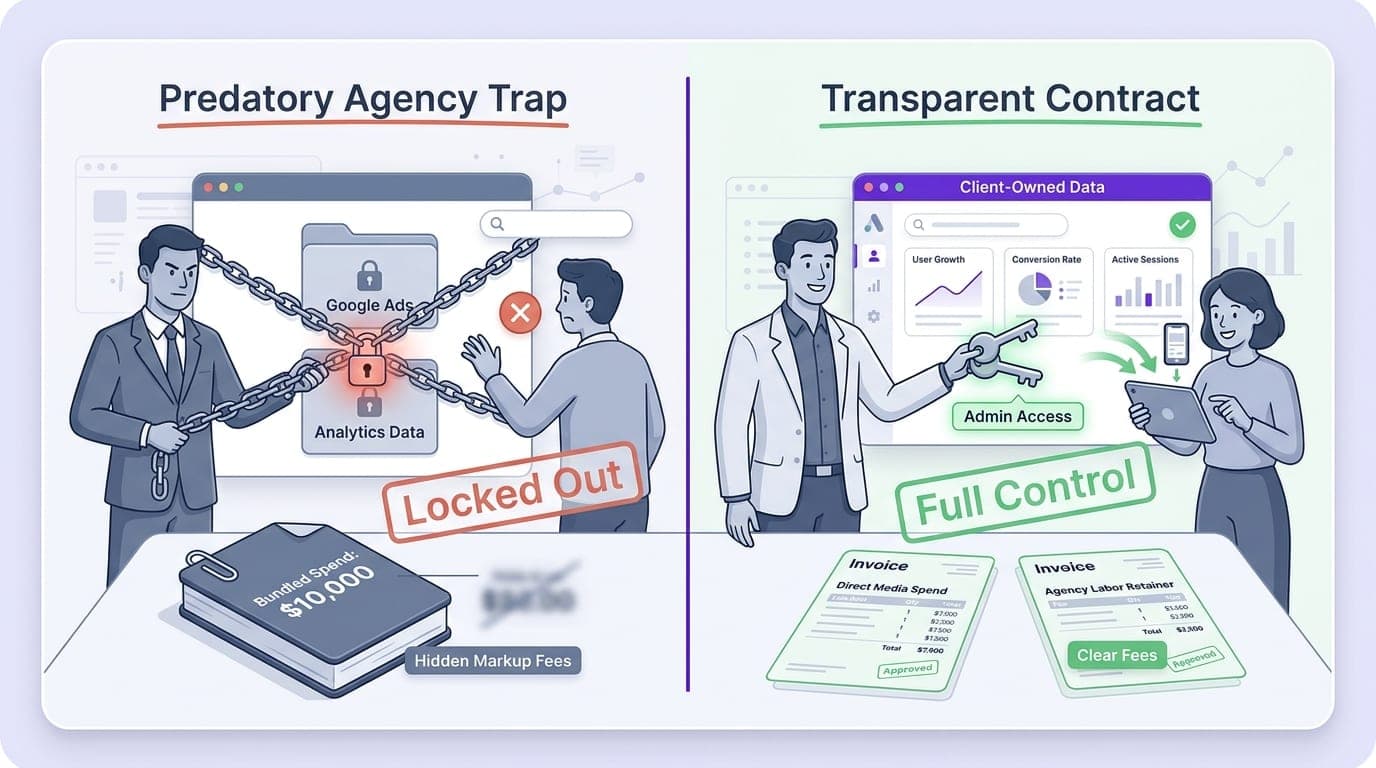
Ensure your contract adheres to consumer transparency standards outlined by the Federal Trade Commission. Agencies must provide raw ad-spend invoices rather than bundling media costs into an opaque single invoice with hidden management markups.
Technical search guidelines documented on Google Search Central emphasize transparent, user-focused optimization. Watch out for agencies promising proprietary link networks or instant algorithmic manipulation.
- Hostage ad accounts: The agency sets up Google Ads or Meta Ads within their proprietary business manager, locking you out of historical data upon contract termination.
- Vanity reporting: Retainer reports highlight total keyword positions or raw impressions instead of organic conversions, pipeline revenue, and blended acquisition cost.
- Markup surcharges on ad spend: Agencies hide fees by pocketing 15% to 25% of media budgets behind bundled billing rather than separating labor retainers from ad platform spend.
- Vague deliverable commitments: Contracts describe 'ongoing technical improvements' without specifying actual hours, published assets, or monthly production quotas.
- Private blog networks (PBNs): Agencies buy artificial links from private web networks that risk severe search penalties against your primary domain.
If your budget is constrained, look at vetted affordable SEO services that provide transparent hourly scopes rather than vague, lock-in retainers.
In my experience, any agency that refuses to grant you full administrative ownership of your Google Ads, Tag Manager, or Analytics properties from day one plans to hold your data hostage.
Balancing internal resources with external agency retainers requires clear performance milestones and flexible execution. If you need to scale search presence efficiently without inflating retainer hours, ProgSEO automatically builds data-backed landing pages that capture long-tail organic search volume.
Paid advertising channels generate qualified clicks and immediate conversion feedback within the first 14 to 30 days. Organic search engine optimization deliverables typically require four to nine months to build sufficient domain authority and compound into significant inbound organic traffic.
No, agency retainers cover strategy, creative production, campaign optimization, and account management labor. Media spend on Google Ads, Meta, or LinkedIn is billed directly to your business credit card on the respective ad platforms.
Most professional agencies permit tier adjustments with a standard 30-day written notice. Ensure your contract includes variable scope adjustment terms so you can scale resources up during peak sales seasons and down during slower quarters without breach of contract.
Reputable agencies utilize enterprise SEO suites like Semrush, Ahrefs, and Screaming Frog for technical diagnostics, alongside Google Search Console, Google Analytics 4, Looker Studio, and native advertising platforms for reporting and execution.
Sources & References
- Digital Applied — Industry survey data detailing the $3,000 median agency retainer and 62% retainer adoption rate in 2026.
- Semark Global — Comprehensive agency pricing analysis highlighting typical small business tiers ($1,500–$5,000) and enterprise ranges.
- Chatterbuzz Media — Agency cost benchmarks detailing mid-market retainer bands ($5,000–$40,000) and revenue-based budgeting frameworks.
- Clutch — B2B agency research platform documenting typical mid-market service retainers spanning $5,000 to $50,000 monthly.
- W3C — World Wide Web Consortium technical documentation defining foundational markup and accessibility standards for technical site audits.
- Google Ads — Official paid media platform documentation detailing search query data extraction and conversion measurement.
- Search Engine Land — Search marketing publication examining cross-channel brand signals and algorithmic evaluation trends.
- Federal Trade Commission — Federal regulatory guidance establishing transparency standards for commercial service agreements and marketing fee structures.
- Google Search Central — Official Google documentation covering organic search best practices, spam policies, and webmaster standards.