Executing a structured monthly seo action plan transforms search optimization from a chaotic reaction into a reliable growth channel. I run these cycles across thirty-day sprints so engineering, editorial, and PR efforts work toward verifiable search milestones.
▶ Related Video
SEO in 2025: How I'd Learn it if I Were Starting Over
You can review baseline technical metrics via Google Search Console within a single afternoon. Maintaining consistent compounding returns requires allocating roughly twenty to thirty hours per month across technical hygiene, content refinement, and link analysis.
Key Takeaways
- Technical audits prevent silent traffic loss. Monthly crawl checks catch 404 response codes, redirect chains, and accidental noindex directives before search engines drop your core URLs.
- Updating existing content beats publishing volume. Refreshing decaying pages that slipped from top rankings recovers traffic significantly faster than drafting unranked net-new articles.
- Backlink monitoring protects brand equity. Auditing lost referring domains each month highlights broken outbound links and uncovers reclaimed link opportunities immediately.
- Impact-effort scoring eliminates wasted cycles. Prioritizing tasks using a matrix prevents engineering backlogs from stalling simple, high-yield metadata and internal linking fixes.
- Look beyond top-line organic traffic. Monthly performance reviews must measure commercial conversions, qualified pipeline, and page-level intent rather than vanity impression surges.
The Four Pillars of an Effective Monthly SEO Cadence
A successful monthly workflow balances four interconnected disciplines: technical health, content optimization, link acquisition, and performance diagnosis. Focusing on only one area creates an unstable foundation that crumbles during core algorithm updates.
In my experience, teams fail when they treat search optimization as a disconnected punch list. If you publish ten articles without fixing your crawl budget, those articles linger in indexation purgatory for months. Each pillar depends on the integrity of the other three.
To organize your calendar, align your operational sprints alongside a broader seo weekly plan that divides tasks into manageable phases. Here is how I divide responsibilities across any thirty-day period:
- Week 1 (Technical & Crawl Verification): Full site crawl, server status code review, index coverage check, and Core Web Vitals audit.
- Week 2 (Content Strategy & Updates): Content decay analysis, search intent alignment, on-page optimization, and editorial production.
- Week 3 (Authority & Outreach): Competitor backlink gap analysis, digital PR distribution, internal link distribution, and broken link reclamation.
- Week 4 (Reporting & Backlog Planning): Attribution reporting, conversion tracking review, roadmap updates, and engineering ticket prioritization.
Monthly Technical Maintenance and Health Audits
Run a comprehensive crawl during the first week of every month to identify infrastructure regressions introduced by code deployments. I configure Screaming Frog SEO Spider to crawl staging and production environments, comparing differences in canonical tags, meta robots rules, and response codes.
One catastrophic mistake I regularly encounter is treating technical audits as an annual task. A single template update can accidentally push a `noindex` tag across hundreds of conversion assets, wiping out rankings before anyone in marketing notices.
Pay close attention to index coverage inside Google Search Console. Look at the Page Indexing report to verify that valid pages are not categorized under Crawled - currently not indexed or Discovered - currently not indexed. If these numbers surge, your site may have duplicate content issues or low crawl priority.
- Review 4xx and 5xx errors: Export broken URLs and implement 301 redirects to relevant live destinations.
- Audit canonical tags: Ensure canonical declarations match preferred protocol, subdomains, and trailing slash structures.
- Check XML sitemaps: Remove redirected or non-indexable URLs from XML sitemaps submitted to search engines.
- Inspect robots.txt directives: Confirm new product launches or design directories are not unintentionally blocked from search bots.
Evaluate your field performance using the web.dev Core Web Vitals guidelines. Track Largest Contentful Paint (LCP), Interaction to Next Paint (INP), and Cumulative Layout Shift (CLS) across mobile templates. Chasing a perfect 100 score is a vanity exercise; keeping your URLs within the "Good" threshold is all search engines require.
If you manage complex migrations or domain changes, reference a dedicated seo migration plan to ensure redirect maps and canonical tags remain stable throughout platform updates.
Executing Content Updates and Targeting Keyword Gaps
Deciding between writing new pages and updating existing URLs comes down to historical performance data. I open Google Search Console, set the date range to compare the last three months against the previous period, and filter for queries with declining impressions and click-through rates.
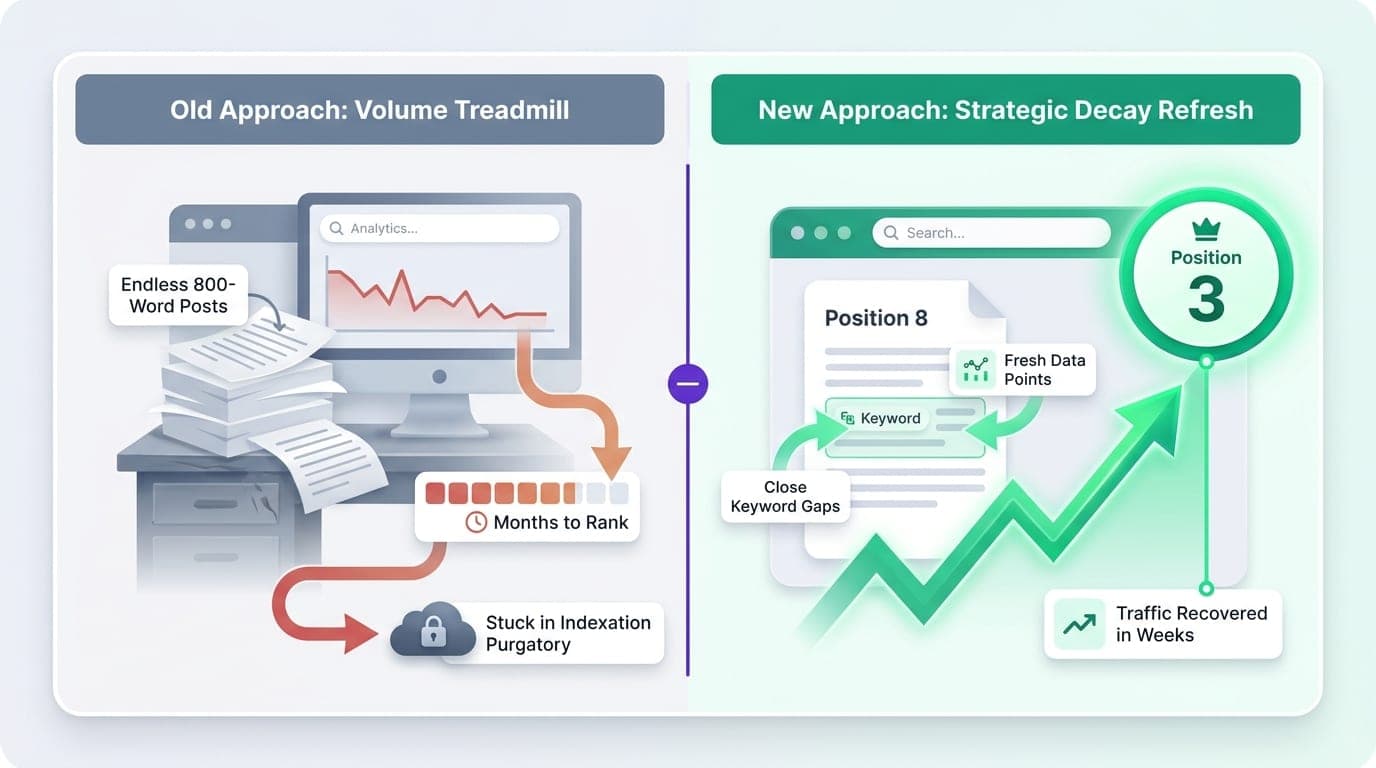
Refreshing a URL that previously ranked in positions three through six yields a far faster commercial return than drafting unproven content. When a page experiences content decay, competitors have likely produced more thorough answers or Google has adjusted its interpretation of user search intent.
A second major mistake I see teams make is publishing endless 800-word blog posts while ignoring the authoritative content already sitting on their domain. To systematically fix decayed content, coordinate production through a structured seo content plan that pairs refreshes with gap analysis.
- Identify declining URLs: Flag pages that lost more than 15% of their organic clicks over the prior ninety days.
- Analyze SERP changes: Compare current top-three ranking results against your asset to identify missing subtopics and schema markup.
- Prune outdated statistics: Replace obsolete figures with current data points, updating visual diagrams and step-by-step instructions.
- Close keyword gaps: Use Semrush Keyword Gap to identify queries your direct competitors rank for that your domain overlooks.
- Add internal links: Pass equity from high-authority landing pages to newly refreshed articles using contextual, descriptive anchor text.
“Updating an established page that slipped from position 4 to 8 captures traffic back within weeks, whereas a brand-new page can take months to earn comparable authority.”
- Technical SEO Consultant
Backlink Monitoring and Authority Management
Monitoring your backlink profile each month ensures you retain earned authority while identifying toxic link spikes or negative link-building attacks. I export new and lost referring domains using Ahrefs Site Explorer on the fifteenth of every month.
Cold mass email outreach is an obsolete tactic that damages your brand reputation. Five hyper-personalized pitches directed to legitimate editors who cover your exact niche will outperform five hundred automated email blasts every single time.
Focus your monthly authority tasks on reclamation and targeted digital PR initiatives. If an authoritative website links to a URL that now returns a 404 error, redirect that URL immediately to recover equity.
- Reclaim broken backlinks: Map inbound links pointing to deleted URLs toward their closest modern equivalents.
- Track lost editorial mentions: Contact journalists or webmasters whose recent page revisions accidentally dropped your contextual citation.
- Analyze competitor link velocity: Identify which new industry assets or studies are earning your competitors editorially placed references.
- Audit local citation consistency: For brick-and-mortar operations, align NAP data across aggregators using structured local seo plans.

Prioritizing Recurring Tasks by Impact and Effort
Every growth team operates under finite resources, making an effort-versus-impact matrix indispensable for your monthly backlog. If a technical recommendation requires forty engineering hours but offers questionable organic lift, I deprioritize it in favor of high-yield on-page optimizations.
Score initiatives on a simple 1 to 5 scale for estimated organic upside and technical complexity. Categorizing actions into distinct execution buckets keeps in-house teams focused on revenue-generating actions rather than low-value aesthetic tweaks.
| Task Focus Area | Monthly Cadence | Estimated Effort | Traffic Impact | Primary Tool Used |
|---|---|---|---|---|
| Crawl Error Resolution | Week 1 | Low (2-4 hrs) | High | Screaming Frog / GSC |
| Content Decay Refreshes | Week 2 | Medium (6-8 hrs) | Very High | Google Search Console |
| Keyword Gap Net-New Content | Weeks 2-3 | High (10-15 hrs) | High | Semrush / Ahrefs |
| Broken Backlink Reclamation | Week 3 | Low (2-3 hrs) | Medium | Ahrefs / Moz Link Explorer |
| Core Web Vitals Optimization | Week 1 | High (8-12 hrs) | Medium | PageSpeed Insights / Chrome UX |
Budget constraints vary across platforms. If you run a hosted storefront or CMS, assess your software ecosystem alongside guides like wix seo plan cost to determine if native infrastructure tools satisfy your monthly tracking requirements.
Reporting Performance and Closing the Monthly Loop
Effective monthly reporting connects search metrics to actual pipeline and revenue rather than celebrating arbitrary impression increases. I configure dashboards in Google Looker Studio to blend conversion events from Google Analytics 4 with search query impressions.
In an agency environment, standard monthly retainer deliverables typically cover executive KPI summaries, completed technical fixes, content delivered, and next month's strategic priorities. In-house marketers, conversely, should emphasize cross-departmental enablement and engineering ticket resolution.
- Organic revenue and lead conversions: Measure direct form submissions, demo requests, or e-commerce purchases generated by organic search.
- Non-branded click distribution: Track non-branded traffic trends to gauge genuine market discovery versus existing brand awareness.
- Top landing page velocity: Identify which specific URLs gained or conceded the most organic traffic over the trailing thirty days.
- Keyword portfolio movements: Monitor position movements for primary commercial keywords within striking distance (positions 4 through 15).
Evaluate data over a rolling ninety-day baseline to avoid reacting prematurely to weekly seasonal dips. Use your findings to build the subsequent month's backlog, ensuring continuous organic improvements.
To systematically scale recurring content execution and manage programmatic landing pages alongside your monthly tasks, consider exploring ProgSEO for data-driven page creation. Automating high-volume page architecture frees up internal resources to focus on complex technical audits and high-impact digital PR.
A comprehensive plan covers technical crawls, index coverage reviews, content decay updates, keyword gap analysis, backlink reclamation, and commercial conversion reporting. You execute these in dedicated weekly blocks to maintain operational focus.
Audit for broken internal links (404 errors), redirect loops, canonical misconfigurations, unintended robots.txt disallow rules, XML sitemap errors, and regressions in Core Web Vitals metrics.
Review Google Search Console for URLs that lost clicks over the prior ninety days. If you possess pages with decaying impressions for primary keywords, refresh those first. Only prioritize net-new content when target keyword gaps exist.
Prioritize organic conversions, assisted revenue, non-branded search clicks, indexation coverage trends, and keyword movement across high-intent commercial terms.
Use an impact-effort matrix. Focus first on high-impact, low-effort items like fixing critical crawl errors, updating meta descriptions on striking-distance pages, and optimizing internal links across top-performing assets.
Sources & References
- Google Search Console — Official search reporting platform used for monitoring indexation, crawl errors, and organic search impressions.
- Screaming Frog — Desktop website crawler that inspects technical website architecture, canonical tags, and broken links.
- web.dev Core Web Vitals — Google developer documentation outlining performance thresholds for LCP, INP, and CLS metrics.
- Ahrefs — SEO software suite utilized for analyzing domain backlink velocity and identifying lost referring domains.
- Semrush — Search engine marketing toolkit providing keyword gap analysis and competitor ranking data.
- Google Analytics Help — Official documentation detailing event tracking and conversion attribution in Google Analytics 4.
- Google Looker Studio — Business intelligence and visualization platform used for automated monthly marketing reporting.