
Executing a profitable international seo plan requires moving beyond literal translation and into systematic regional optimization. In this guide, I will walk you through qualifying foreign search demand, architecting scalable URLs, and managing technical signals. You will have a functional, 12-month global roadmap within three to six months of active implementation.
▶ Related Video
International SEO for Beginners - How to do Global SEO
Before touching your code base, ensure you have active access to Google Search Console, your web analytics suite, and a dedicated staging environment. Expanding organic reach across borders introduces severe crawl-budget and indexing risks if you execute without verified search demand.
| International Element | Recommended Strategy | Primary Tradeoff | Best Suited For |
|---|---|---|---|
| URL Architecture | Subfolders (/de/, /es/) | Weaker local geo-trust signals | Growing brands consolidating authority |
| Targeting Model | Language targeting initially | No local currency or pricing differentiation | SaaS and cross-border digital services |
| Hreflang Deployment | XML Sitemaps | Requires automated index management | Catalogs with frequent inventory updates |
| Content Production | Native Transcreation | Higher upfront editorial production cost | High-intent transactional category pages |
Key Takeaways
- Audit before translating. Existing unprompted international impressions in your analytics reveal real demand before you allocate engineering resources.
- Subfolders consolidate authority. Using subdirectory routing preserves root domain equity far better than launching separate, resource-intensive country code domains.
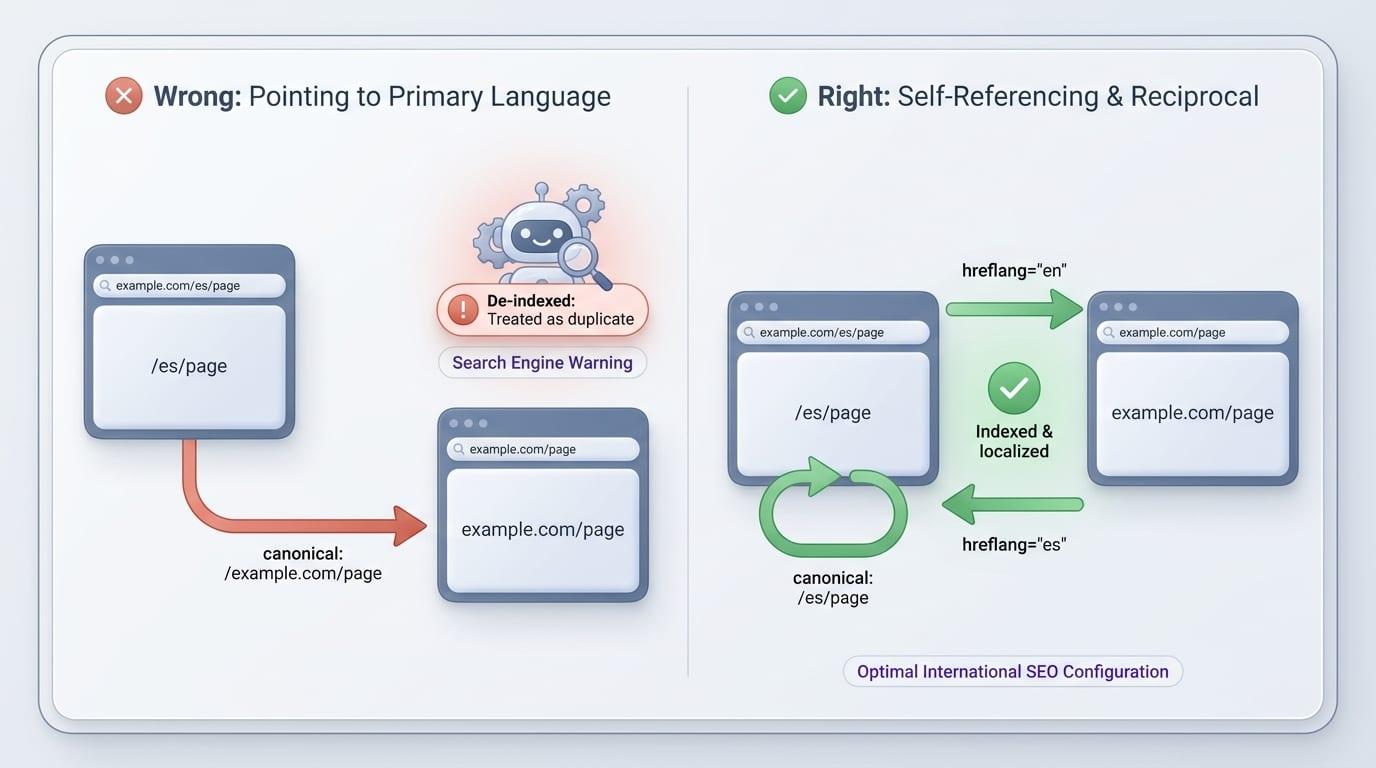
- Self-referencing canonicals are mandatory. Every localized variant must point its canonical tag to itself rather than defaulting to the English primary URL.
- Transcreation beats translation. Adapting to native search volume and cultural query patterns prevents ranking for phrases with zero actual transactional intent.
- XML sitemaps streamline hreflang. Managing language annotations inside XML feeds prevents bloated page markup, source code errors, and caching conflicts.
Step 1: Market Qualification and Search Opportunity Sizing
Prioritize expansion markets based on proven organic traffic rather than theoretical market size. In my experience, teams waste thousands translating content before verifying whether organic demand converts into viable revenue. I start every international strategy by auditing existing unprompted impressions in organic reports.
Check your analytics for non-domestic visitors already browsing your domestic pages. If international buyers are converting despite friction like wrong currencies, you have validated market pull. Pair this internal baseline with competitive intelligence from Ahrefs to quantify local organic click potential.
One catastrophic mistake teams make is relying on gross keyword volumes translated directly from English. A keyword with 50,000 monthly searches in the United States might translate into a localized phrase that native speakers never use. You must evaluate whether commercial search intent exists locally.
- Existing traffic analysis: Filter analytics data by country to find regions driving baseline engagement without dedicated localized pages.
- Addressable keyword volume: Verify that regional query volume represents distinct search patterns using local keyword databases.
- SERP competitor dominance: Identify whether local search engine result pages are monopolized by entrenched domestic market leaders.
- Commercial viability: Ensure the target market supports your unit economics, payment channels, and fulfillment costs.
Integrate these market qualification criteria directly into your monthly SEO action plan before committing localized editorial resources.
Step 2: Choosing Language Targeting vs. Country Targeting
Deciding between language targeting and country targeting dictates your entire technical architecture and operational overhead. My stance is unequivocal: do not implement country targeting unless legal, financial, or fulfillment barriers force your hand. Language targeting is vastly more scalable for growing operations.
Language targeting serves speakers of a language regardless of geographic location. If you publish a generic Spanish section (`es`), you serve users across Spain, Mexico, Argentina, and Colombia with a unified content library. This drastically reduces maintenance, crawl budget strain, and duplicate content risks.
Country targeting becomes mandatory when you must alter pricing, shipping terms, or local regulatory compliance across regions. Serving users in the United Kingdom (`en-GB`) distinct legal terms from users in the United States (`en-US`) requires country-specific URLs. Follow standard W3C language tags to structure valid locale pairs.
- Evaluate operational necessity: Determine if product catalogs, currencies, or legal agreements diverge between target territories.
- Choose broad language targeting: Implement generic language codes like `es`, `fr`, or `de` if offerings remain uniform globally.
- Select country-language pairs: Use ISO standards like `es-MX` or `de-AT` only when local pricing or product variations require separation.
- Standardize regional codes: Reference official ISO 3166 country codes to prevent formatting mismatches in your site architecture.
If you manage a multi-regional retail catalog, consult our guide on ecommerce website SEO plan architectures to align product variants with regional inventory rules.
Step 3: Selecting Your International URL Architecture
Choose subfolders over subdomains and separate domains to preserve domain authority. I consider raw ccTLDs an operational trap for mid-market brands without dedicated localized engineering teams. Building backlink profiles and domain trust from scratch across individual national domains consumes immense capital.
A subfolder structure (`example.com/de/`) consolidates all external backlink equity into your primary root domain. This allows new international pages to inherit established ranking power immediately. Subfolders are simple to maintain, run on single SSL certificates, and centralize technical monitoring.
A subdomain structure (`de.example.com`) isolates international sections technically, which works if regional teams require distinct CMS installations. However, Google frequently treats subdomains as distinct entities, fragmenting link equity. The official Google Search Central international guide details how URL structures influence regional indexing behavior.
- ccTLDs (e.g., brand.fr): Maximum localized trust and ranking signals, but demands isolated backlink acquisition, individual hosting overhead, and separate analytics setups.
- Subdirectories (e.g., brand.com/fr/): Immediate inheritance of root domain authority, minimal infrastructure cost, and simplified technical audits.
- Subdomains (e.g., fr.brand.com): Clean infrastructure separation for regional dev teams, but fragments domain authority across hostnames.

Step 4: Technical Configuration for Hreflang and Canonicals
Every localized page must point its canonical tag to itself while maintaining reciprocal hreflang annotations. HTML `` hreflang annotations are an outdated liability for enterprise catalogs; XML sitemap implementation is far superior. Sitemaps prevent bloated page load times and eliminate deployment errors in production.
The most disastrous mistake I routinely discover is pointing canonical tags from translated regional pages back to the English original. When you canonicalize `/es/` back to `/`, you explicitly instruct Google to remove the Spanish version from search results. A translated page is not duplicate content; it requires a self-referencing canonical.
A valid hreflang tag cluster requires bidirectional reciprocity. If your US English page references a German variant, that German page must link back to the US page. Omitting return links invalidates the entire relationship in search engines.
text
<!-- Canonicalization and Hreflang in Page Head -->
<link rel="canonical" href="https://example.com/de/" />
<link rel="alternate" hreflang="en" href="https://example.com/" />
<link rel="alternate" hreflang="de" href="https://example.com/de/" />
<link rel="alternate" hreflang="x-default" href="https://example.com/" />- Self-referencing canonical tag: Ensure `/es/page` contains a canonical pointing to `/es/page`, never to the primary English URL.
- Bidirectional return tags: Verify that every targeted variant contains exact reciprocal links back to every alternative locale.
- Valid x-default declaration: Set an `x-default` URL to direct unmatched global searchers to a global landing or selector page.
- XML sitemap delivery: Shift hreflang arrays containing more than five language variations into XML index files to conserve document weight.
Review your crawling budget and indexation logs alongside your ubersuggest plans audit workflow to spot orphaned alternate URLs before they trigger crawl waste.
Step 5: Content Localization and Search Transcreation Workflow
Transcreation adapts your messaging culturally and matches native search behavior instead of mechanically translating words. Literal translation is organic suicide; I would rather publish ten culturally transcreated landing pages than five hundred machine-translated blog posts. Direct machine translation completely ignores regional phrasing.
For instance, an American software buyer searches for "customer support platform", whereas a German enterprise lead frequently looks for "Helpdesk Software Lösungen". Translating the English phrase verbatim yields a clunky term that exhibits virtually zero monthly search volume in Germany.
Build a repeatable workflow pairing AI machine translation drafts with native-speaking SEO editors. Native specialists adjust keyword density, address regional idioms, and modify currency or metric references. To maintain speed, routing site assets through a high-performance CDN like Cloudflare ensures fast localized delivery worldwide.
- Conduct localized keyword research: Never translate keywords; find the natural terms local buyers actually type into regional search engines.
- Audit local transactional intent: Verify whether target queries return informational guides or commercial landing pages in local SERPs.
- Adapt on-page trust signals: Localize contact addresses, phone numbers, customer testimonials, and regulatory accreditations.
- Localize on-page metadata: Write dedicated title tags, meta descriptions, and image alt tags tailored to native query lengths and click triggers.
Align your transcreated category messaging with our conversion optimization plan framework to turn newly acquired international visitors into paying accounts.
Step 6: Engineering Regional Authority Beyond Google
Treating East Asian search engines as mere Google clones is a fundamental error that guarantees failure. If you target China, South Korea, or Japan, your search strategy must pivot toward platform-specific algorithmic factors. Local engine architectures prioritize distinct server, indexing, and content freshness signals.
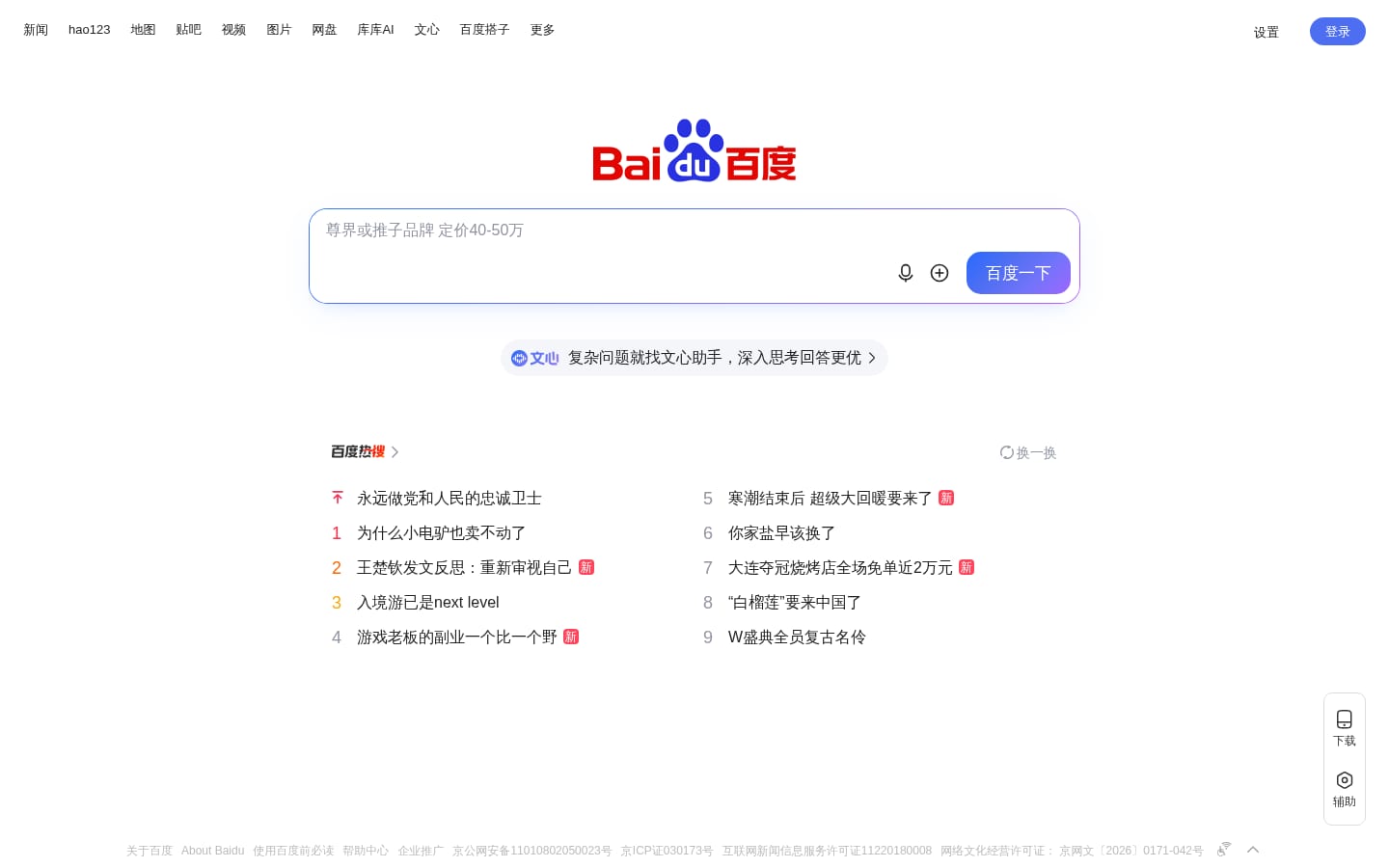
In China, Baidu dominates desktop and mobile queries. Baidu heavily favors websites hosted within mainland China or Hong Kong possessing an official Internet Content Provider (ICP) license. It still relies on older on-page signals, like meta keyword tags, while penalizing sites with slow render times behind domestic firewalls.
In South Korea, Naver Search Advisor runs a hybrid ecosystem combining organic web indexes with its own community platforms, such as Naver Blogs and Cafes. Ranking in South Korea requires syndicating content directly into these proprietary environments alongside standard web optimization.
- Baidu compliance: Secure an official ICP license, host assets physically within mainland China, and optimize raw HTML content for Baidu spider crawling.
- Naver platform integration: Register with Naver Search Advisor and maintain an active branded Naver Blog presence to capture mixed SERP blocks.
- Regional link acquisition: Secure backlinks from top-level domestic domains (`.de`, `.jp`, `.co.uk`) to establish geo-specific link authority.
- Entity verification: Build citations in respected local business directories and regional trade publications to establish geographic entity trust.
Strengthen your foreign authority profiles by executing a targeted link building plan tailored specifically to regional publications and local news distributors.
Step 7: Phased Rollout Roadmap and Market-by-Market KPIs
Staging a global rollout across ten countries at once is reckless; I always enforce a phased pilot to catch indexing anomalies early. Launching two markets initially allows you to test hreflang parsing, monitor crawling health, and refine localization workflows before expending your full budget.
Structure your rollout across three distinct quarters. In Quarter 1, complete technical routing, hreflang validation, and core transactional page transcreation for your pilot market. In Quarter 2, review localized indexation rates and scale content production. In Quarter 3, expand your framework into secondary territories.
90 Days
Pilot market validation window
< 100ms
Target localized server TTFB
100%
Hreflang reciprocal match rate
- Phase 1 (Months 1–2): Audit technical infrastructure, establish subfolder routing, and deploy transcreated high-priority landing pages for one pilot market.
- Phase 2 (Months 3–4): Verify hreflang indexation in search consoles, measure local CTR, and resolve routing anomalies.
- Phase 3 (Months 5–6): Scale informational blog transcreation and replicate the validated framework across secondary target countries.
- Track regional KPIs: Monitor non-branded search impressions by country, localized conversion rates, and SERP feature acquisition per target territory.
When expanding localized landing pages at scale, ProgSEO helps teams generate programmatic, data-driven SEO architectures tailored to capture high-intent international search queries. Automating structured regional content deployment ensures you maintain consistency across languages without exhausting engineering capacity.
You build an international SEO plan by qualifying foreign search demand, selecting an appropriate URL structure (such as subfolders), implementing precise hreflang and self-referencing canonical annotations, and culturally transcreating high-intent pages.
Target languages broadly if your product offerings, currencies, and legal agreements are identical worldwide. Switch to country targeting only when local pricing, shipping restrictions, or legal compliance demand distinct user experiences.
Subfolders (/de/, /fr/) are the most practical choice for most businesses because they consolidate backlink authority into your primary root domain and minimize server maintenance overhead.
Hreflang tags inform search engines which language and regional version of a URL to serve to a user. Common mistakes include omitting self-referencing canonicals, missing reciprocal return links, and pointing canonical tags back to the English source.
Sources & References
- Google Search Central — Official developer guidelines for multi-regional and multilingual site architectures.
- Google Search Console — Search performance monitoring, international targeting reports, and index validation.
- W3C Language Tags — Specifications and standards for BCP 47 and ISO language identification tags.
- ISO Country Codes — Authoritative ISO 3166-1 alpha-2 regional and country code standards.
- Ahrefs — International keyword research database and multi-country competitive intelligence.
- Cloudflare — Global edge CDN routing, localized SSL certificate delivery, and caching infrastructure.
- Baidu — Search platform guidelines, ICP licensing requirements, and crawling specifications for China.
- Naver Search Advisor — Technical webmaster documentation and syndication guidelines for South Korean search.