
To rank for competitive queries in 2026, you cannot rely on casual link acquisition. I build every client campaign around a structured link building plan that maps competitor deficits, isolates linkable assets, and enforces strict vetting standards. You can execute this complete process in roughly six to eight weeks using basic crawling tools and an outreach inbox.
▶ Related Video
Link Building for Beginners: Complete Guide to Get Backlinks
According to Google Search Central's spam policies, manipulating links with automated schemes risks algorithmic demotion. A predictable strategy relies on earning genuine editorial endorsements from authoritative, topically aligned publishers.
Key Takeaways
- Link gaps define targets. Calculate referring domain deficits against the top three ranking pages rather than chasing arbitrary sitewide link counts.
- Relevance beats raw authority. A link from a niche site with five hundred monthly visits drives more rank impact than an unrelated corporate portal.
- Original assets compound value. Benchmarks, proprietary surveys, and interactive tools generate passive citations over time without manual outreach.
- Strict vetting protects rankings. Filter every prospective domain by indexation status and active organic traffic before sending a pitch.
- Consistent velocity matters most. Acquire links at a steady monthly pace to mimic natural editorial discovery.
Benchmarking Your Link Gap and Setting Realistic Targets
Before sending a single email, you must determine your exact target requirements by auditing your direct search competitors. In my opinion, obsessing over overall domain metrics rather than page-level URL gaps is a complete waste of analytical time.
A common mistake I see teams make during gap audits is counting raw backlink volume instead of unique referring domains. Search engines discount twenty sitewide footer links from one source, while twenty independent editorial domains signal genuine authority across the web.
To run this calculation, query your target keyword and pull the top three organic results. Plug these URLs into Ahrefs Site Explorer to isolate dofollow referring domains pointing to those specific ranking URLs.
- Identify the top three ranking pages for your primary commercial or informational search intent.
- Export the referring domains for each competitor URL, filtering out nofollow, user-generated, and forum mentions.
- Find the average number of unique referring domains among the top three ranking competitors.
- Subtract your target page's existing referring domains from that average to uncover your real link gap deficit.
If the top three pages average 36 referring domains and your page has 6, your net deficit is 30 domains. Rather than buying arbitrary vendor tiers or generic link building packages, spread that gap across a six-month roadmap.
| Implementation Phase | Primary Focus | Key Deliverable | Typical Timeline |
|---|---|---|---|
| Phase 1: Gap Analysis | Audit top 3 SERP competitors | Link deficit metric & target list | Weeks 1–2 |
| Phase 2: Asset Creation | Produce data studies or free utility tools | 1 citation-worthy linkable asset | Weeks 2–4 |
| Phase 3: Prospecting & Vetting | Filter domains by traffic, relevance & indexation | 150–200 vetted target URLs | Weeks 4–5 |
| Phase 4: Outreach Execution | Deliver personalized value-first email pitches | 30–50 weekly targeted pitches | Weeks 6–8+ |
Budget allocation determines whether you execute in-house or hire freelance contractors. Dedicated link prospecting software, contact scrapers, and outreach tools usually cost between $250 and $600 per month in operating overhead.
- Internal execution: Lower direct cash spend, but demands 15 to 20 hours of weekly specialist labor.
- Freelance contractor: Costs roughly $150 to $300 per placed editorial link, requiring strict quality oversight.
- Hybrid model: In-house team creates the linkable content while external researchers handle prospecting lists.
Building Linkable Assets That Earn Natural Citations
Cold outreach without a compelling resource yields abysmal response rates below two percent. In my experience, standard 2,000-word informational blog posts almost never attract natural editorial backlinks anymore.
Journalists and content creators link out when they need evidence, calculation tools, or source attribution to back up their own claims. Building high-quality link building assets gives third-party writers a functional reason to cite your domain as a primary reference.
- Original proprietary data: Run customer surveys or mine aggregated platform metrics to reveal unpublished industry trends.
- Interactive web calculators: Create lightweight JavaScript tools that solve concrete mathematical problems in your niche.
- Definitive industry glossaries: Standardize technical vocabulary and taxonomy that bloggers link to for context.
- Visual trend frameworks: Design proprietary diagrams or workflow templates that creators embed with source links.
Use audience research tools like SparkToro to find the publications, podcasts, and social accounts your target audience actually consumes. Designing assets around topics they actively discuss guarantees a receptive pool of outreach targets.
Selecting Core Link Acquisition Tactics for Your Site
I find that unlinked brand mentions deliver a dramatically higher return on effort than cold guest post pitching. Your acquisition strategy should combine low-friction tactics with proactive outreach campaigns.
Rather than trying every conceivable tactic, select two complementary channels that match your site's current authority. A newer website should focus on resource updates and expert quotes before attempting complex digital PR stunts.
- Unlinked brand reclamation: Search for web mentions of your company, executives, or products that lack a clickable link.
- Resource page link building: Pitch your free tools, guides, or data assets to curated industry directories and educational lists.
- Broken link replacement: Uncover 404 errors on competitor domains using the Internet Archive Wayback Machine and offer your live asset as a replacement.
- Expert sourcing queries: Monitor PR platforms like Connectively to provide prompt quotes to journalists covering your industry.
“The easiest links to earn are those where you resolve a headache for an editor who has already published content in your space.”
- ProgSEO Outreach Principle
Prospecting and Vetting Target Domains
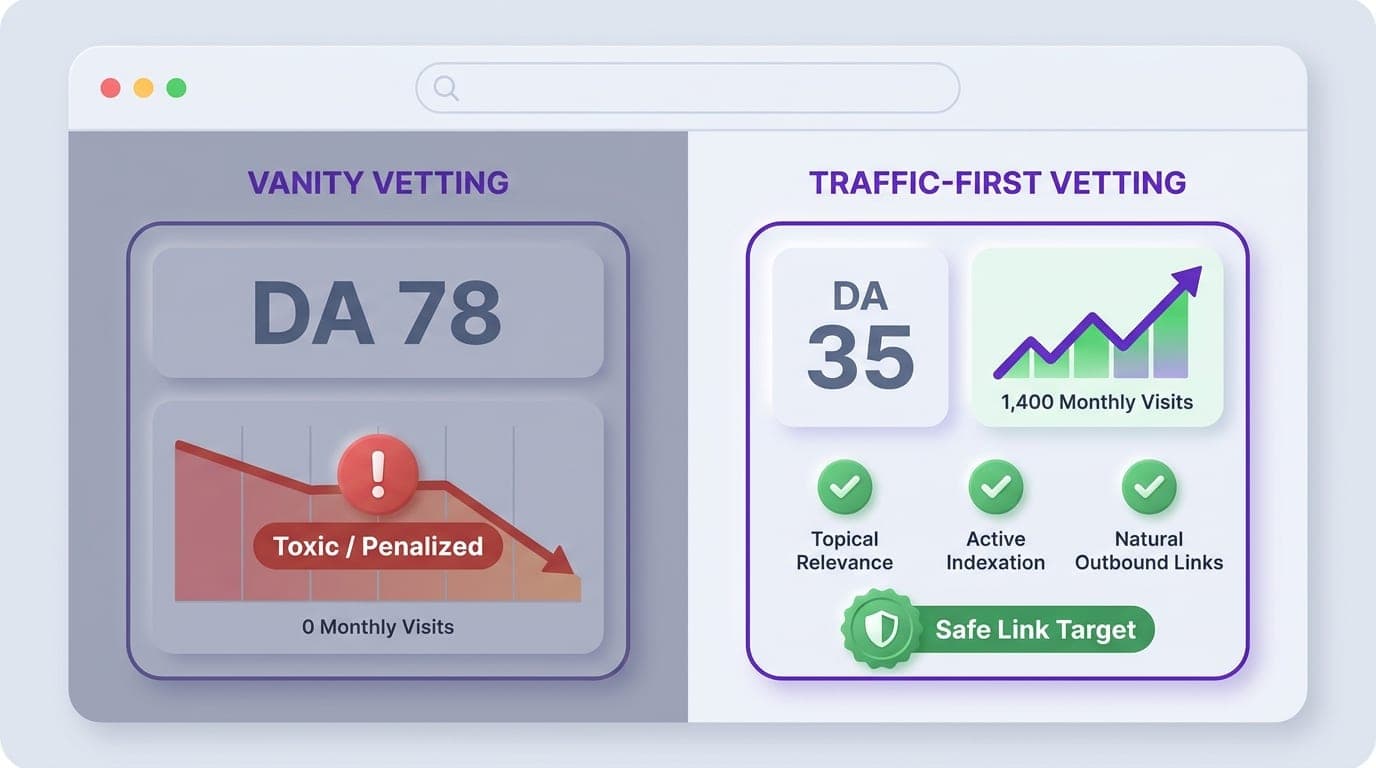
I hold the firm opinion that pitching a site with zero organic traffic hurts your backlink profile more than earning nothing at all. Low-quality links waste outreach resources and flag unnatural link patterns to search evaluation algorithms.
Another frequent mistake is relying entirely on third-party domain authority metrics while ignoring organic traffic trends. An expired domain with high historical authority that lost all organic traffic after an algorithmic update is toxic for link placement.
Before adding any website to your outreach database, verify its domain health using Semrush Domain Analytics. Ensure the publication passes four non-negotiable criteria:
- Topical relevance: The website must publish content directly adjacent to your industry, not generic lifestyle roundups.
- Stable organic traffic: The domain must attract at least 1,000 monthly search visits from organic Google queries.
- Active indexation: The specific page and its parent directory must be discoverable in Google's live index.
- Natural outbound links: The site must not sell obvious casino, essay-writing, or crypto links in unrelated articles.
You can confirm that Google trusts and indexes the domain by running manual `site:` search queries and checking its organic search trends in third-party SEO tools.
Managing Outreach Cadence, Velocity, and Progress
My view is that sending more than two follow-up emails borders on harassment and destroys long-term publisher relationships. A high-converting outreach sequence relies on tight personalization and immediate value rather than repetitive reminders.
Locate direct editorial contacts using Hunter.io to verify email deliverables. Bounced messages ruin domain reputation, so keep bounce rates strictly under two percent.
- Day 1 (Initial Pitch): Send a concise, 100-word email referencing a specific recent piece written by the author.
- Day 5 (Follow-up): Provide a secondary angle, additional data point, or polite check-in without guilt-tripping.
- Day 12 (Closeout): Move unresponsive prospects to an archive status and avoid contacting the same editor for 90 days.
Track campaign pipelines in outreach platforms like BuzzStream to avoid emailing the same editor twice across different team members. Maintain consistent operational metrics to evaluate real commercial return.
- Link velocity: Monitor weekly new referring domains to avoid unnatural spikes followed by months of total inactivity.
- Anchor text distribution: Ensure over 75% of your anchor text consists of brand names or natural URL variations.
- Indexation status: Recheck placed links every thirty days to verify the host URL remains indexed in search results.
- Target page keyword movement: Track target landing page rankings across your primary focus search queries.
When backlinks land on your top-level assets, route their earned authority to your core conversion pages using an automated internal linking tool. Establishing a clean technical structure aligned with internal links documentation ensures maximum equity distribution throughout your entire catalog.
Once your external backlink equity begins flowing, pairing those inbound links with programmatic content architectures like ProgSEO ensures link equity distributes efficiently across thousands of long-tail pages. This deliberate balance between targeted acquisition and internal distribution creates compounding organic visibility.
Rankings typically respond within four to ten weeks after search bots crawl and index newly acquired referring domains. Highly competitive terms with massive link gaps may take four to six months of steady acquisition.
Aim for a realistic monthly velocity based on your competitor gap analysis. For most established small-to-midsize websites, five to fifteen high-relevance editorial domains per month provides safe, steady momentum.
Yes. While dofollow links directly pass link equity, nofollow and sponsored mentions drive referral traffic and maintain a natural, diversified link profile that mirrors authentic web citations.
Outreach emails get ignored when they pitch irrelevant content, rely on robotic mass templates, or ask editors for favors without offering original research, broken link fixes, or valuable resources in return.
Sources & References
- Google Search Central — Official guidelines on search spam policies and manipulative link schemes.
- Ahrefs — SEO software for competitor backlink profiling and link gap analysis.
- SparkToro — Audience research platform for discovering relevant publications and target media.
- Internet Archive — Digital preservation tool used to identify historical URLs for broken link building.
- Connectively — Platform connecting subject matter experts with journalists seeking source commentary.
- Semrush — Search intelligence platform for verifying organic traffic and domain health.
- Google Search Console Help — Official documentation on page indexing and URL inspection.
- Hunter.io — Email discovery and domain verification tool for outreach deliverability.
- BuzzStream — Digital PR and link outreach CRM for managing editorial cadences.