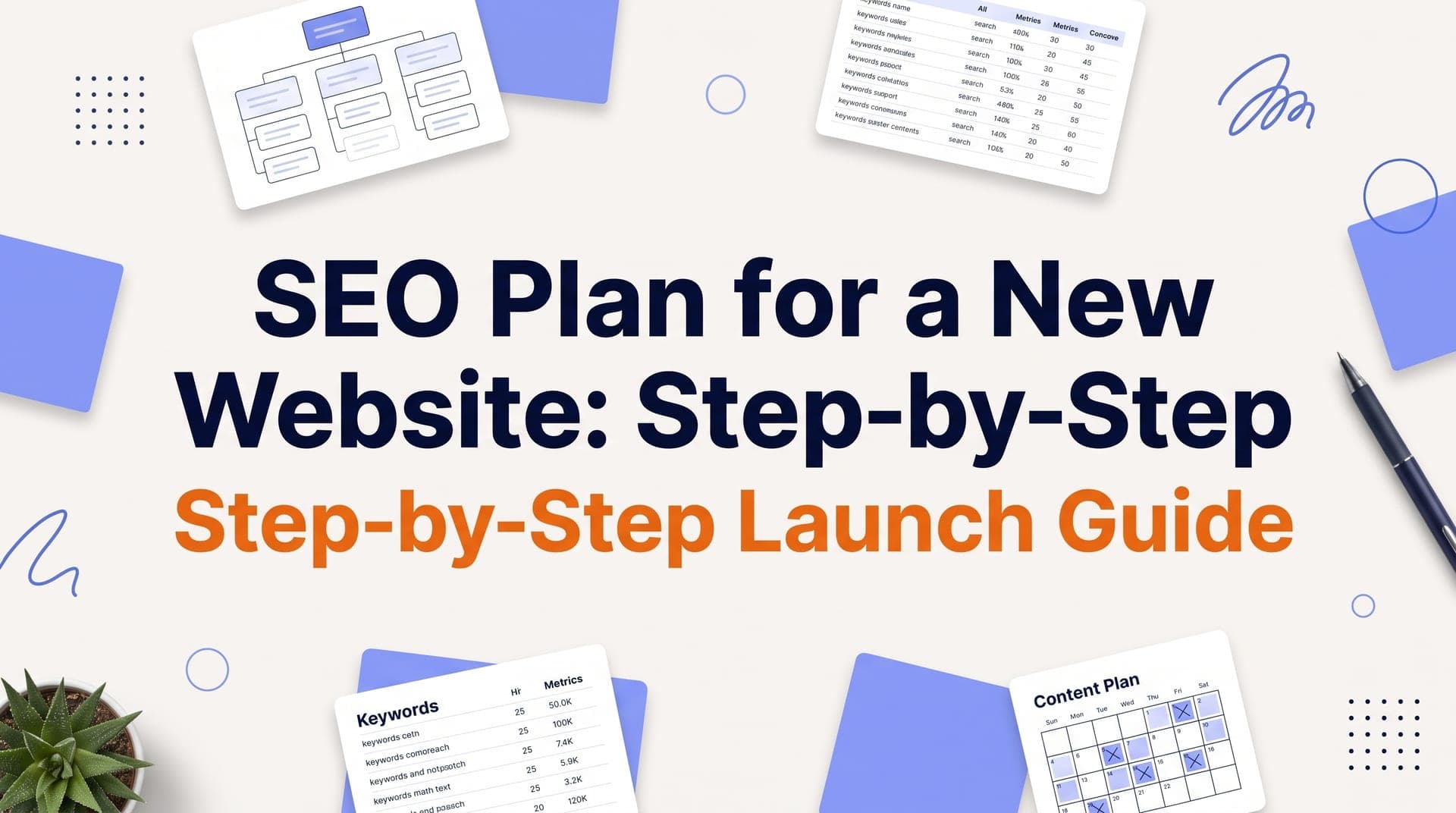
When I launch a fresh domain with zero authority, I treat organic acquisition as an engineering sprint rather than an editorial guessing game. Executing a structured seo plan for new website deployments requires four to six months of runway, direct DNS access, and core tracking tools.
▶ Related Video
SEO for Beginners: Rank #1 In Google (2023)
You will walk away with an actionable operational framework. I will guide you through establishing clean technical crawlability, isolating zero-competition search queries, configuring webmaster indexing hooks, and monitoring early performance signals without paying for enterprise software.
Key Takeaways
- Clean technical baselines win. Crawlers prioritize lightweight, accessible page architecture over complex JavaScript and heavy visual assets on young domains.
- Target zero-difficulty queries. Ranking in your first three months demands granular search queries that established category leaders habitually neglect.
- Verify indexation manually. Uploading an XML sitemap is only step one; priority landing pages require manual submission in Google Search Console.
- Expect a 90-day sandbox. Search impressions routinely accumulate weeks before organic clicks emerge, making impressions your primary diagnostic signal.
- Secure authentic seed links. Foundational directory profiles and vendor citations validate domain identity faster than aggressive cold email outreach.
Phase 1: Technical Infrastructure and Pre-Launch Tracking
Your site must be crawlable, secure, and fully measurable before search engine bots ever encounter your root URL.
Too many developers rush toward publishing blog posts before confirming that search engines can actually interpret their underlying HTML. In my view, skipping server-side redirect checks prior to public launch is a reckless gamble that costs weeks of crawl equity.
| Phase | Focus Area | Key Deliverables | Target Timeframe |
|---|---|---|---|
| Phase 1 | Technical & Tracking | Robots.txt, XML sitemaps, GA4, GSC verification | Pre-Launch (Week 1) |
| Phase 2 | Architecture & Keywords | Topical clustering, zero-KD queries, metadata | Pre-Launch (Weeks 2-3) |
| Phase 3 | Launch & Indexing | Live crawl test, URL inspection, sitemap ping | Launch Week (Week 4) |
| Phase 4 | Authority Building | Brand citations, digital PR, unlinked mentions | Months 2-3 |
| Phase 5 | Diagnostics & Iteration | CTR tuning, cannibalization audit, cluster expansion | Months 4-6 |
Before launching publicly, I audit our foundational setup. You must install Google Analytics 4 alongside a server-side tag container to capture user engagement metrics accurately without skewing script execution speed.
Organizing your technical deliverables inside a dedicated seo project management plan keeps cross-functional teams aligned on dependencies like DNS records and SSL certification.
- Set a single canonical host: Enforce strict 301 redirects from HTTP to HTTPS and resolve either the `www` or `non-www` subdomain variant.
- Validate response headers: Ensure all staging URLs return clean 200 OK status codes and remove any development `noindex` response headers.
- Generate machine-readable sitemaps: Build an automated XML sitemap adhering to standard protocols at `https://yourdomain.com/sitemap.xml`.
- Configure responsive viewport parameters: Verify that mobile stylesheets load asynchronously without render-blocking CSS.
- Implement Core Web Vitals checks: Audit Largest Contentful Paint and Cumulative Layout Shift using web.dev performance guidelines before DNS propagation.
Mistake #1: Leaving the site blocked by a staging `Disallow: /` directive in your robots.txt file or forgetting to strip noindex meta tags. This simple oversight leaves your domain completely invisible to search engines for weeks.
Verify your production configuration by reviewing your website settings to confirm that canonical URLs match your live HTTPS protocol.
Phase 2: Zero-Authority Keyword Selection and Topical Architecture
To rank a zero-authority domain, target long-tail queries where search volume is modest but commercial intent is explicit.
When your site carries zero domain authority, competing for head terms like 'CRM software' or 'running shoes' is futile. You are fighting legacy brands with hundreds of thousands of authoritative backlinks and years of behavioral data.
Instead, I hunt for specific, multi-word queries boasting low competition scores. You can identify these long-tail opportunities using entry-level research suites like the SEMrush Pro plan, which filters keyword lists by specific keyword difficulty thresholds.
My opinion is that publishing five deeply researched, tightly connected cluster pages outperforms scattering twenty shallow 400-word glossaries across disconnected categories.
- Target keyword difficulty (KD) below 15: According to Ahrefs keyword research documentation, queries in this range require minimal external links to achieve first-page visibility.
- Focus on informational intent: Target 'how to', 'troubleshooting', and 'comparison' phrasing where users seek direct problem-solving guidance.
- Filter for 50 to 250 monthly searches: Low volume terms often yield higher conversion rates and face near-zero competitive resistance.
- Confirm SERP feature viability: Check if the top three search results feature forum threads or thin content, signaling an easily winnable position.
Once keywords are selected, organize them into a clean hub-and-spoke topical hierarchy. Structure your internal linking using contextual anchors according to Moz internal linking principles so crawl equity flows seamlessly from parent category pages down to supporting articles.
Mistake #2: Keyword cannibalization across shallow pages. Publishing separate articles for 'best running shoes for flat feet' and 'flat feet running shoe reviews' splits your ranking signals and confuses crawler intent.
Ensure every core landing page contains structured data. Implementing JSON-LD entities based on Schema.org standards helps Google parse your brand name, organization details, and product attributes effortlessly.
Phase 3: Launch Day Indexing Protocol and Verification
Search engines do not discover brand-new sites instantly unless you actively push verified XML sitemaps and manual fetch requests.
On launch day, I never wait for web crawlers to passively wander onto the domain. I believe relying on automated web crawler discovery instead of actively submitting through webmaster APIs is an inexcusable operational bottleneck.
The moment DNS records propagate and your SSL certificate activates, head directly to Google Search Console to prove domain ownership via DNS TXT record.
- Verify domain-level property: Configure a DNS TXT verification record at your domain registrar to track all protocol and subdomain variants.
- Validate robots.txt syntax: Review your live file against the official Google Search Central robots documentation to verify user-agents have access.
- Submit the XML sitemap index: Enter your primary sitemap endpoint via the Google Search Central sitemaps tool to initiate crawl queues.
- Configure Bing Webmaster Tools: Import your verified Google property into Bing Webmaster Tools to capture Yahoo and DuckDuckGo crawlers simultaneously.
- Request manual URL inspection: Run Google's URL Inspection tool on your homepage and top four commercial landing pages to trigger priority indexing.
Monitor the Crawl stats report inside Google Search Console over the next 48 hours. Look for average response times under 300 milliseconds and ensure zero 5xx server errors occur during bot fetches.
Phase 4: Early Backlink Acquisition Without Brand Presence
Initial domain trust begins with verifiable digital footprint citations and authentic vendor relationships.
Zero-authority domains face a chicken-and-egg dilemma: nobody links to websites they have never heard of, yet Google requires external signals to validate authenticity. Cold outreach begging for guest posts yields abysmal response rates for unproven sites.
In my assessment, purchasing automated link bundles on web 2.0 properties inflicts irreversible trust damage on young domains before they establish baseline authority.
Instead, I build foundational backlinks through authentic, verified business relationships. If your internal resources are constrained, evaluating flexible models like a pay monthly website and seo partner can sometimes help support initial execution without heavy upfront commitments.
- Establish verified brand entity profiles: Register high-trust social and technical presences on GitHub, LinkedIn, Crunchbase, and relevant industry registries.
- Leverage tech stack vendor directories: Submit customer quotes or case study snippets to the SaaS tools, hosting providers, or platforms powering your website.
- Claim niche-specific professional memberships: Acquire listings in verified local chambers of commerce, trade associations, or accredited industry organizations.
- Produce proprietary reference assets: Publish original calculation formulas, benchmark data, or downloadable templates that naturally earn citations according to Search Engine Land industry guidance.
Focus strictly on context and relevance rather than raw link volume. Five authoritative backlinks from legitimate business partners within your niche deliver infinitely more trust than five hundred generic blog comments.
Phase 5: 90-Day Diagnostics, Sandboxes, and Performance Timelines
Evaluate your first three months through search impressions and crawler frequency rather than organic conversions.
New domains operate under algorithmic scrutiny commonly referred to as the sandbox period. During this window, Google tests your content viability by serving impressions in deep search positions without granting immediate top-tier rankings.
My stance is that measuring organic conversions before establishing 10,000 monthly impressions is a complete misuse of analytics data. In 2026, search algorithms require time to establish topical consistency and validate user dwell metrics.
- Days 1 to 30 (Discovery Phase): Track crawl requests in GSC. Your primary metric is the total count of 'Indexed' URLs versus 'Discovered - currently not indexed'.
- Days 31 to 60 (Impression Growth): Monitor long-tail impression volume. Expect queries to appear in positions 40 to 90 as algorithms test relevance.
- Days 61 to 90 (Position Consolidation): Identify breakout queries ranking between positions 11 and 25. Update these pages with enhanced depth and internal links.
- Days 91 to 180 (Click Acceleration): Target first-page rankings for primary long-tail keywords and observe organic lead or conversion emergence.
If your pages languish in 'Discovered - currently not indexed' status after 45 days, you have an internal authority or content quality problem. Revisit your topical clustering, strengthen your internal linking architecture, and expand thin sections.
Scaling topical coverage across dozens of cluster pages requires systematic data orchestration. For modern teams seeking to automate dynamic page generation from structured data, ProgSEO provides programmatic publishing infrastructure that keeps technical SEO parameters synchronized as your catalog expands.
For a brand-new domain with zero backlinks, initial impressions usually appear within 4 to 8 weeks. Meaningful first-page rankings for low-competition long-tail keywords typically require 3 to 6 months of consistent publishing and technical maintenance.
Launching with 5 to 10 comprehensive, well-structured pages is ideal. Ensure you have your homepage, primary service or product landing pages, an about page establishing entity trust, and a supporting cluster of 3 to 5 deeply researched articles.
Yes, brand-new websites can achieve top rankings for low-competition, zero-difficulty keywords solely through technical excellence, flawless search intent matching, and robust internal linking. However, competitive queries will eventually require external backlinks to sustain top positions.
Crawling means Googlebot visited and read the code of your URL. Indexing means Google analyzed the page, deemed it high-quality, and stored it in its searchable database to display in search engine results pages.
Sources & References
- Google Analytics Support — Official guide on configuring GA4 properties and user interaction tracking.
- web.dev — Google's engineering reference for Core Web Vitals and site speed performance.
- Ahrefs — Original research defining keyword difficulty calculation and backlink requirements.
- Moz — Comprehensive practitioner guide on internal linking structures and PageRank distribution.
- Schema.org — Technical documentation for structured data vocabularies and entity markup.
- Google Search Central Robots Documentation — Specifications for robots.txt syntax and crawler directives.
- Google Search Central Sitemaps Guide — Official guidelines on XML sitemap construction and submission.
- Bing Webmaster Tools Help — Documentation on verifying properties and index management for Microsoft Bing.
- Search Engine Land — Industry guide outlining foundational ranking factors and authority building.