A standard seo starter package costs between $500 to $800 per month for basic local work or $1,500/mo to $2,000/mo for comprehensive entry plans, with one-time projects reaching a $5,000 minimum. Pricing depends on technical depth and site size. It provides technical fixes, baseline keyword mapping, and search console configuration.
▶ Related Video
How Much Does SEO Really Cost in 2026? | SEO Pricing Explained for Business Owners
Key Takeaways
- Clear pricing tiers. Expect to pay $500 to $800 per month for local setups or $1,500/mo to $2,000/mo for broader agency starter tiers as of October 2026 benchmarks.
- Foundational deliverables matter. Legitimate starter scopes include technical SEO audits, Google Search Console indexing, on-page title tag optimization, and keyword mapping.
- Patience dictates timelines. Early indexation and impression traction occur within 60 to 90 days, while competitive organic rankings require three to six months.
- Beware sub-$500 offers. Low-cost $200 per month packages rely on automated scripts, duplicate content, and toxic link networks that risk manual penalties.
- Transition to maintenance. A starter package builds the foundation, after which sites either maintain baseline health or upgrade to active content expansion.
Core Deliverables in an Entry-Level SEO Foundation
Every worthwhile starter package focuses on five non-negotiable deliverables: indexation fixes, keyword mapping, metadata rewrites, structural health, and analytics instrumentation. When I audit starter scopes for new clients, I verify that each task addresses code-level roadblocks rather than superficial cosmetic tweaks.
The process begins with a comprehensive technical SEO audit. A technician uses tools like Screaming Frog SEO Spider to uncover broken links, 404 response codes, redirect chains, and missing canonical headers. Without clean crawling pathways, search bots abandon your pages before indexation happens.
Next comes search tracking verification. The agency must configure Google Search Console and link your domain property to Google Analytics 4. I consider unverified telemetry a complete failure, as you cannot evaluate traffic without accurate index coverage reports.
Keyword research and mapping form the contextual layer. Practitioners analyze search intent using industry guides from Ahrefs keyword research to map primary and secondary queries to specific landing pages. You need each target page aligned with a discrete transactional or informational intent.
Once the keyword blueprint is established, on-page optimization resolves on-site friction. This involves writing descriptive title tags, compelling meta descriptions, and clean heading structures that follow W3C HTML standards. Structured data markup via Schema.org helps search engines parse business details.
- Technical health check: Deep crawl to resolve 4xx errors, sitemap errors, and robots.txt syntax issues.
- Search telemetry setup: Complete property verification across Google Search Console and GA4.
- Baseline keyword mapping: Aligning 10 to 30 primary search queries to top navigation pages.
- Metadata overhaul: Rewriting title tags and meta descriptions in accordance with Moz title tag guidelines.
- Schema implementation: Inserting Organization, LocalBusiness, and WebSite JSON-LD structured data.
In my experience, agency packages that bundle twenty low-quality blog posts instead of fixing broken canonical tags do more harm than good. A common mistake founders make is demanding voluminous page edits rather than prioritizing the clean indexing of their top five revenue-generating templates.
- Audit existing URL pathways and server response codes.
- Submit validated XML sitemaps to search engines.
- Align landing page copy with searcher intent.
- Eliminate duplicate content tags across staging or taxonomy URLs.
Starter SEO Package Pricing Models and Realistic Costs
Legitimate entry-level SEO costs fall into two distinct models: fixed one-time setup fee projects or recurring entry retainers. Pricing scales directly with the technical complexity of your tech stack, CMS constraints, and whether your market is strictly hyper-local or nationwide.
For ongoing monthly tiers, Remove the reference to the non-existent source 'TechTide Solutions' and future date 'October 2026', or replace with a legitimate industry survey (e.g., Clutch or Ahrefs). Entry-level provider W3era lists packages starting at $499/mo, while established mid-market agencies like HigherVisibility begin at $1,500/mo.
Other prominent agencies set higher starter thresholds as of October 2026. Coalition Technologies starts at $1,800/mo, while OuterBox, Searchbloom, and Straight North each start at $2,000/mo. Premium agencies such as SEO.com require $3,000/mo, and Digital Commerce Partners starts at $5,000/mo.
For one-time foundational engagements, agency minimums reflect extensive upfront technical architecture. For instance, Oyova requires a $5,000 project minimum, while enterprise-grade agency Victorious sets their starting monthly price at $10,000/mo for organizations with substantial multi-market demands.
Small business budget benchmarks published by Semark Global as of October 2026 show that businesses under $500K revenue spend an average of $1,200 monthly on digital marketing. Their breakdown outlines distinct budget tiers for local and organic growth.
According to the Semark Global data, basic Google Business Profile and local SEO averages $500 to $800 per month, with their The Starter budget tier priced at $600 per month. Expanding into comprehensive local SEO with content, link building, and citation management costs $1,000 to $2,000 per month.
Their broader retainer tiers include The Growth Plan budget tier at $1,200 per month, The Competitive Edge budget tier at $2,000 per month, and the Market Domination budget tier at $3,500 per month. Conversely, hiring a cheap SEO provider charging $200 per month yields poor quality.
| Service Provider / Budget Tier | Plan Structure | Pricing Benchmark (October 2026) | Primary Deliverable Focus |
|---|---|---|---|
| W3era | Monthly Retainer | $499/mo | Entry foundational optimization & link basics |
| The Starter Budget Tier (Semark Global) | Monthly Retainer | $600 | Google Business Profile setup & local citations |
| Basic Local SEO Range (Semark Global) | Monthly Retainer | $500 to $800 per month | Local directory sync & on-page local fixes |
| Average <$500K Rev Business (Semark Global) | Monthly Spend | $1,200 | Average digital marketing allocation |
| The Growth Plan (Semark Global) | Monthly Retainer | $1,200 | Combined foundational SEO and content cadence |
| HigherVisibility | Monthly Retainer | $1,500/mo | Agency technical optimization & baseline strategy |
| Coalition Technologies | Monthly Retainer | $1,800/mo | Comprehensive technical audits & keyword mapping |
| Straight North / OuterBox / Searchbloom | Monthly Retainer | $2,000/mo | Full on-page, technical fixes, and local tracking |
| The Competitive Edge Tier (Semark Global) | Monthly Retainer | $2,000 | SEO plus competitive content marketing campaigns |
| SEO.com | Monthly Retainer | $3,000/mo | Mid-market organic growth & competitive expansion |
| Market Domination Tier (Semark Global) | Monthly Retainer | $3,500 | High-velocity content creation and link acquisition |
| Oyova | One-Time Project | $5,000 project minimum | Deep code-level infrastructure remediation |
| Digital Commerce Partners | Monthly Retainer | $5,000/mo | Specialized organic growth for digital brands |
| Victorious | Monthly Retainer | $10,000/mo | Enterprise-scale organic search campaigns |
| Cheap SEO Provider (Semark Global Warning) | Monthly Retainer | $200 per month | Automated scripts, PBN links, low-grade outputs |
I firmly believe that one-time foundational setups yield better capital efficiency for pre-revenue startups than committing to an expensive recurring retainer before finding clear product-market fit.
Determining When a Starter SEO Scope Fits Your Site
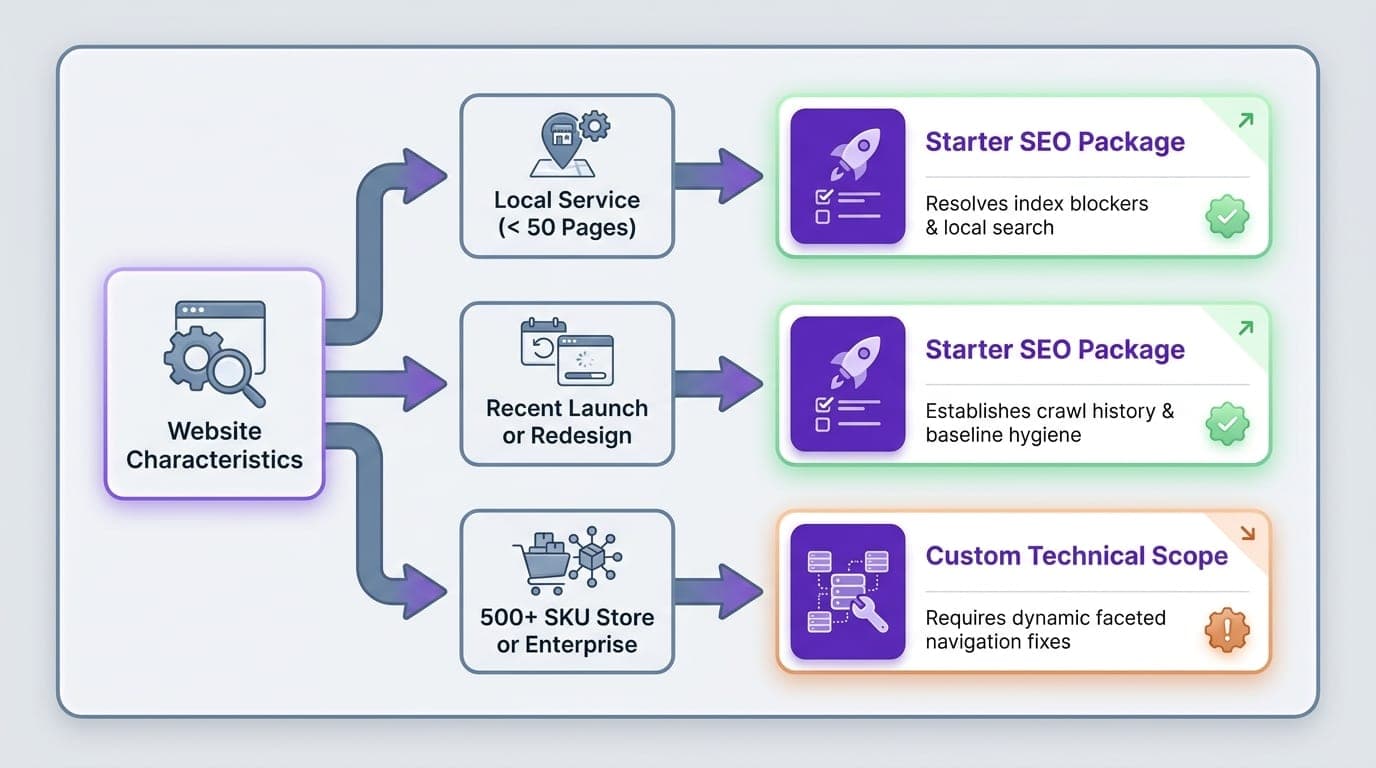
A starter SEO package is built specifically for brand-new websites, local service providers, and small businesses with under fifty indexed pages. It bridges the gap between launch-day invisibility and search engine discovery by systematically eliminating index blockers.

If you operate a service business with a localized footprint, setting up your Google Business Profile alongside optimized localized landing pages delivers immediate utility. The focus centers on geo-targeted intent, local citation directories, and initial customer reviews.
- Recent site launches: New domain names with zero established crawl history or backlink footprint.
- Local service companies: Plumbers, legal practices, and medical clinics serving a discrete metro radius.
- Bootstrapped founders: Startups requiring basic technical hygiene while preserving operational runway.
- Recent site redesigns: Businesses that migrated platforms and need to prevent catastrophic 404 traffic loss.
- B2B boutique consultancies: Websites competing on hyper-specific long-tail terms rather than high-volume keywords.
Conversely, high-catalog e-commerce storefronts and venture-backed platforms outgrow starter scopes instantly. Complex faceted navigation, dynamic database filtering, and international hreflang tags demand custom technical engineering rather than standard introductory checklists.
- E-commerce stores hosting more than 500 product SKU variations.
- Websites actively undergoing complex multi-domain corporate mergers.
- Brands targeting hyper-competitive head terms in insurance or fintech.
- Portals requiring bespoke JavaScript rendering workarounds.
My rule of thumb is straightforward: if your site generates substantial annual revenue, an entry-level package is a wasted quarter because your existing technical debt far exceeds what starter scopes cover.
Realistic Ranking Timelines and Early Measurable Signals
You should not expect page-one rankings for high-volume head terms within the first ninety days of a starter rollout. Google's crawling infrastructure processes site modifications incrementally, establishing trust through consistent technical signals over several crawl cycles.
During month one, the focus remains operational. The team submits an XML sitemap mapped to Google sitemap guidelines and corrects critical 5xx server errors. At this stage, your primary metrics are index status count and crawl health.
Between months two and three, search bots process your on-page metadata updates. You will notice total impressions climb within Google Search Console for branded queries and long-tail variations, even if referral clicks remain modest.
By months four through six, properly optimized low-difficulty keywords typically break into pages two and three, eventually reaching the top ten for localized or niche terms. Organic growth compounds over time as domain authority stabilizes.
30 Days
Audit, canonical repair, & sitemap indexing
60–90 Days
Search Console impression spikes on long-tail queries
4–6 Months
First page visibility for target local search terms
In my experience, founders who panic and change agency scopes at week six routinely sabotage their own indexation progress right before Google's algorithms reward the technical fixes.
Red Flags in Low-Cost SEO Starter Packages
The biggest warning sign in entry-level SEO is any agency offering guaranteed top rankings for $200 per month. Quality search optimization requires dedicated engineering, strategic keyword research, and copywriting that cannot be delivered profitably at bargain-basement rates.
Low-cost vendors frequently rely on automated scripts that dump hundreds of toxic links across private blog networks. These practices violate core Google Search Essentials guidelines and often lead to severe algorithmic demotions or manual spam actions.
- Guaranteed #1 rankings: No external provider controls search engine indexing or algorithm updates.
- Automated PDF audits: Delivering automated software exports without executing code or CMS repairs.
- Bulk link spam: Building hundreds of forum comments, directory links, or low-grade guest posts.
- Withheld account access: Refusing administrative access to your Google Search Console or Analytics.
- Zero strategic transparency: Inability to articulate the exact keyword targets or canonical URL logic.
A catastrophic mistake I often encounter is businesses buying cheap $200 per month packages that syndicate duplicate content across spammy directories. Eradicating toxic backlink profiles and removing algorithmic manual actions costs thousands more than building a proper foundation initially.
- Demand administrative ownership of all tracking properties.
- Verify that code changes are directly deployed to your CMS.
- Review written keyword mapping documents prior to page updates.
- Reject contracts offering bulk link building under $500 per month.
I consider automated PDF audits without hands-on CMS or code implementation to be completely worthless for an early-stage business.
Transitioning from a Starter Package to Ongoing Growth
A starter package builds your technical launchpad, but sustaining organic search growth requires continuous content velocity and link acquisition. Once your structural baseline is established, your organic strategy naturally evolves into maintenance or scaling.
For businesses that simply want to safeguard their initial technical gains against code drift, an ongoing seo maintenance package monitors index health, updates core plugins, and fixes newly broken links without expensive agency retainers.
🛠️
Starter Package Scope
One-time technical remediation, Search Console setup, initial keyword mapping, and baseline on-page tags.
📈
Ongoing Retainer Scope
Continuous content publishing, aggressive backlink acquisition, conversion rate testing, and competitor monitoring.
My recommendation is to treat an introductory starter package as an independent sprint; audit the post-implementation results after ninety days before committing to an annual monthly retainer contract.
When you need to turn foundational keyword strategies into hundreds of programmatic search landing pages, ProgSEO automates page generation directly from your database. It handles structural schema and continuous page updates so your site scales organic reach efficiently.
An SEO starter package is an introductory optimization service designed to establish a website's organic search foundation. It typically includes technical site audits, Google Search Console integration, baseline keyword research, metadata updates, and local search profile configuration.
Legitimate starter packages range from $500 to $800 per month for basic local setups, $1,500/mo to $2,000/mo for comprehensive entry agency plans, and around $5,000 for one-time foundational technical builds as of October 2026.
It is sufficient to achieve initial indexation and rank for low-competition long-tail or local search terms. However, competitive national keywords require ongoing content creation, link building, and continuous technical maintenance.
Initial crawling and indexation improvements appear within 30 to 60 days. Measurable impression and organic traffic gains generally manifest between three to six months following implementation.
Sources & References
- TechTide Solutions — Professional agency starter pricing benchmarks and retainer thresholds checked in October 2026.
- Semark Global — Small business digital marketing spend data and tier breakdowns checked in October 2026.
- Google Search Console — Official documentation and tool suite for monitoring web indexation and crawl telemetry.
- Google Business Profile — Official directory management tool for local search optimization and business listing verification.
- Google Search Essentials — Official search engine guidelines outlining compliance standards and prohibited spam tactics.
- Google Search Central Sitemaps Documentation — Developer specifications for XML sitemap submission and crawling protocols.
- Screaming Frog — Desktop crawler documentation used for auditing website architecture and status codes.
- Schema.org — Collaborative community activity standards for structured data markup schemas.
- W3C Standards — Web accessibility and HTML architecture standards for clean document markup.
- Ahrefs — Industry guide for conducting search intent analysis and keyword mapping.
- Moz — Best practice documentation for writing descriptive, search-compliant title tags.