
When I evaluate cheap link building packages, the total spend depends on publisher traffic tiers, domain authority thresholds, and fulfillment methods. Standard agency retainers require massive commitments, but budget-focused packages operate on pay-per-placement rates or monthly platform credits. You can inspect active rate cards directly on FATJOE pricing and the No-BS Marketplace pricing portal.
▶ Related Video
Cheap Link Building Services: What to Check Before You Buy
Choosing budget off-page services requires strict publisher verification. Low rates often mask automated networks, while legitimate providers leverage pre-negotiated editorial relationships. If you understand what drives placement costs, you can secure valuable equity without putting your domain at risk.
Key Takeaways
- Pricing drivers determine quality. Placement costs scale based on organic search traffic, editorial review standards, and third-party authority metrics.
- Delivery models dictate safety. Manual guest posting and vetted niche edits protect your domain far better than automated blasts or private networks.
- Algorithmic devaluation is common. Low-tier link networks rarely cause manual actions today; instead, search engines silently ignore low-relevance links.
- Publisher vetting prevents waste. Never buy a backlink without inspecting historic search visibility and organic keyword distributions first.
- Topical alignment beats authority. A relevant link on a niche site delivers significantly more ranking impact than a generic post on an unfocused portal.
Evaluating Pricing Models for Budget Links
Link packages generally fall into three billing categories: pay-per-link inventory, monthly credit subscriptions, and entry-level retainers. The exact expense hinges on whether content creation is bundled into the order, the minimum traffic guaranteed, and the target site's authority metrics. I always compare these options against comprehensive link-building packages to see where margins go.
In my opinion, per-link pricing models offer vastly superior financial accountability compared to fixed monthly agency retainers. With per-link purchases, you only pay for live, indexable placements that match your specific criteria rather than funding agency overhead.
| Pricing Model | Primary Cost Drivers | Quality Control Level | Best Fit |
|---|---|---|---|
| Self-Serve Marketplaces | Domain metrics, verified traffic, niche category | High (pre-approval available) | Bootstrap founders, niche affiliate sites |
| Outreach Resellers | Content length, turnaround speed, domain tiers | Moderate (review upon delivery) | In-house teams, agency white-labeling |
| Starter Agency Retainers | Account management hours, prospecting volume | Variable (depends on agency) | Small businesses wanting hands-off delivery |
| Automated Blast Packages | Volume of links generated, software licenses | Extremely Low (unfiltered spam) | Disposable testing domains only |
Tiering in these services is almost universally determined by Domain Rating (DR) from Ahrefs or Domain Authority (DA) from Moz. Higher tiers command larger fees because vendors assume authority metrics equate to rank-passing power. However, authority metrics can be easily gamed if you do not check real audience traffic.
- Authority tiering: Rates rise as sites cross DR 30, DR 50, and DR 70 thresholds.
- Traffic requirements: Placements on domains exceeding substantial monthly organic visits carry higher charges.
- Editorial involvement: Custom, journalist-written copy costs substantially more than programmatic or syndicated content.
- Turnaround guarantees: Expedited delivery within five business days adds platform surcharges.
Delivery Models Behind Affordable Packages
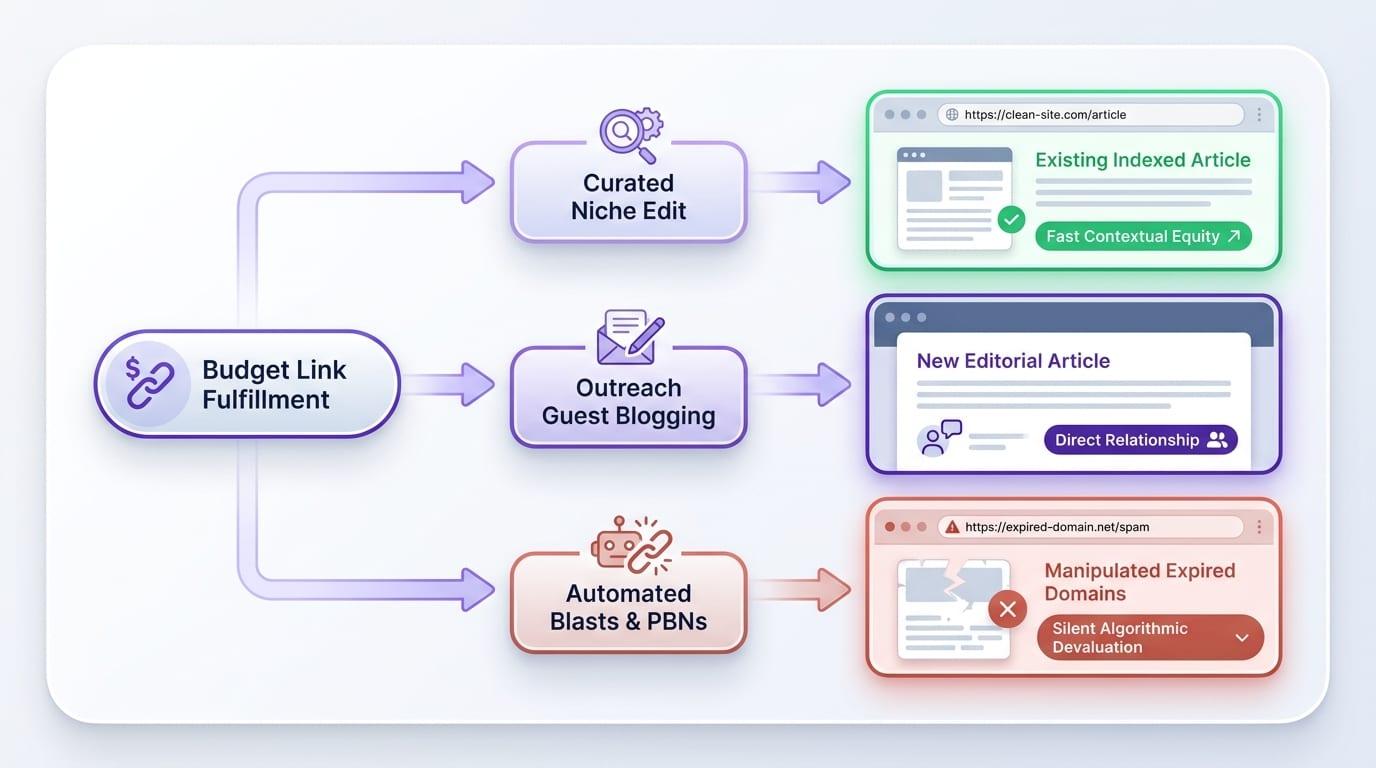
Budget packages fulfill links through distinct delivery pipelines, ranging from authentic relationship-based outreach to automated scripts. Knowing how a vendor secures placements tells you immediately whether those links will help your rankings or trigger search engine filters.
The most reliable low-cost model is the curated niche edit, also called a curated link insertion. In this model, the vendor reaches out to an existing webmaster to insert your link into an already-indexed, ranking article. This passes contextual equity faster than a fresh page that lacks internal authority.

Another prominent method is guest posting, where the vendor supplies original content to an external blog. Self-serve platforms like Authority Builders maintain direct relationships with blog editors. This arrangement bypasses lengthy cold outreach campaigns and lowers client fulfillment expenses.
In my view, self-serve curated marketplaces consistently beat programmatic cold email vendors because you retain editorial veto power. When you can review the publishing URL before cash leaves your account, you eliminate unpleasant surprises.
- Curated niche edits: Inserting contextual links into historical, authoritative blog posts.
- Outreach guest blogging: Publishing new editorial articles containing target brand references.
- Private Blog Networks (PBNs): Networks of expired domains used by cut-rate sellers to manipulate links.
- Syndicated web directories: Low-effort directory submissions that offer virtually zero indexing value today.
A frequent mistake people make is buying automated bulk packages from freelance marketplaces, expecting real ranking gains. Blasting thousands of automated forum profiles and blog comments against a primary website creates toxic link spikes that violate Google Search Essentials.
Algorithmic Risks and Quality Red Flags
Purchasing low-cost links carries real hazards if you pick providers who rely on synthetic metric inflation. Unscrupulous sellers register dropped domains, point automated link bursts at them to artificially pump their authority scores, and sell placements on empty shells.
My take is that Google rarely issues manual action penalties for low-end link schemes anymore; instead, its algorithms quietly devalue the links to zero, meaning bad packages waste your entire capital investment without a warning.
When algorithmic systems detect link manipulation patterns, they devalue the referring domain. While official Search Console Manual Actions remain possible, silent algorithmic suppression is far more common. If a supplier offers pricing that seems too good to be true, inspect the domain for critical warning signs.
- Inflated authority with zero traffic: High authority metrics accompanied by nonexistent organic search visibility.
- Sites covering mismatched topics: Portals publishing articles on casino gaming, plumbing, and tech within the same category list.
- Sudden traffic drops: Historical analytics showing severe declines caused by recent search algorithm updates.
- Public 'Write for Us' pages: Sites openly promoting guest posts with visible payment instructions across navigation bars.
- Identical outbound anchor profiles: Domains linking exclusively to affiliate review hubs using commercial keywords.
Another frequent mistake people make is allowing providers to use exact-match commercial anchors across all target links. Over-optimizing anchor text flags pattern-recognition systems instantly. Establishing a clean link-building plan with varied branded and natural anchors prevents ranking regression.
Comparing Reputable Low-Cost Marketplaces
You do not need an enterprise budget to find dependable link vendors. Several established self-serve marketplaces offer direct access to real publishers with clear metric transparency and guaranteed placement periods. These platforms reduce overhead by letting you select domains directly.
I believe domain transparency before purchase is completely non-negotiable; buying blind links from vendors who refuse to reveal publisher URLs is an unnecessary risk. Platforms that allow full domain inspections protect your capital.
On No-BS Marketplace, clients can filter publishers by traffic volume, niche relevance, and geographic targeting. Similarly, LinksManagement offers access to a massive database of international publishers for entry-level placements, letting buyers filter inventory by targeted cost ceilings.
For hands-off agency fulfillment, FATJOE handles copywriting and placement outreach natively. Meanwhile, platforms like Authority Builders run publishers through internal algorithmic safety screenings.
- FATJOE: Turnkey wholesale outreach service ideal for busy agencies requiring predictable monthly deliverables.
- No-BS Marketplace: Transparent platform providing complete publisher URLs, organic traffic data, and direct pricing control.
- Authority Builders: Quality-screened inventory that filters out link farms, explained further in their case study archives.
- LinksManagement: Budget-friendly self-serve portal featuring vast domestic and international publisher inventory.
My Six-Point Publisher Vetting Checklist
Before approving any link from a budget package, I run the target domain through a thorough verification routine. Relying strictly on vendor-supplied metrics is reckless because domain rating calculations can be manipulated using redirect chains, as documented by Ahrefs domain metric research.
My stance is that topical relevance at the individual URL level matters ten times more than the publisher's site-wide authority score. A contextually sensible link on a small, focused site outperforms an out-of-place link on a sprawling general blog.
- Confirm organic search traffic stability: Use tools like Semrush to ensure the domain's traffic curve is stable or climbing rather than crashing from algorithmic updates.
- Examine ranked keyword relevance: Verify the publisher ranks for commercial or informational terms in your target language and geographic market.
- Audit outbound link neighborhoods: Review the site's most recent twenty posts to ensure it is not linking out to questionable niches.
- Evaluate site design and original media: Check if the website features custom branding, legitimate author bios, and original photography rather than auto-generated layouts.
- Specify safe anchor ratios: Maintain a profile dominated by branded, URL, and phrase-match anchors rather than repetitive exact-match phrases.
- Secure a replacement guarantee: Ensure the marketplace or vendor contract guarantees a free replacement if the placement is removed within twelve months.
Prioritizing verified editorial standards ensures you secure high-quality link building without paying enterprise retainers. The time spent checking these criteria saves you from wasting budget on discounted placements that search engines disregard.
Budget-Friendly Link Building Alternatives
If you lack budget for recurring placement packages, sweat equity can yield powerful results. Digital PR platforms connect journalists with subject matter experts, allowing you to secure authoritative placements on mainstream publications at zero software cost.
I firmly believe that building your own linkable data assets compounds far more sustainable equity than repeatedly buying low-tier guest posts. Creating original resources, industry calculators, or original surveys naturally attracts high-tier citations over time.
- Expert sourcing queries: Pitch relevant commentary to journalists via Connectively and Featured.
- Broken link reclamation: Find broken links on reputable resource lists using browser crawlers and pitch your updated content as a direct replacement.
- Unlinked brand reclamation: Locate existing mentions of your company or tools and request an active reference link.
- Strategic internal architecture: Maximize existing domain equity by auditing your internal link distribution using a dedicated internal linking tool.
Optimizing how authority flows through your existing pages often yields faster ranking improvements than acquiring new backlink packages. Reviewing the principles in the internal links documentation ensures every drop of external link juice reaches your core landing pages.
To get the highest return from every backlink you acquire, pairing external placements with automated semantic structures through ProgSEO helps distribute page authority systematically across your highest-value content. Establishing this architectural foundation ensures budget link campaigns drive measurable organic growth.
Low-quality link schemes rarely cause manual actions today; instead, automated search filters silently devalue manipulative links. However, purchasing low-quality PBNs or aggressive exact-match link blasts can still cause algorithmic ranking drops.
Private blog networks usually share telltale footprints: hidden WHOIS details, identical WordPress themes, thin content across broad topics, lack of legitimate social media profiles, and sudden spikes in artificial authority metrics without real search traffic.
Editorial links typically take between four to ten weeks to be discovered, indexed, and factored into search rankings. Niche edits on established, frequently crawled articles often pass ranking signals faster than new guest posts on low-traffic domains.
Contextual niche edits on genuine, niche-relevant websites with steady organic traffic and strict outbound linking standards are the safest option. Pre-approving domains before paying eliminates the risk of receiving spammy placements.
Sources & References
- FATJOE Pricing — Rate schedules and wholesale pricing tiers for outsourced agency link building.
- No-BS Marketplace — Publisher inventory access, transparent filtering, and pricing guidelines.
- Authority Builders — Quality-vetted guest post platform and editorial backlink marketplace.
- LinksManagement — Self-serve publisher database and budget link placement network.
- Google Search Essentials — Official guidelines on search spam policies and manipulative link schemes.
- Google Search Console Help — Documentation on manual actions and deceptive backlink patterns.
- Ahrefs Research — Detailed breakdown of domain rating calculations and metric manipulation tactics.
- Semrush — Competitive intelligence suite used for auditing publisher organic traffic trends.
- Featured — Expert commentary platform connecting business founders with media journalists.
- Connectively — Journalist inquiry platform for securing earned digital PR citations.