
When auditing digital growth strategies for stores, I look directly at bottom-line economics: viable ecommerce seo packages typically run between $1,000 and $12,000+ per month for ongoing retainers, while one-time overhauls span $1,000 to $50,000+. Your final spend is driven almost entirely by catalog size, technical debt in faceted navigation, and platform architecture.
▶ Related Video
Ecommerce SEO Strategy (What Actually Works in 2026)
Key Takeaways
- Retainers scale with inventory. Retainers range from $1,000 to $12,000+ monthly depending on catalog size, scaling from stores with under 500 SKUs to multi-brand catalogs exceeding 20,000 SKUs.
- Category pages drive revenue. Optimizing high-intent collection templates produces far higher commercial returns than rewriting isolated product descriptions.
- Faceted navigation breaks crawl budgets. Without strict canonicalization and parameter handling, multi-attribute filtering creates millions of duplicate URLs.
- Cheap tiers hide automation. Any retainer under $1,000 per month usually relies on toxic private blog networks and unedited generative copy that risks algorithmic penalties.
- Attribution requires revenue metrics. Measure agency performance through organic transactions and blended customer acquisition cost rather than vanity keyword counts.
Realistic Pricing Tiers for Ecommerce SEO Packages
Professional agency pricing reflects labor intensity, technical risk, and catalog scope. According to WebFX agency marketing pricing data , standard monthly retainer cost ranges span $1,000 to $12,000+ per month, while broader monthly SEO services reach from $1,000 to $30,000 per month for complex enterprise platforms.
Their benchmark data also places per project cost ranges at $1,000 to $50,000+ for one-time audits, with agency hourly rates running from $50 to $500 per hour. Longstanding market leaders like WebFX—with 30 years of experience, over $10,085,355,239+ in client revenue driven according to their web design overview, a 4.9/5 agency rating, and a 4.9-star rating on Clutch—demonstrate what dedicated resources command.
In my experience, any low-cost package costs more in technical cleanup than it saves in overhead. If you are comparing broader seo digital marketing packages or multi-channel seo packages, you must separate basic local visibility scopes from the heavy data demands of ecommerce.
$1,000 - $12,000+
Monthly Retainer Market Range
$50 - $500
Agency Hourly Consulting Rate
$1,000 - $50,000+
One-Time Project Scopes
| Package Tier | Monthly Cost | Catalog Size | Primary Deliverables |
|---|---|---|---|
| Starter Ecommerce | See pricing page | Under 500 SKUs | Technical crawl fixes, schema markup, 5-10 core category optimizations. |
| Mid-Market Scale | See pricing page | 500 - 10,000 SKUs | Faceted navigation logic, internal linking matrices, digital PR outreach. |
| Enterprise Retail | See pricing page | 10,000+ SKUs | Log file audits, custom edge rendering, international hreflang, data automation. |
Core Deliverables You Should Expect in Every Scope
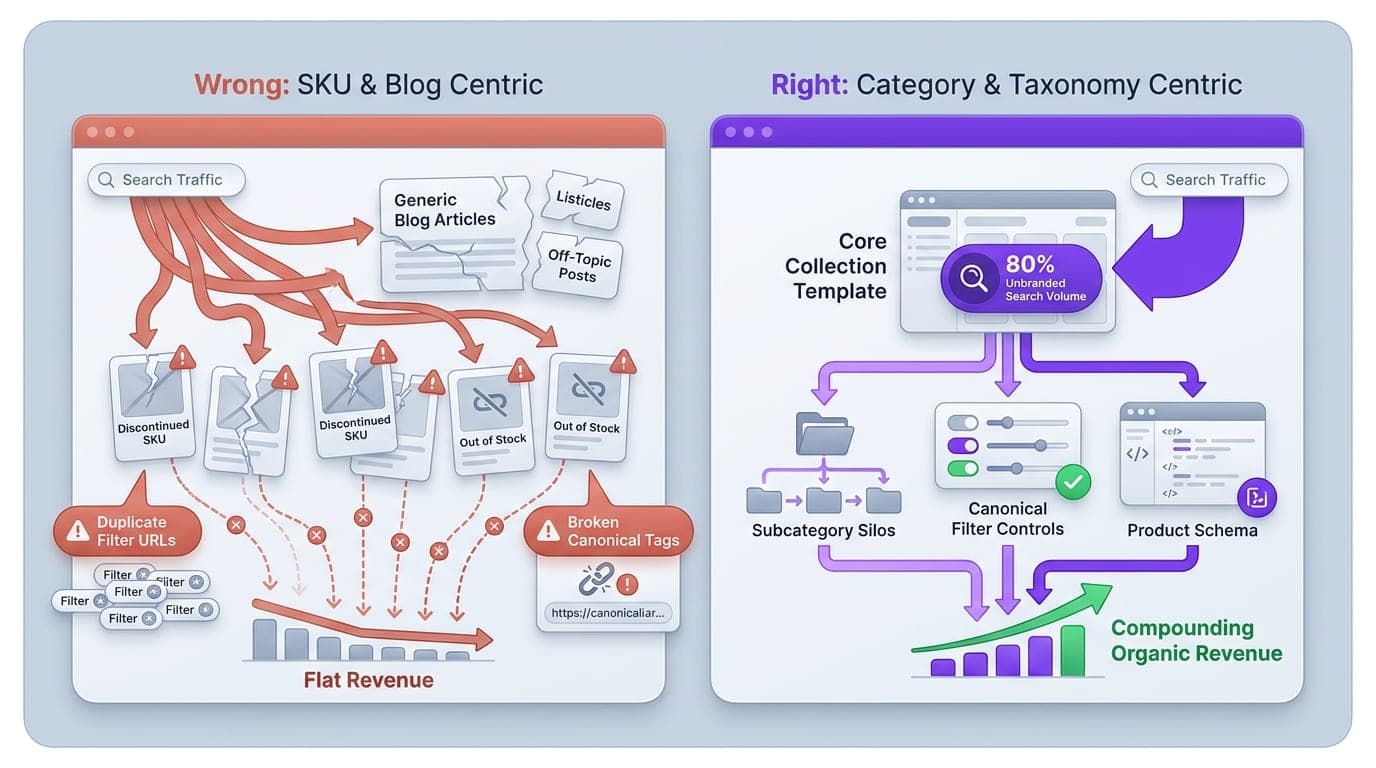
A competent ecommerce deliverable list prioritizes template architecture, faceted indexation, and product structured data over generic blog posts. If an agency promises thirty generic articles a month instead of fixing internal page rank flow, your commercial conversion rates will remain flat.
I firmly believe that if an agency spends the first 60 days writing top-of-funnel informational articles before fixing broken canonical tags on your category trees, you are wasting capital. Commercial intent lives on category pages, not blog archives.
Your scope must resolve duplicate content caused by tracking tags, sort parameters, and pagination. We rely on clear rules from Google's duplicate URL guidelines to ensure search bots index only primary canonical collection versions.
Structured data is equally non-negotiable. An agency must configure comprehensive Schema.org Product specifications paired with Offer details, merchant return policies, and stock availability per Google Search Central's product guidelines to capture visual rich snippets.
- Technical crawl audits: Routine log file reviews, orphan URL eradication, and Core Web Vitals profiling.
- Taxonomy and facet management: Clean parameter controls that prevent index bloat from color, size, and price filters.
- Collection template architecture: Contextual internal links, subcategory silos, and optimized commercial copy.
- Digital PR and brand mentions: Earning contextual backlinks from product review publications, gift guides, and industry news.
- Product feed optimization: Harmonizing Merchant Center data attributes with organic on-page schema.
Watch out for Mistake #1: Prioritizing individual product pages over category architecture. Individual SKUs go out of stock, change variants, or get discontinued. Collection pages endure for years and capture 80% of high-intent unbranded search volume.
Sizing Scope by SKU Volume and Platform Complexity
Your product catalog count and CMS architecture dictate whether an agency needs five hours or fifty hours of engineering collaboration each month. Auditing a boutique store requires a completely different operational playbook than wrangling an enterprise marketplace.
My view is that platform-specific technical proficiency matters twice as much as vertical familiarity. An agency that does not understand platform routing mechanics will accidentally wreck your indexation status.

For instance, Shopify natively generates secondary product URLs nested within collection paths, creating duplicate paths unless theme files point back to the root `/products/` URL. Meanwhile, stores on BigCommerce offer deeper native URL customization but demand careful handling of 301 redirect chains.
Migrating to open-source or custom frameworks like Adobe Commerce (Magento) or WooCommerce introduces complex database query loads and crawling bottlenecks. Enterprise catalogs with 50,000 SKUs require custom robots.txt rules, dynamic XML sitemaps, and server-side cache management.
If you are balancing development costs alongside marketing retainers, exploring a pay monthly website and seo model helps bundle development hours directly with technical optimization tasks.
- Under 500 SKUs: Focus scope on root category optimization, clean metadata templates, and foundational backlink acquisition.
- 500 to 10,000 SKUs: Prioritize automated internal link hubs, faceted parameter handling, and dynamic structured data scripts.
- 10,000+ SKUs: Mandate log file analysis, crawl budget conservation, edge SEO implementations, and programmatic landing page strategies.
Monthly Retainers vs. One-Time Project Packages
Choose a one-time project package for migrations or technical remediation, but rely on a monthly retainer for continuous crawl management and domain authority growth. One-time sprints repair structural damage, but retainers build competitive market share.
I consider a one-time audit completely useless unless you already have dedicated in-house developers scheduled to execute the backlog within thirty days. Unimplemented PDF recommendations generate zero revenue.
A project package ranging from $1,000 to $50,000+ makes sense during platform migrations, domain mergers, or penalty recoveries. The agency steps in, maps 301 redirects, audits canonical tags, resolves legacy technical debt, and validates the launch.
Conversely, ongoing monthly retainers running $1,000 to $12,000+ are mandatory if your store regularly cycles seasonal inventory, adds supplier catalogs, or competes in aggressive link landscapes. When considering whether to seo pay monthly or pay for seo in upfront blocks, align your decision with your team's internal execution capacity.
📦
One-Time Project Scopes
Ideal for pre-launch audits, CMS platform migrations, and penalty recoveries. High upfront cost with a defined finish line.
🔄
Monthly Retainer Scopes
Essential for ongoing link acquisition, resolving index bloat from new products, monitoring algorithm shifts, and expanding taxonomy.
Warning Signs in Cheap SEO Packages
Low-cost ecommerce packages priced under $1,000 per month almost always employ automated PBN links and generic AI text that trigger search quality penalties. Cheap agencies cut corners on manual labor by using dangerous shortcuts.
In my playbook, any proposal promising 'first-page guarantees within thirty days' belongs in the trash bin. Search engines operate on algorithmic probability, not vendor contracts.
Low-tier packages frequently violate Google Search Essentials policies against link spam and thin scraped content. When an agency buys automated links on irrelevant blogs, your domain risks manual action or algorithmic suppression.
Here is Mistake #2: Accepting syndicated backlink blasts instead of category-relevant placements. Building five contextual links from legitimate lifestyle publications beats 500 forum profile links every single time.
- Guaranteed keyword rankings: Nobody controls Google's indexing systems or competitive volatility.
- No direct developer access: The agency delivers superficial spreadsheets but refuses to touch your staging environment.
- Ignored faceted navigation: The team has no answer for how they will manage multi-select filter parameters.
- Repetitive AI product copy: Spinning manufacturer descriptions across hundreds of SKUs without adding original value.
- Zero crawl log analysis: Failing to inspect web server logs to see how search engines actually traverse your catalog.
How I Evaluate and Choose an Ecommerce Agency Scope
When vetting an ecommerce SEO agency, evaluate their developer workflow, custom analytics reporting, and previous catalog growth case studies before looking at their pricing slide. A polished sales pitch means nothing without technical execution.
I always demand to interview the actual technical lead who will audit our crawl logs, not just the sales representative delivering the pitch. You need to know who is touching your code.
Review verified client feedback on platforms like Clutch to confirm whether the agency meets project deadlines and communicates effectively during critical catalog updates.
- How do you handle discontinued products? Look for clear 404 vs. 301 redirect logic based on historical backlink equity.
- What is your deployment workflow? Confirm whether they submit pull requests to your GitHub repository or simply email recommendations.
- How do you measure revenue attribution? Ensure reporting tracks assisted organic revenue and average order value rather than just impressions.
- What is your experience with our specific CMS? Verify past work handling our platform's unique URL and canonical quirks.
- What are the contract exit terms? Avoid agencies that lock you into annual agreements without 60-day performance exit clauses.
For stores looking to automate scalable organic landing pages from existing product data without manual overhead, ProgSEO provides an efficient programmatic workflow. It bridges the gap between deep catalog databases and indexable search demand seamlessly.
Monthly ecommerce SEO retainers typically range from $1,000 to $12,000+ per month, with broader monthly SEO services scaling up to $30,000 for enterprise multi-brand stores. Pricing depends on SKU count, technical platform debt, and backlink requirements.
Technical crawl fixes and schema improvements often yield initial ranking movements within 60 to 90 days. However, sustainable organic revenue growth and high-authority link equity typically require four to six months of consistent optimization.
Yes, high-tier packages include direct implementation via developer staging environments or pull requests. Packages that only deliver PDF audit checklists force your internal team to execute the work, delaying results.
A qualified agency keeps temporarily out-of-stock product pages live with structured data showing 'OutOfStock' status while serving related category recommendations. Permanently discontinued products with backlink equity are redirected via 301 to the closest category equivalent.
Sources & References
- WebFX Marketing Agency Costs — US agency pricing benchmarks for monthly retainers, projects, and hourly rates as of October 2026.
- WebFX Web Design Overview — Historical agency experience metrics and client revenue benchmarks.
- Clutch Directory — Independent agency ratings and verified B2B customer reviews.
- Google Search Central Structured Data — Official search engine specifications for ecommerce product structured data.
- Google Duplicate Content Guidelines — Developer documentation on canonical tags and resolving faceted duplicate URLs.
- Google Search Essentials — Quality guidelines outlining prohibited manipulative link schemes and thin content.
- Schema.org Product Vocabulary — Standardized technical schema definitions for merchant product and offer entities.
- Shopify Documentation — Official ecommerce platform architectural guidelines and collection path structure.
- BigCommerce Dev Center — Platform technical specifications for URL routing and multi-storefront data.
- Adobe Commerce Magento — Enterprise catalog management and indexing framework specifications.
- WooCommerce Platform — Open-source ecommerce database taxonomy and architectural standards.