When I sketch technical site architecture, I build actionable blueprints google seo algorithms can parse effortlessly. Setting up this framework takes about three days of spreadsheet planning, log file review, and keyword clustering before touching code. Doing this upfront protects your crawl budget and ensures reliable indexation.
▶ Related Video
Website- SEO Site Architecture
Key Takeaways
- Taxonomy dictates crawlability. A strict directory structure reveals topical relationships to Googlebot before it parses page content.
- Maintain shallow click depth. Critical commercial URLs should never sit more than three clicks away from your root domain.
- Conserve PageRank with purpose. Contextual in-body links pass significantly more topical relevance than sitewide header or footer links.
- Faceted navigation requires strict boundaries. Unchecked filter combinations generate millions of duplicate URLs that exhaust crawl limits.
- Directives must align completely. Conflicting canonical tags, robots.txt disallows, and XML sitemaps trigger unpredictable indexation drops.
Blueprint Fundamentals: The Core Pillars of Site Architecture
An architectural blueprint is the structural wireframe of your website's digital ecosystem. It maps how individual templates, subdirectories, and database records connect to one another.
Without a deliberate layout, web crawlers encounter dead ends, duplicate paths, and diluted authority. According to Google Search Central documentation, predictable site structures help search systems understand entity relationships and locate fresh content faster.
| Blueprint Component | Primary SEO Function | Core Risk If Ignored |
|---|---|---|
| URL Taxonomy | Establishes semantic parent-child hierarchy | Fragmented topical relevance and keyword cannibalization |
| Internal Link Distribution | Transfers authority and discovered equity | Deep pages stay orphaned and unranked |
| Crawl Depth Architecture | Keeps high-priority URLs within rapid crawl reach | Googlebot ignores stale, deeply nested inventory |
| Technical Directives | Controls crawl access and canonical indexing | Index bloat and wasted crawl budget on parameter strings |
Every durable blueprint relies on four foundational components that dictate how bots navigate and index your assets:
- URL Taxonomy: The logical nesting of folders, directories, and endpoints.
- Internal Link Pathways: The deliberate routing of PageRank from authority hubs to child nodes.
- Crawl Boundaries: Directives that keep search engine spiders focused on indexable assets.
- Topical Silos: Clustered subject domains that build comprehensive topical authority.
“In my experience, engineering teams waste months tweaking on-page metadata when their real issue is an architectural labyrinth Googlebot refuses to crawl.”
- Technical SEO Consultant
In my opinion, visual flowchart tools like Lucidchart are helpful for executive presentations, but an architectural spreadsheet listing URI patterns and parent IDs is what developers actually need. You should review your broader Google SEO plans before locking down this structural schema.
Mapping Content Silos and Hierarchical URL Taxonomy
I always organize site content into discrete, impenetrable topical silos. A silo groups semantically linked articles or product pages under a dedicated parent category URL.
This structure mirrors the formal URI standards detailed in IETF RFC 3986 and guidelines from the World Wide Web Consortium (W3C). When subdirectories represent real conceptual hierarchies, search engines interpret context effortlessly.
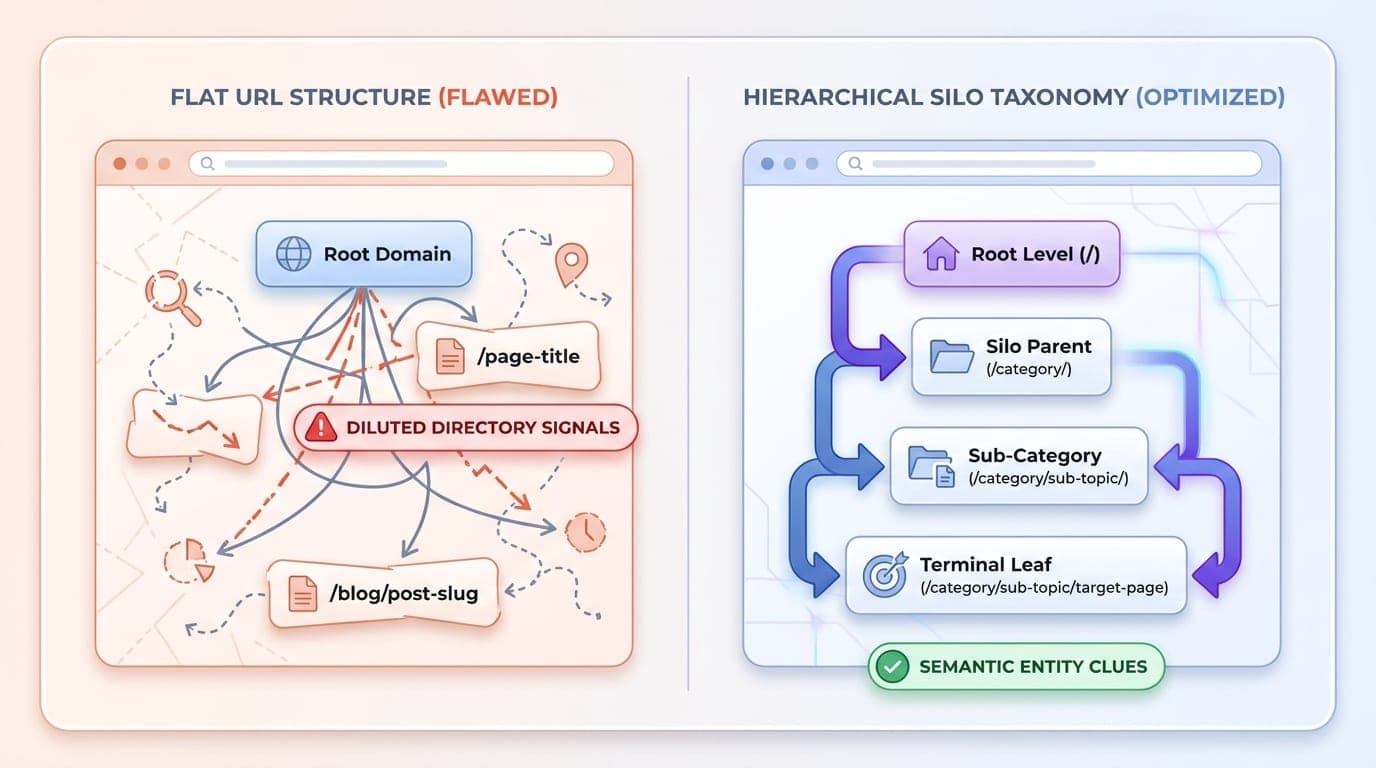
Here is the first mistake people usually make: adopting a completely flat URL pattern across thousands of distinct pages. Flattening everything into `/page-title` strips away vital directory signals that communicate category relationships.
Instead, organize your URL taxonomy across four distinct structural tiers:
- Root Level (`/`): Represents the core domain entity and primary brand identity.
- Silo Parent (`/category/`): Targets primary high-volume head terms and hub topics.
- Sub-Category (`/category/sub-topic/`): Houses mid-tier category facets and clustered keywords.
- Terminal Leaf (`/category/sub-topic/target-page`): Targets hyper-specific long-tail queries and bottom-funnel intent.
When planning content production, I organize keyword research gathered from Google Keyword Planner for SEO directly into these directory tiers. Follow this execution workflow:
- Group semantically related keywords into single conceptual buckets.
- Assign each bucket to a distinct subdirectory level before assigning individual URLs.
- Restrict intra-silo links so sibling pages reference each other rather than cross-pollinating unrelated categories.
In my opinion, flat URL paths like `/blog/post-slug` are vastly inferior to hierarchical structures like `/category/subcategory/post-slug` on enterprise platforms. Google evaluates directory paths as structural clues when calculating entity boundaries.
Engineering Internal Link Equity and PageRank Distribution
Internal link equity is the currency that fuels organic visibility. If you do not construct deliberate pathways for PageRank, your best pages will languish in obscurity.
Larry Page and Sergey Brin documented the mathematical principles of link authority in their foundational Stanford PageRank paper. That same foundational dynamic still powers Google's evaluation of internal link architecture.
Breadcrumb trails are the single most dependable mechanism for establishing structural upward links. Implementing standardized Google Search Central Breadcrumb structured data allows search engines to map your vertical hierarchies seamlessly.
- Breadcrumbs: Provide strict upward navigational equity back to root category hubs.
- Contextual Body Links: Pass horizontal equity across related sibling articles within the same silo.
- Category Hub Links: Distribute downward authority from top-level landing pages to tier-two nodes.
- Faceted Cross-Links: Connect related products or topics based on shared attributes rather than generic menus.
In my opinion, sprawling mega-menus stuffed with 150 generic links dilute link equity far more than they help real users navigate. Concentrated, contextual links placed within body copy consistently outperform global header links.
When you execute this equity routing correctly, you give your highest-value assets the authority needed to rank 1 on Google. Link equity must follow search demand, not organizational chart politics.
Managing Googlebot Crawl Depth and Crawl Budgets
Crawl depth measures the minimum number of clicks required to reach a page from the root domain. In my blueprints, every critical indexing target must sit at click depth three or fewer.
As sites expand past tens of thousands of URLs, crawling constraints emerge. Consult Google's large site crawl budget guide to understand how host load and crawl demand govern resource allocation.
Here is the second mistake people usually make: leaving dynamic ecommerce faceted navigation open to unrestricted crawling. When users can select four filters at once, faceted search engines generate millions of URL variations containing virtually identical products.
Implement these controls to protect your site from indexing bloat and wasted crawler attention:
- Cap click depth at 3: Ensure key product and editorial templates live within three hops of the homepage.
- Paginate cleanly: Implement numeric pagination rather than infinite scroll scripts that lack static fallback links.
- Block low-value facets: Disallow crawl access to multi-parameter filter strings that offer no distinct search intent.
- Audit log files: Analyze server access logs monthly to verify where Googlebot spends crawl bandwidth.
In my opinion, if a commercial page sits buried at click depth five, it does not matter how good the copy is. Googlebot will crawl it infrequently, delaying indexation updates and suppressing keyword rankings.
Maintaining lean click depth also ensures your architecture performs reliably when indexed by other search engines other than Google, such as Bing or DuckDuckGo.
Integrating Technical Directives: Robots, Sitemaps, and Canonicals
Directives tell search spiders where they are permitted to travel and which URL version represents the definitive source. When technical directives conflict, site architecture breaks down immediately.
As outlined in Google Search Central URL canonicalization guidelines, canonical tags serve as strong suggestions rather than absolute mandates. If your internal links contradict your canonical tags, Google often ignores your preferred directives.
To guarantee unambiguous crawl signals, integrate this technical directive checklist into your blueprint:
- Self-Referential Canonicals: Place clean, self-referential canonical tags on all primary static URLs.
- Robots.txt Boundaries: Disallow administrative paths, internal search queries, and sorting parameters.
- Segmented XML Sitemaps: Split sitemaps by content type and category to isolate indexing drop-offs.
- Noindex Controls: Use noindex tags on thin utility pages while leaving them crawlable for equity pass-through.
In my opinion, self-referential canonical tags are non-negotiable insurance policies that every development team should bake into baseline templates. They prevent parameter pollution from social tags and campaign UTM strings.
Building an intentional structured SEO business blueprint prevents orphan pages from slipping into production undetected. When every technical directive aligns with your URL hierarchy, indexing remains predictable.
When executing programmatic content expansions from these blueprints, ProgSEO helps teams generate and maintain structured page architectures directly from catalog data. This systematic approach guarantees every new template respects your directory rules, taxonomy models, and canonical structures as you scale.
I recommend keeping all revenue-generating and indexable content within three clicks from the homepage. Deeper pages receive less PageRank and are crawled far less frequently by Googlebot.
Subdirectories are preferable because they consolidate internal link equity under a single root domain. Subdomains can be treated by Google as distinct entities, fragmenting your authority.
Multi-attribute faceted filters create exponential URL combinations. If left unmanaged with canonicals or robots.txt disallows, Googlebot can waste its entire crawl budget indexing identical product sets.
No. An XML sitemap acts as a discovery tool, not an authority distribution channel. Without logical internal links passing PageRank, sitemap URLs often fail to rank.
Sources & References
- Google Search Central Crawling & Indexing Documentation — Official guidelines on site architecture and crawler behavior.
- Google Search Central Breadcrumb Structured Data — Specifications for structured breadcrumb markup.
- Google Search Central Large Site Crawl Budget Guide — Best practices for managing crawler resources across enterprise architectures.
- Google Search Central URL Canonicalization Guidelines — Directives for consolidating duplicate URLs and resolving canonical signals.
- Stanford InfoLab PageRank Technical Paper — Original academic paper detailing the mathematical foundation of hyperlink authority.
- World Wide Web Consortium Architecture of the Web — Formal standard for web identifiers and URI structure.
- Internet Engineering Task Force RFC 3986 — Universal URI generic syntax standard.
- Schema.org Vocabulary — Collaborative community standard for structured data schema.
- Screaming Frog SEO Spider — Desktop site crawler used to analyze crawl depth and link structures.