Bing Copilot SEO in 2026 is not a separate trick layered on top of search. It is the day-to-day work of making pages easy to find, check, parse, and trust, so they get picked as sources in Microsoft Copilot, AI-generated summaries in Bing, and related AI search experiences.
This practical playbook gives SEO teams a focused framework for improving Bing AI citations without confusing citations with rankings, impressions, or clicks.
Key Takeaways
- Citations are not rankings. A page can be cited in Copilot answers for grounding queries it never ranks first for in blue links.
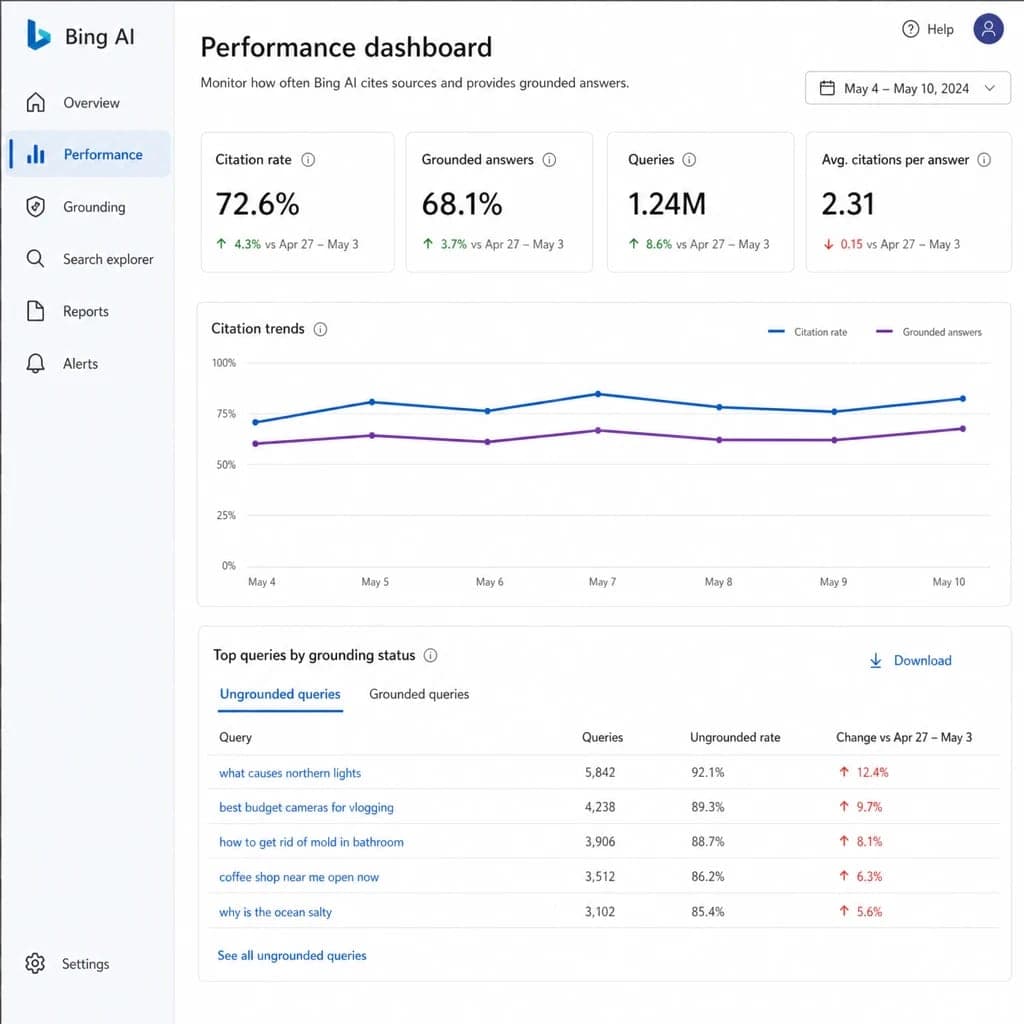
- Measure in Bing Webmaster Tools. The AI Performance report shows total citations, cited pages, grounding queries, and page-level activity.
- One URL, one answerable topic. Focused pages with self-contained answer blocks are easier for AI systems to reuse.
- Freshness is operational. Clean sitemaps, accurate lastmod, and IndexNow keep changed URLs discoverable.
- Manipulation backfires. Keyword stuffing, misleading schema, and prompt injection can remove grounding eligibility.
How do you get cited in Bing AI answers in 2026?
You raise your citation chances by making each important URL easy for Bing to find, understand, verify, and reuse in a specific answer.
Microsoft's AI Performance launch confirms that Bing Webmaster Tools now reports how your content appears across Microsoft Copilot, AI-generated Bing summaries, and select partner integrations. That includes cited URLs, citation trends, grounding queries, and page-level citation activity.
None of this guarantees inclusion. But it gives SEO teams a measurable path from "we rank" to "we are referenced in AI answers."
For teams asking come usare Bing Copilot per la SEO, the short answer is: treat it as retrieval optimization plus classic SEO discipline.
Bing's own webmaster guidelines say SEO fundamentals still support visibility across Bing, Copilot, grounding results, and citations. They also warn that manipulative tactics can lower rankings, suppress grounding visibility, or remove eligibility entirely.
Bing AI visibility starts with the right measurement model
A common mistake is treating a Bing AI citation like a blue-link ranking. They are related, but not the same.
| Signal | What it means | Where it shows up |
|---|---|---|
| Ranking | A position in traditional search results | Blue links |
| Impression | Exposure in search reporting | Search performance reports |
| Click | A user visit to your page | Search and analytics reports |
| Grounding | Retrieval that connects an AI answer to current web information | Behind the AI answer |
| Citation | Visible source attribution inside the AI answer | Copilot and Bing AI summaries |
Microsoft describes grounding as the system that connects AI to current, trusted information. Visibility now covers answers, citations, reasoning, and outcomes — not only rankings and clicks.
What the AI Performance report measures
Use the AI Performance report in Bing Webmaster Tools to separate these signals:
- Total Citations: how often your site is shown as a source in supported AI-generated answers.
- Average Cited Pages: the average number of unique pages from your site cited per day. It is not a ranking or authority score.
- Grounding Queries: sampled phrases the AI used when it retrieved content that was cited.
- Page-Level Citation Activity: which URLs get referenced and how often.
- Citation Share, Intents, Topics, and Compare: preview features that add query context, topic visibility, and relative citation presence beyond raw counts.
If you also track answer engines beyond Microsoft, pair this report with a brand mention tracking workflow for AI search.
The 2026 Bing Copilot SEO framework
This is the working model for teams that want stronger Bing AI citations without relying on myths about Bing ranking factors or keyword stuffing.
- Earn eligibility first. Make sure important pages are crawlable, indexable, canonicalized, internally linked, and submitted through reliable discovery paths.
- Map each URL to one answerable topic. Bing's guidelines favor focused URLs, clear entity definitions, visible facts, and content that stands on its own.
- Build modular answer blocks. Use H2s, H3s, short explanations, bullets, steps, and examples so AI systems can parse each section.
- Support claims visibly. Add evidence, examples, author context, sources, product details, dates, or methodology where it fits.
- Keep freshness operational. Maintain updated sitemaps, accurate lastmod, HTTP validation where relevant, and IndexNow for changed URLs.
- Measure citations by intent and topic. A page may not win broad head terms, but it can become the cited source for high-value grounding queries.
Rethink Bing keyword research
Bing keyword research should go beyond search volume. Build a list of grounding-style prompts instead:
- Buyer questions
- Comparison needs
- Troubleshooting queries
- Entity clarification searches
Then audit whether your pages contain self-contained answer sections for each of those intents.
Content structures that Copilot can reuse
Microsoft's official guidance recommends clear titles and descriptions, H1 alignment, strong headings, Q&A formats, lists, schema, and short "snippable" answers for AI search inclusion.
It also warns against long walls of text, key information hidden in tabs, PDFs holding core details, and facts that exist only inside images.
What strong Bing AI SEO pages include
- A direct answer in the first few sentences.
- One primary topic per URL, with related subtopics grouped logically.
- Clear entity names for products, people, locations, organizations, and categories.
- Definitions that still make sense when pulled out of the page.
- Step-by-step instructions for how-to queries.
- Comparison bullets for commercial research queries.
- Visible dates or update notes when freshness matters.
- Structured data that matches the visible content.
Weak vs. strong answer copy
A weak page says: "Our platform is the next-generation solution for modern teams."
A stronger page says: "ProgSEO helps teams generate, structure, edit, and export SEO pages at scale using keyword data, templates, metadata, and schema."
The second version tells Bing Copilot exactly what the product is, what it does, and who it is for.
Structured data, IndexNow, and technical trust signals
Structured data labels visible content in a machine-readable way. It is useful, but it is not a shortcut to Bing AI citations.
Bing's guidelines say structured data may support clearer grounding, but it must reflect visible content and does not guarantee visibility. For implementation patterns, see our guide to advanced schema markup.
Why IndexNow matters for freshness
IndexNow is a protocol that lets site owners notify participating search engines when URLs are added, updated, or deleted. Bing's URL submission documentation strongly recommends it for automated submission.
Microsoft also notes that IndexNow does not guarantee crawling or indexing. Treat it as a way to speed up discovery, not as a ranking factor.
Technical readiness checklist
- Verify your site in Bing Webmaster Tools.
- Submit clean XML sitemaps with canonical URLs only — see how to build dynamic XML sitemaps for large websites.
- Implement IndexNow for publish, update, and deletion events.
- Fix crawl, indexing, redirect, duplicate title, missing metadata, and canonical issues.
- Add accurate schema for articles, products, FAQs, events, organizations, or local entities where relevant.
- Keep critical answer content in HTML, not only in images, scripts, downloads, or hidden UI.
Common mistakes that suppress Bing AI citations
The fastest way to lose Bing Copilot SEO momentum is to optimize for the model instead of the user.
Bing's guidelines explicitly warn against scraped content without added value, keyword stuffing, unsupervised auto-generated content at scale, misleading structured data, and prompt-injection attempts aimed at AI systems.
| Bad pattern | Better approach |
|---|---|
| One page targeting every related keyword, entity, and audience | Dedicated URLs for distinct intents, each with a complete answer |
| Repeating "Bing Copilot SEO" and "Bing SEO tips" unnaturally | Related terms where they clarify: Bing AI citations, grounding queries, structured data, AI Performance reporting |
| Schema claiming reviews, pricing, availability, or FAQs not on the page | Markup that faithfully mirrors what users can see |
| Measuring success only by organic clicks | Tracking citations, cited pages, grounding queries, citation share, topics, impressions, clicks, and conversions separately |
Your next step: a repeatable AI search optimization workflow
Bing Copilot SEO is now an ongoing workflow, not a one-time page rewrite.
The teams that adapt fastest monitor AI Performance data, find grounding-query gaps, refresh stale pages, improve structured sections, and keep discovery signals clean across hundreds or thousands of URLs.
That is hard to manage by hand. ProgSEO handles the repetitive parts: generating structured SEO pages, applying metadata and schema, editing content blocks, exporting in practical formats, and scaling updates across many keyword and topic targets.
If your team needs a repeatable way to keep pages optimized for classic search and AI visibility, use ProgSEO to automate your SEO workflow and turn Bing AI search optimization into a system instead of a scramble.
No. A ranking is a position in traditional results, while a citation is source attribution inside an AI answer. A page can be cited for grounding queries it does not rank first for.
In the AI Performance report in Bing Webmaster Tools. It shows total citations, average cited pages, grounding queries, and page-level citation activity.
No. Bing says structured data may support clearer grounding, but it must match visible content and does not guarantee visibility or grounding traffic.
No. IndexNow notifies search engines about added, updated, or deleted URLs so they can be discovered faster. It does not guarantee crawling, indexing, or rankings.
Sources & References
- Introducing AI Performance in Bing Webmaster Tools — Microsoft's announcement of citation reporting for Copilot and Bing AI answers.
- Elevating the Role of Grounding on the AI Web — How Microsoft defines grounding and AI visibility.
- Bing Webmaster Guidelines — Official rules for rankings, grounding eligibility, and structured data.
- AI Performance report help — Definitions of citations, cited pages, and grounding queries.
- IndexNow in Bing Webmaster Tools — How URL change notifications work.